UMC-University Children's Hospital, Faculty of Medicine, University of Ljubljana, Bohoričeva 20, Ljubljana, Slovenia.
Diabetologia. 2012 Dec;55(12):3155-62. doi: 10.1007/s00125-012-2708-9. Epub 2012 Sep 11.
AIMS/HYPOTHESIS: The aim of this multicentre, randomised, controlled crossover study was to determine the efficacy of adding continuous glucose monitoring (CGM) to insulin pump therapy (CSII) in type 1 diabetes.
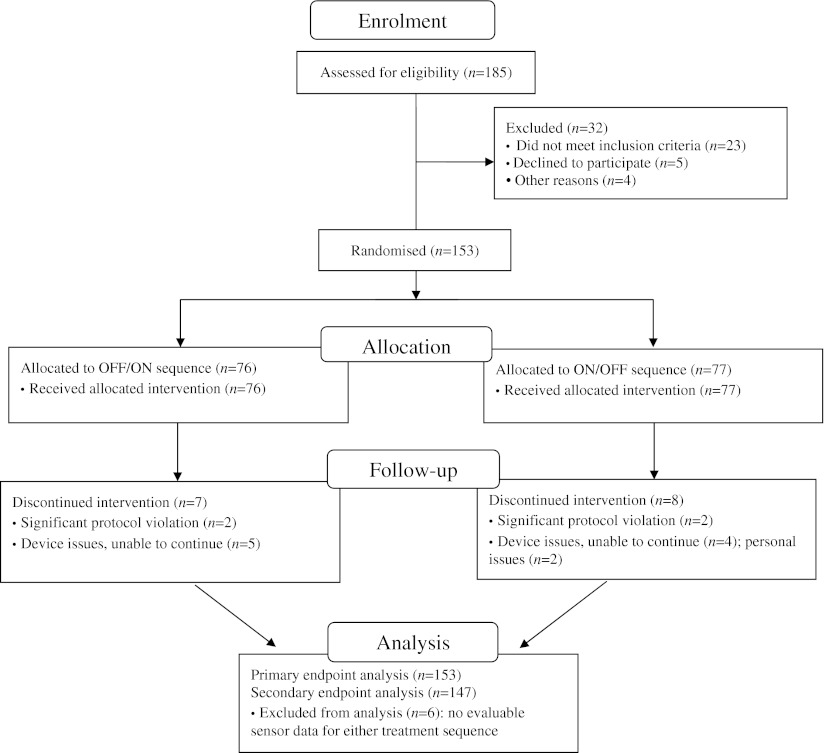
Children and adults (n = 153) on CSII with HbA(1c) 7.5-9.5% (58.5-80.3 mmol/mol) were randomised to (CGM) a Sensor On or Sensor Off arm for 6 months. After 4 months' washout, participants crossed over to the other arm for 6 months. Paediatric and adult participants were separately electronically randomised through the case report form according to a predefined randomisation sequence in eight secondary and tertiary centres. The primary outcome was the difference in HbA(1c) levels between arms after 6 months.
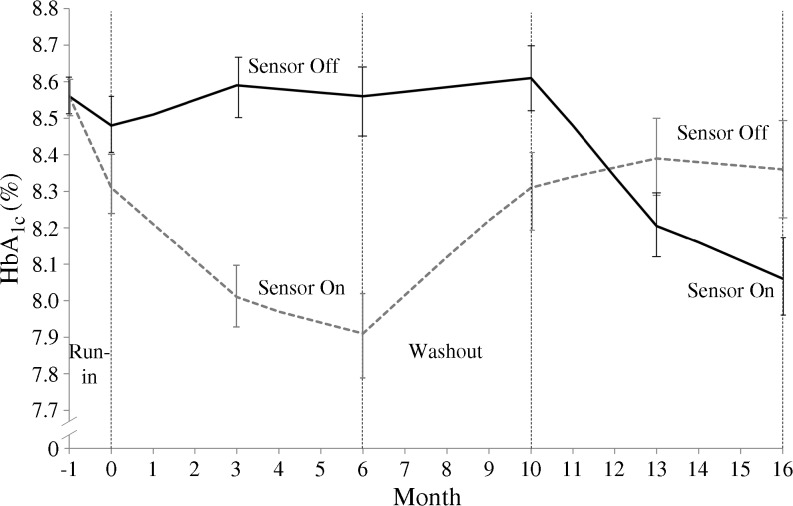
Seventy-seven participants were randomised to the On/Off sequence and 76 to the Off/On sequence; all were included in the primary analysis. The mean difference in HbA(1c) was -0.43% (-4.74 mmol/mol) in favour of the Sensor On arm (8.04% [64.34 mmol/mol] vs 8.47% [69.08 mmol/mol]; 95% CI -0.32%, -0.55% [-3.50, -6.01 mmol/mol]; p < 0.001). Following cessation of glucose sensing, HbA(1c) reverted to baseline levels. Less time was spent with sensor glucose <3.9 mmol/l during the Sensor On arm than in the Sensor Off arm (19 vs 31 min/day; p = 0.009). The mean number of daily boluses increased in the Sensor On arm (6.8 ± 2.5 vs 5.8 ± 1.9, p < 0.0001), together with the frequency of use of the temporary basal rate (0.75 ± 1.11 vs 0.26 ± 0.47, p < 0.0001) and manual insulin suspend (0.91 ± 1.25 vs 0.70 ± 0.75, p < 0.018) functions. Four vs two events of severe hypoglycaemia occurred in the Sensor On and Sensor Off arm, respectively (p = 0.40).
CONCLUSIONS/INTERPRETATION: Continuous glucose monitoring was associated with decreased HbA(1c) levels and time spent in hypoglycaemia in individuals with type 1 diabetes using CSII. More frequent self-adjustments of insulin therapy may have contributed to these effects.
目的/假设:本多中心、随机、对照交叉研究的目的是确定在 1 型糖尿病患者中,将连续血糖监测(CGM)添加到胰岛素泵治疗(CSII)中是否有效。
HbA1c 为 7.5-9.5%(58.5-80.3 mmol/mol)的 CSII 治疗的儿童和成人(n=153)被随机分为传感器开启或关闭臂,接受 CGM 治疗 6 个月。经过 4 个月的洗脱期后,参与者交叉到另一个臂接受 6 个月治疗。儿科和成年参与者分别通过案例报告表根据 8 个二级和三级中心的预设随机序列通过电子方式随机分组。主要结局是 6 个月后各臂之间的 HbA1c 水平差异。
77 名参与者被随机分配到 On/Off 序列,76 名参与者被随机分配到 Off/On 序列;所有参与者均纳入主要分析。HbA1c 的平均差值为 -0.43%(-4.74 mmol/mol),有利于传感器开启臂(8.04%[64.34 mmol/mol] vs 8.47%[69.08 mmol/mol];95%CI-0.32%,-0.55%[-3.50,-6.01 mmol/mol];p<0.001)。停止葡萄糖感测后,HbA1c 恢复到基线水平。传感器开启臂时,传感器葡萄糖<3.9 mmol/l 的时间比传感器关闭臂时少(19 分钟/天 vs 31 分钟/天;p=0.009)。传感器开启臂时,每日胰岛素推注次数增加(6.8±2.5 次 vs 5.8±1.9 次,p<0.0001),临时基础率的使用频率(0.75±1.11 次 vs 0.26±0.47 次,p<0.0001)和手动胰岛素暂停(0.91±1.25 次 vs 0.70±0.75 次,p<0.018)的使用频率也增加。传感器开启臂和传感器关闭臂分别发生 4 次和 2 次严重低血糖事件(p=0.40)。
结论/解释:在使用 CSII 的 1 型糖尿病患者中,连续血糖监测与 HbA1c 水平降低和低血糖时间减少相关。胰岛素治疗的自我调整更频繁可能促成了这些效果。