Entwicklungs- und Molekularbiologie der Pflanzen, Heinrich-Heine-Universität Düsseldorf, Universitätsstrasse 1, Düsseldorf, Germany.
Planta. 2013 Feb;237(2):413-28. doi: 10.1007/s00425-012-1752-5. Epub 2012 Sep 14.
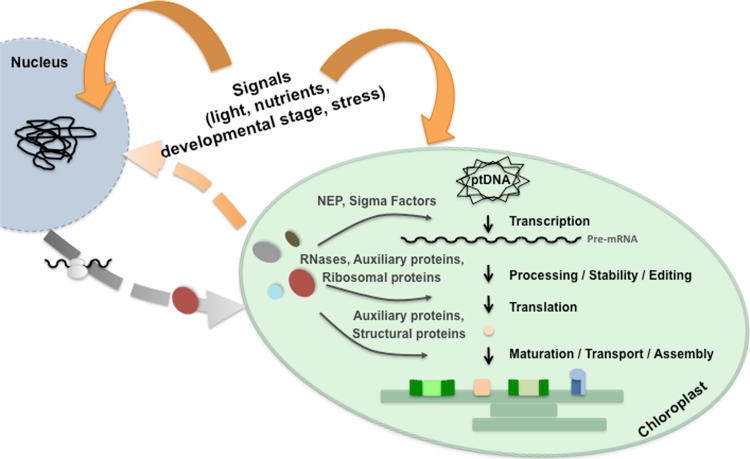
Chloroplasts are the endosymbiotic descendants of cyanobacterium-like prokaryotes. Present genomes of plant and green algae chloroplasts (plastomes) contain ~100 genes mainly encoding for their transcription-/translation-machinery, subunits of the thylakoid membrane complexes (photosystems II and I, cytochrome b (6) f, ATP synthase), and the large subunit of ribulose-1,5-bisphosphate carboxylase/oxygenase. Nevertheless, proteomic studies have identified several thousand proteins in chloroplasts indicating that the majority of the plastid proteome is not encoded by the plastome. Indeed, plastid and host cell genomes have been massively rearranged in the course of their co-evolution, mainly through gene loss, horizontal gene transfer from the cyanobacterium/chloroplast to the nucleus of the host cell, and the emergence of new nuclear genes. Besides structural components of thylakoid membrane complexes and other (enzymatic) complexes, the nucleus provides essential factors that are involved in a variety of processes inside the chloroplast, like gene expression (transcription, RNA-maturation and translation), complex assembly, and protein import. Here, we provide an overview on regulatory factors that have been described and characterized in the past years, putting emphasis on mechanisms regulating the expression and assembly of the photosynthetic thylakoid membrane complexes.
叶绿体是蓝细菌样原核生物的内共生后代。植物和绿藻叶绿体(质体基因组)的现有基因组包含~100 个基因,主要编码其转录/翻译机制、类囊体膜复合物(光合系统 II 和 I、细胞色素 b(6)f、ATP 合酶)的亚基,以及核酮糖-1,5-二磷酸羧化酶/加氧酶的大亚基。然而,蛋白质组学研究已经鉴定出叶绿体中的数千种蛋白质,这表明质体蛋白组的大部分不是由质体基因组编码的。事实上,质体和宿主细胞的基因组在它们的共同进化过程中发生了大规模的重排,主要通过基因丢失、从蓝细菌/叶绿体到宿主细胞细胞核的水平基因转移,以及新核基因的出现。除了类囊体膜复合物和其他(酶)复合物的结构成分外,细胞核还提供了参与叶绿体内部各种过程的必需因子,如基因表达(转录、RNA 成熟和翻译)、复合物组装和蛋白质导入。在这里,我们概述了过去几年中描述和表征的调节因子,重点介绍了调节光合类囊体膜复合物表达和组装的机制。