Department of Psychiatry and Health Behavior, Georgia Health Sciences University, Augusta, GA 30912, USA.
Brain Behav Immun. 2013 Jul;31:82-9. doi: 10.1016/j.bbi.2012.08.016. Epub 2012 Sep 11.
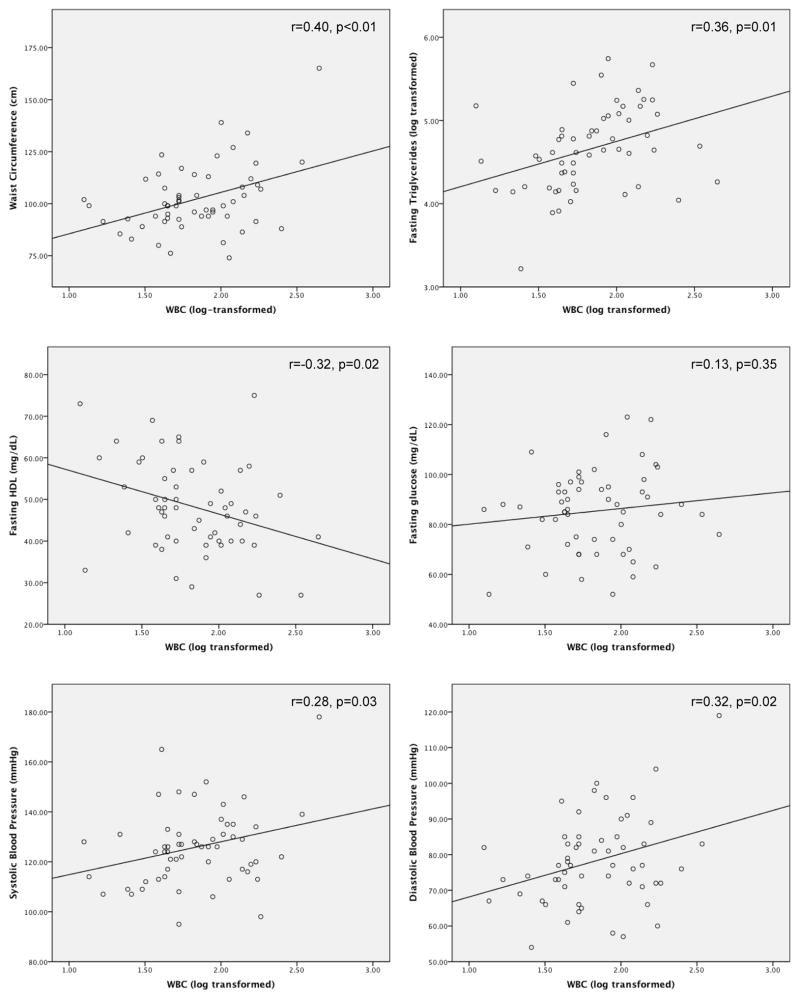
The metabolic syndrome is highly prevalent in patients with schizophrenia, and is associated with a state of chronic, low-grade inflammation. Schizophrenia is also associated with increased inflammation, including aberrant blood levels of pro-inflammatory cytokines and high-sensitivity C-reactive protein (hsCRP). The purpose of this study is to investigate the relationship between total and differential white blood cell (WBC) counts, hsCRP, and the metabolic syndrome in patients with schizophrenia and related non-affective psychoses. Fifty-nine inpatients and outpatients age 18-70 with non-affective psychotic disorders and 22 controls participated in this cross-sectional study. Subjects had a fasting blood draw between 8 and 9 am for glucose, lipids, total and differential WBC counts, and hsCRP. Vital signs and anthropometric measures were obtained. Patients with non-affective psychosis and the metabolic syndrome had significantly higher total WBC counts, monocytes, and hsCRP levels than patients without the metabolic syndrome (p≤0.04 for each). In binary logistic regression analyses, after controlling for potential confounding effects of age, race, sex, age at first hospitalization for psychosis, parental history of diabetes, smoking, and psychotropic medications, total WBC count, monocytes, and hsCRP were significant predictors of metabolic syndrome in patients (p≤0.04 for each). hsCRP was also a significant predictor of increased waist circumference and triglycerides in patients (p≤0.05 for each). Our findings suggest that measurement of total and differential WBC counts and hsCRP blood levels may be germane to the clinical care of patients with schizophrenia and related disorders, and support an association between inflammation and metabolic disturbance in these patients.
代谢综合征在精神分裂症患者中非常普遍,与慢性低度炎症状态有关。精神分裂症也与炎症增加有关,包括促炎细胞因子和高敏 C 反应蛋白(hsCRP)的血液水平异常。本研究旨在探讨精神分裂症和相关非情感性精神病患者的总白细胞和分类白细胞(WBC)计数、hsCRP 与代谢综合征之间的关系。本横断面研究纳入了 59 名年龄在 18-70 岁的非情感性精神障碍住院和门诊患者以及 22 名对照者。受试者在上午 8 点至 9 点空腹采集血液,用于检测血糖、血脂、总白细胞和分类白细胞计数以及 hsCRP。还测量了生命体征和人体测量学指标。患有非情感性精神病和代谢综合征的患者的总白细胞计数、单核细胞和 hsCRP 水平明显高于没有代谢综合征的患者(p≤0.04)。在二元逻辑回归分析中,在控制年龄、种族、性别、首次精神病住院年龄、父母糖尿病史、吸烟和精神药物等潜在混杂因素的影响后,总白细胞计数、单核细胞计数和 hsCRP 是患者代谢综合征的显著预测因素(p≤0.04)。hsCRP 也是患者腰围增加和甘油三酯升高的显著预测因素(p≤0.05)。我们的研究结果表明,总白细胞和分类白细胞计数以及 hsCRP 血液水平的测量可能与精神分裂症和相关疾病患者的临床护理相关,并支持这些患者中炎症与代谢紊乱之间的关联。