Department of Reproductive Medicine, Moores Cancer Center, University of California, San Diego, La Jolla, CA 92093 USA.
Cell Adh Migr. 2012 Jul-Aug;6(4):302-6. doi: 10.4161/cam.20488. Epub 2012 Jul 1.
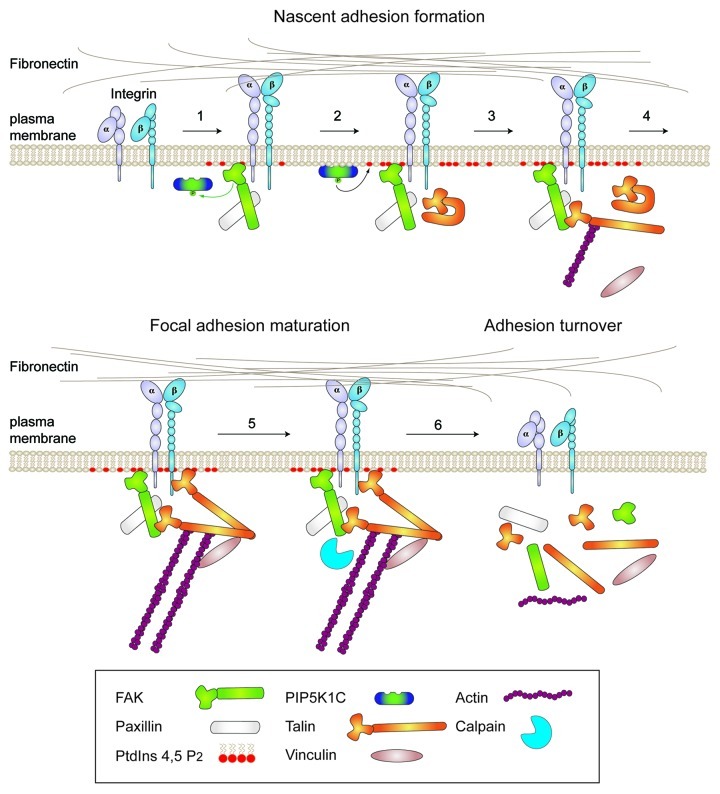
Cell migration requires the coordination of adhesion site assembly and turnover. Canonical models for nascent adhesion formation postulate that integrin binding to extracellular matrix (ECM) proteins results in the rapid recruitment of cytoskeletal proteins such as talin and paxillin to integrin cytoplasmic domains. It is thought that integrin-talin clusters recruit and activate tyrosine kinases such as focal adhesion kinase (FAK). However, the molecular connections of this linkage remain unresolved. Our recent findings support an alternative model whereby FAK recruits talin to new sites of β1 integrin-mediated adhesion in mouse embryonic fibroblasts and human ovarian carcinoma cells. This is dependent on a direct binding interaction between FAK and talin and occurs independently of direct talin binding to β1 integrin. Herein, we discuss differences between nascent and mature adhesions, interactions between FAK, talin and paxillin, possible mechanisms of FAK activation and how this FAK-talin complex may function to promote cell motility through increased adhesion turnover.
细胞迁移需要黏附位点组装和转化的协调。新生黏附形成的规范模型假设整合素与细胞外基质(ECM)蛋白的结合导致细胞骨架蛋白(如塔林和桩蛋白)快速募集到整合素胞质结构域。人们认为整合素-塔林簇募集并激活酪氨酸激酶,如粘着斑激酶(FAK)。然而,这种联系的分子连接仍然没有解决。我们最近的发现支持另一种模型,即 FAK 将塔林募集到小鼠胚胎成纤维细胞和人卵巢癌细胞中β1 整合素介导的黏附的新位点。这依赖于 FAK 和塔林之间的直接结合相互作用,并且独立于塔林与β1 整合素的直接结合。在此,我们讨论了新生和成熟黏附之间的差异、FAK、塔林和桩蛋白之间的相互作用、FAK 激活的可能机制以及这种 FAK-塔林复合物如何通过增加黏附转化来促进细胞迁移。