Osinga Hinke M, Sherman Arthur, Tsaneva-Atanasova Krasimira
Bristol Centre for Applied Nonlinear Mathematics Department of Engineering Mathematics University of Bristol, Queen's Building, University Walk Bristol BS8 1TR, UK.
Discrete Contin Dyn Syst Ser A. 2012 Aug;32(8):2853-2877. doi: 10.3934/dcds.2012.32.2853.
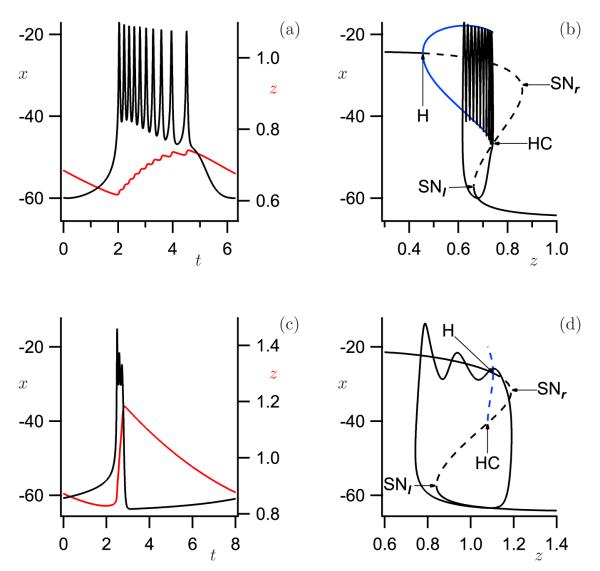
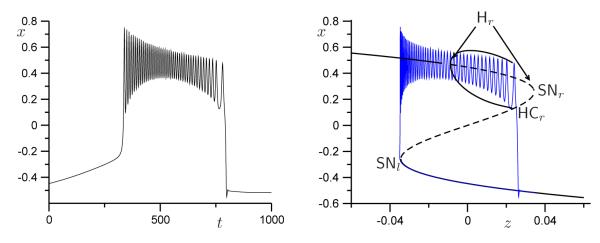
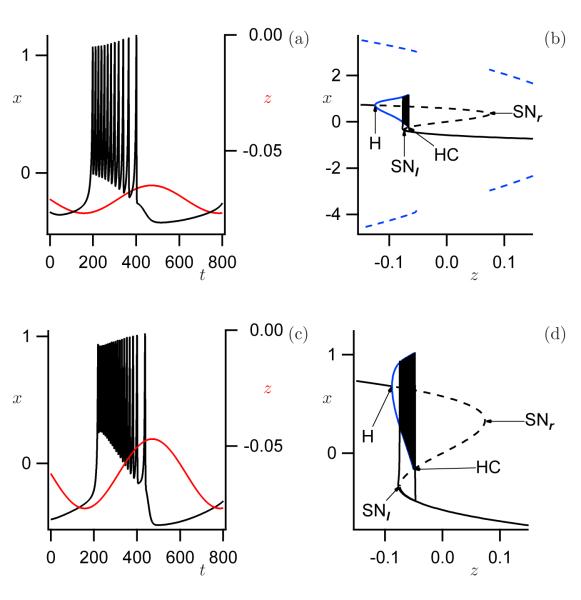
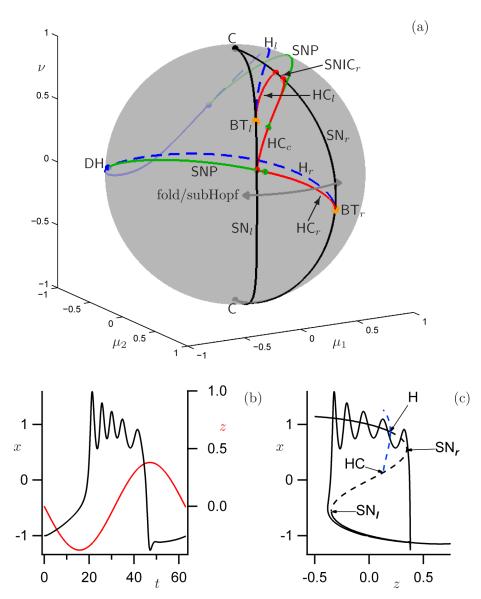
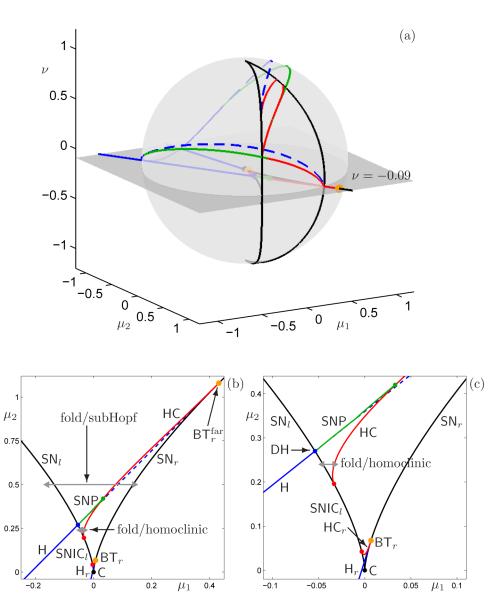
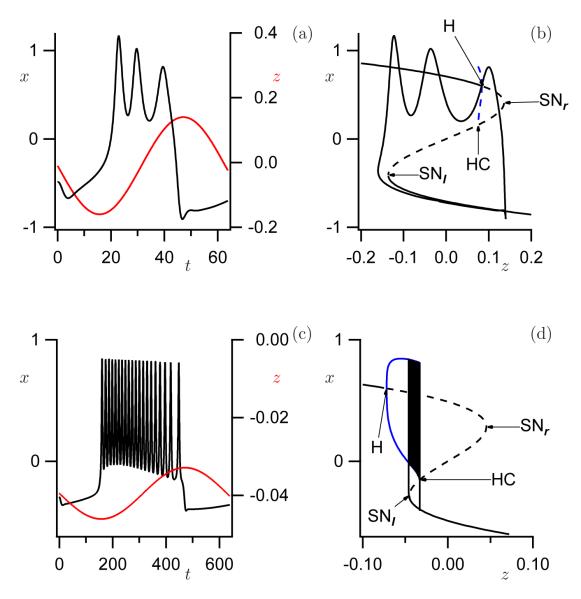
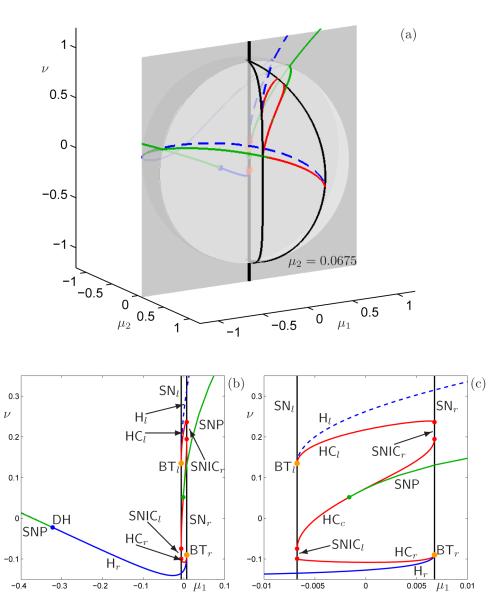
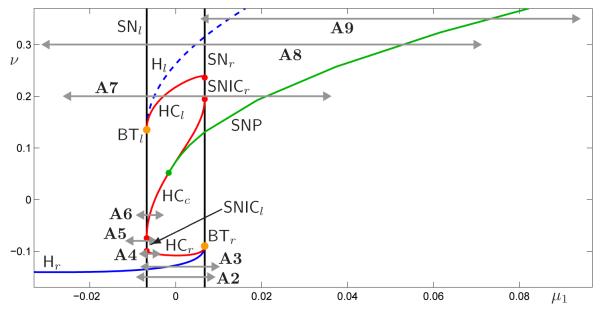
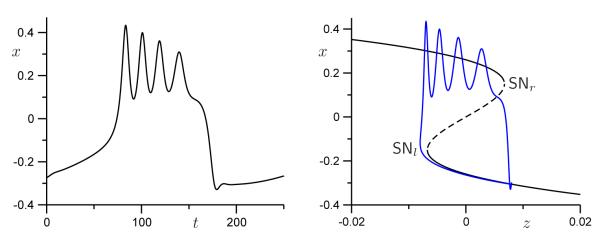
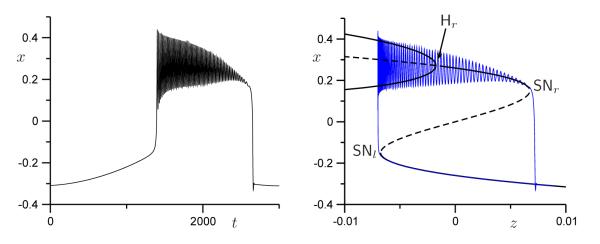
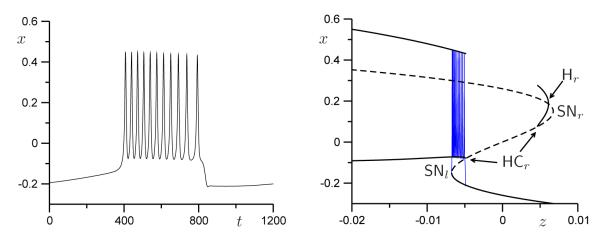
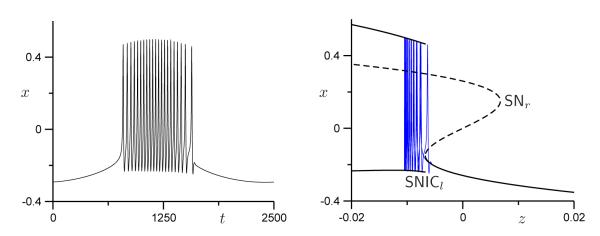
A great deal of work has gone into classifying bursting oscillations, periodic alternations of spiking and quiescence modeled by fast-slow systems. In such systems, one or more slow variables carry the fast variables through a sequence of bifurcations that mediate transitions between oscillations and steady states. A rigorous classification approach is to characterize the bifurcations found in the neighborhood of a singularity; a measure of the complexity of the bursting oscillation is then given by the smallest codimension of the singularities near which it occurs. Fold/homoclinic bursting, along with most other burst types of interest, has been shown to occur near a singularity of codimension three by examining bifurcations of a cubic Liénard system; hence, these types of bursting have at most codimension three. Modeling and biological considerations suggest that fold/homoclinic bursting should be found near fold/subHopf bursting, a more recently identified burst type whose codimension has not been determined yet. One would expect that fold/subHopf bursting has the same codimension as fold/homoclinic bursting, because models of these two burst types have very similar underlying bifurcation diagrams. However, no codimension-three singularity is known that supports fold/subHopf bursting, which indicates that it may have codimension four. We identify a three-dimensional slice in a partial unfolding of a doubly-degenerate Bodganov-Takens point, and show that this codimension-four singularity gives rise to almost all known types of bursting.
大量工作致力于对爆发性振荡进行分类,爆发性振荡是由快慢系统建模的尖峰和静止的周期性交替。在这样的系统中,一个或多个慢变量通过一系列分岔来携带快变量,这些分岔介导振荡和稳态之间的转变。一种严格的分类方法是刻画在奇点邻域发现的分岔;然后,爆发性振荡的复杂性度量由其出现附近奇点的最小余维数给出。通过研究三次Liénard系统的分岔,已表明折叠/同宿爆发以及大多数其他感兴趣的爆发类型发生在余维数为三的奇点附近;因此,这些类型的爆发最多具有余维数三。建模和生物学方面的考虑表明,折叠/同宿爆发应该在折叠/亚霍普夫爆发附近被发现,折叠/亚霍普夫爆发是一种最近才被识别的爆发类型,其余维数尚未确定。人们会预期折叠/亚霍普夫爆发与折叠/同宿爆发具有相同的余维数,因为这两种爆发类型的模型具有非常相似的基础分岔图。然而,目前尚不知道有支持折叠/亚霍普夫爆发的余维数为三的奇点,这表明它可能具有余维数四。我们在一个双退化博德加诺夫 - 塔肯斯点的部分展开中确定了一个三维切片,并表明这个余维数为四的奇点产生了几乎所有已知类型的爆发。