King's College London British Heart Foundation Centre of Excellence, National Institute of Health Research Biomedical Research Centre at Guy's and St. Thomas' NHS Foundation Trust, Wellcome Trust and Engineering and Physical Sciences Research Council Medical Engineering Centre, Division of Imaging Sciences, The Rayne Institute, St. Thomas' Hospital, London, United Kingdom.
J Am Coll Cardiol. 2012 Oct 16;60(16):1546-55. doi: 10.1016/j.jacc.2012.05.052. Epub 2012 Sep 19.
The aim of this study was to compare fully quantitative cardiovascular magnetic resonance (CMR) and positron emission tomography (PET) myocardial perfusion and myocardial perfusion reserve (MPR) measurements in patients with coronary artery disease (CAD).
Absolute quantification of myocardial perfusion and MPR with PET have proven diagnostic and prognostic roles in patients with CAD. Quantitative CMR perfusion imaging has been established more recently and has been validated against PET in normal hearts. However, there are no studies comparing fully quantitative CMR against PET perfusion imaging in patients with CAD.
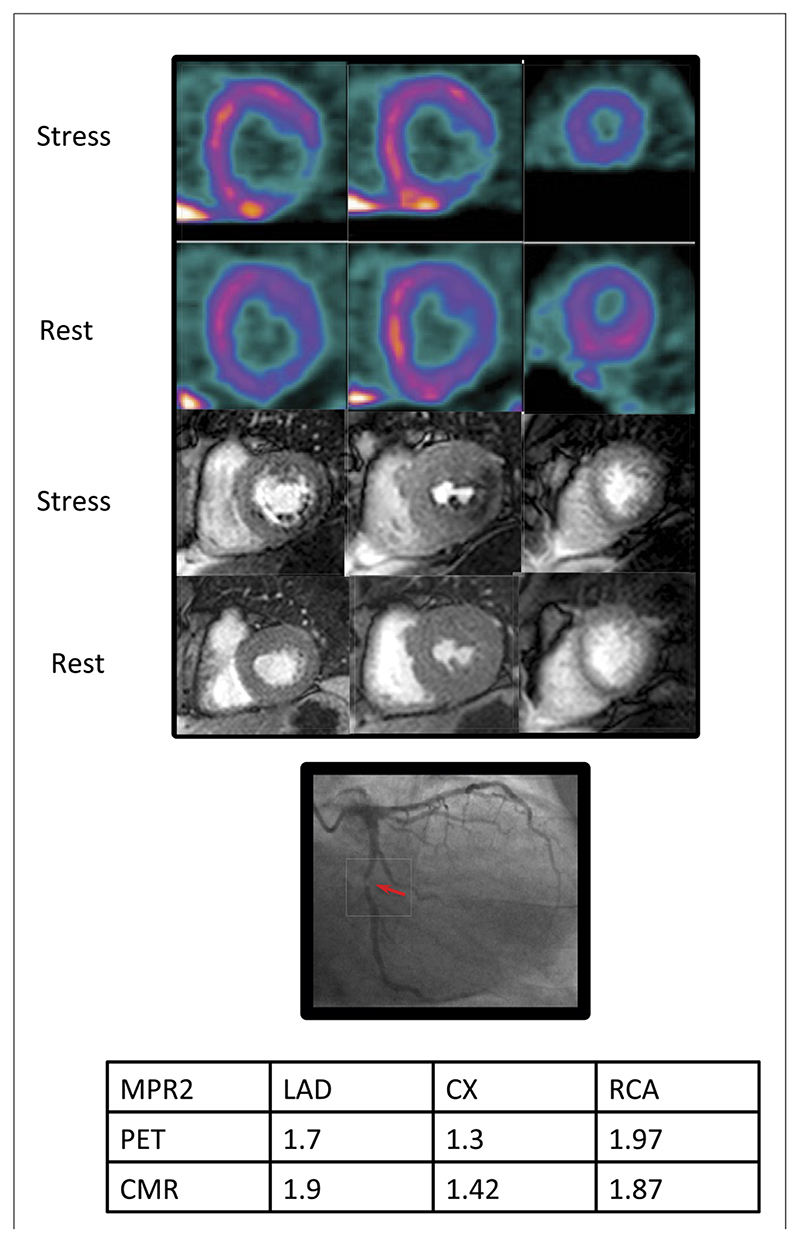
Forty-one patients with known or suspected CAD prospectively underwent quantitative (13)N-ammonia PET and CMR perfusion imaging before coronary angiography.
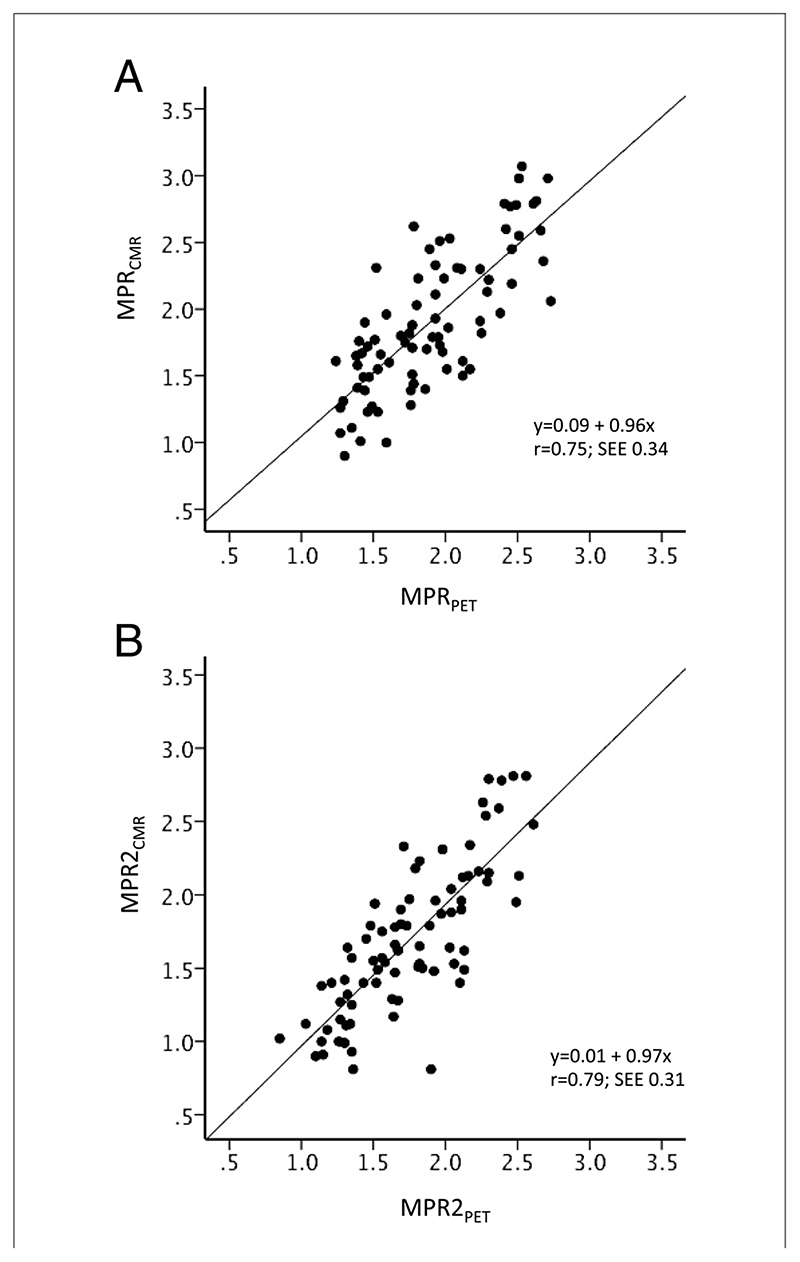
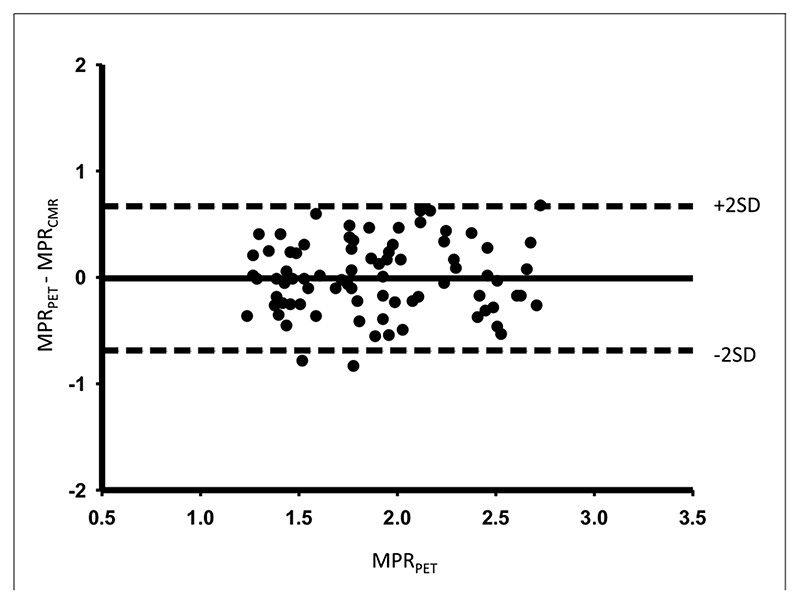
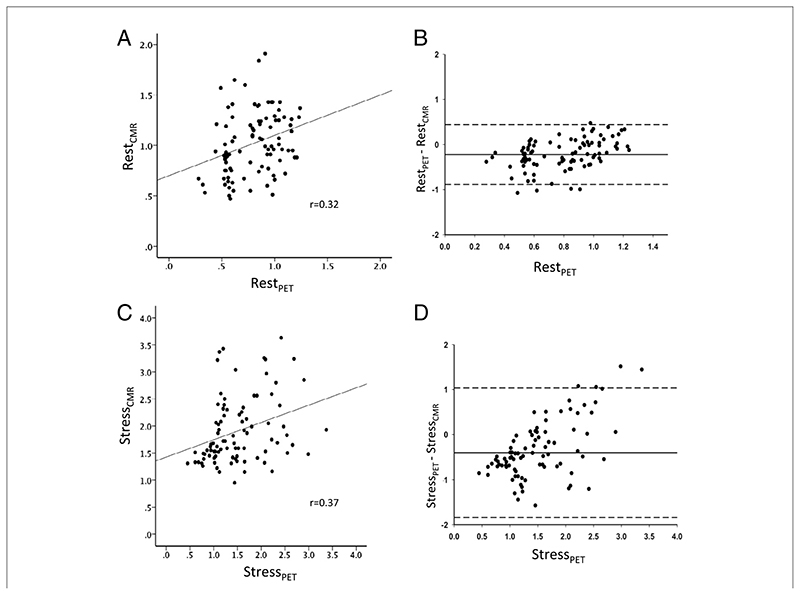
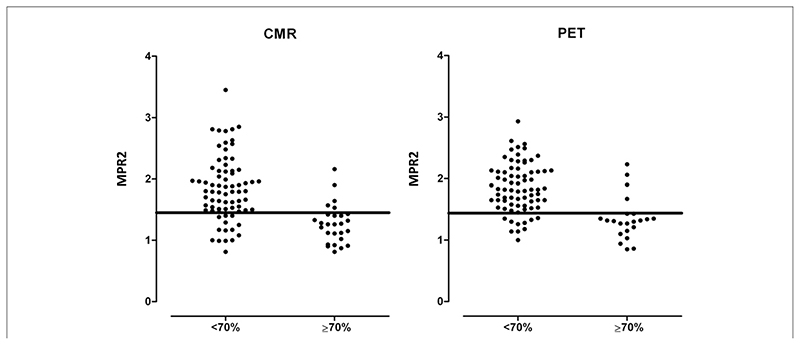
The CMR-derived MPR (MPR(CMR)) correlated well with PET-derived measurements (MPR(PET)) (r = 0.75, p < 0.0001). MPR(CMR) and MPR(PET) for the 2 lowest scoring segments in each coronary territory also correlated strongly (r = 0.79, p < 0.0001). Absolute CMR perfusion values correlated significantly, but weakly, with PET values both at rest (r = 0.32; p = 0.002) and during stress (r = 0.37; p < 0.0001). Area under the receiver-operating characteristic curve for MPR(PET) to detect significant CAD was 0.83 (95% confidence interval: 0.73 to 0.94) and for MPR(CMR) was 0.83 (95% confidence interval: 0.74 to 0.92). An MPR(PET) ≤1.44 predicted significant CAD with 82% sensitivity and 87% specificity, and MPR(CMR) ≤1.45 predicted significant CAD with 82% sensitivity and 81% specificity.
There is good correlation between MPR(CMR) and MPR(PET.) For the detection of significant CAD, MPR(PET) and MPR(CMR) seem comparable and very accurate. However, absolute perfusion values from PET and CMR are only weakly correlated; therefore, although quantitative CMR is clinically useful, further refinements are still required.
本研究旨在比较冠状动脉疾病(CAD)患者的全定量心血管磁共振(CMR)和正电子发射断层扫描(PET)心肌灌注和心肌灌注储备(MPR)测量。
PET 心肌灌注的绝对定量已被证明在 CAD 患者中有诊断和预后作用。定量 CMR 灌注成像较近才建立起来,并已在正常心脏中得到验证。然而,目前尚没有研究比较 CAD 患者的全定量 CMR 与 PET 灌注成像。
41 例已知或疑似 CAD 的患者前瞻性地在冠状动脉造影前进行了定量(13)N-氨 PET 和 CMR 灌注成像。
CMR 衍生的 MPR(MPR(CMR))与 PET 衍生的测量值(MPR(PET))密切相关(r = 0.75,p < 0.0001)。每个冠状动脉区域的 2 个评分最低节段的 MPR(CMR)和 MPR(PET)也具有很强的相关性(r = 0.79,p < 0.0001)。静息(r = 0.32;p = 0.002)和应激(r = 0.37;p < 0.0001)时,绝对 CMR 灌注值与 PET 值显著相关,但相关性较弱。MPR(PET)检测有意义的 CAD 的受试者工作特征曲线下面积为 0.83(95%置信区间:0.73 至 0.94),MPR(CMR)为 0.83(95%置信区间:0.74 至 0.92)。MPR(PET)≤1.44 预测有意义的 CAD 的敏感性为 82%,特异性为 87%,而 MPR(CMR)≤1.45 预测有意义的 CAD 的敏感性为 82%,特异性为 81%。
MPR(CMR)与 MPR(PET)之间存在良好的相关性。对于检测有意义的 CAD,MPR(PET)和 MPR(CMR)似乎具有可比性,且非常准确。然而,PET 和 CMR 的绝对灌注值相关性较弱;因此,尽管定量 CMR 在临床上有用,但仍需要进一步改进。