Arthritis Center Twente, Department of Rheumatology and Clinical Immunology, Medisch Spectrum Twente Hospital and University of Twente, P,O, Box 50,000, 7500 KA, Enschede, The Netherlands.
BMC Gastroenterol. 2012 Sep 24;12:133. doi: 10.1186/1471-230X-12-133.
In this post-hoc analysis of a randomized, double blind, placebo controlled trial, we measured the sensitivity and specificity of Helicobacter pylori IgG-antibody titer changes, hematoxylin and eosin (H&E) stains, immunohistochemical (IHC) stains and culture results in NSAID using patients, following H. pylori eradication therapy or placebo.
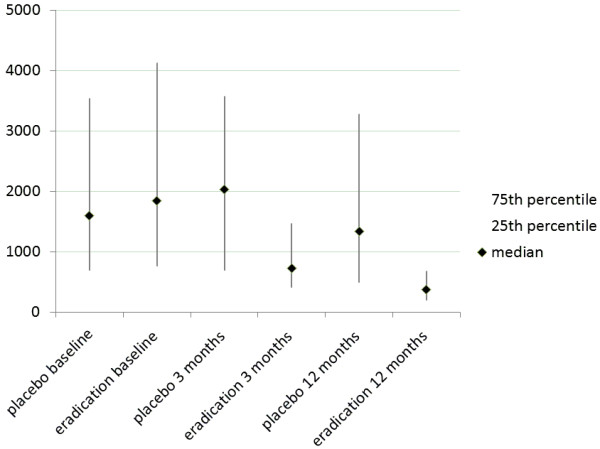
347 NSAID using patients who were H. pylori positive on serological testing for H. pylori IgG-antibodies were randomized for H. pylori eradication therapy or placebo. Three months after randomization, gastric mucosal biopsies were taken for H. pylori culture and histological examination. At 3 and 12 months, blood samples were taken for repeated serological testing. The gold standard for H. pylori infection was based on a positive culture or both a positive histological examination and a positive serological test. Sensitivity, specificity and receiver operating curves (ROC) were calculated.
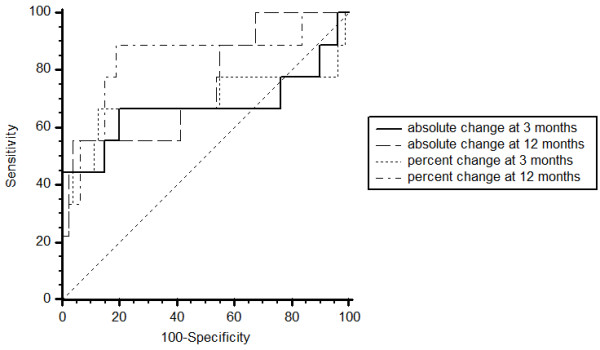
H. pylori eradication therapy was successful in 91% of patients. Culture provided an overall sensitivity of 82%, and 73% after eradication, with a specificity of 100%. Histological examination with either H&E or IHC stains provided sensitivities and specificities between 93% and 100%. Adding IHC to H&E stains did not improve these results. The ROC curve for percent change in H. pylori IgG-antibody titers had good diagnostic power in identifying H. pylori negative patients, with an area under the ROC curve of 0.70 (95 % CI 0.59 to 0.79, P = 0.085) at 3 months and 0.83 (95% CI 0.76 to 0.89, P < 0.0001) at 12 months. A cut-off point of at least 21% decrease in H. pylori IgG-antibody titers at 3 months and 58% at 12 months provided a sensitivity of 64% and 87% and a specificity of 81% and 74% respectively, for successful eradication of H. pylori.
In NSAID using patients, following H. pylori eradication therapy or placebo, histological examination of gastric mucosal tissue biopsies provided good sensitivity and specificity ratios for evaluating success of H. pylori eradication therapy. A percentual H. pylori IgG-antibody titer change has better sensitivity and specificity than an absolute titer change or a predefined H. pylori IgG-antibody titer cut-off point for evaluating success of H. pylori eradication therapy.
在这项针对随机、双盲、安慰剂对照试验的事后分析中,我们测量了在 NSAID 使用患者中,幽门螺杆菌 IgG 抗体滴度变化、苏木精和伊红(H&E)染色、免疫组织化学(IHC)染色以及培养结果在幽门螺杆菌根除治疗或安慰剂后的敏感性和特异性。
347 例血清学检测 H. pylori IgG 抗体阳性的 NSAID 使用患者被随机分为接受幽门螺杆菌根除治疗或安慰剂。随机分组 3 个月后,进行胃黏膜活检以进行幽门螺杆菌培养和组织学检查。在 3 个月和 12 个月时,采集血样进行重复血清学检测。幽门螺杆菌感染的金标准基于培养阳性或组织学检查阳性和血清学检测阳性。计算了敏感性、特异性和接收者操作特征(ROC)曲线。
91%的患者接受了幽门螺杆菌根除治疗。培养的总体敏感性为 82%,根除后为 73%,特异性为 100%。H&E 或 IHC 染色的组织学检查提供了 93%至 100%的敏感性和特异性。添加 IHC 到 H&E 染色并没有提高这些结果。在 3 个月时,幽门螺杆菌 IgG 抗体滴度变化百分比的 ROC 曲线具有良好的诊断能力,ROC 曲线下面积为 0.70(95%CI 0.59 至 0.79,P=0.085),在 12 个月时为 0.83(95%CI 0.76 至 0.89,P<0.0001)。在 3 个月时至少降低 21%和在 12 个月时降低 58%的幽门螺杆菌 IgG 抗体滴度作为治疗成功的截断值,可分别提供 64%和 87%的敏感性和 81%和 74%的特异性。
在 NSAID 使用患者中,接受幽门螺杆菌根除治疗或安慰剂后,胃黏膜组织活检的组织学检查为评估幽门螺杆菌根除治疗的成功率提供了良好的敏感性和特异性比值。与绝对滴度变化或预定义的幽门螺杆菌 IgG 抗体滴度截断值相比,幽门螺杆菌 IgG 抗体滴度变化的百分比具有更好的敏感性和特异性,用于评估幽门螺杆菌根除治疗的成功率。