Edith Cowan University Health and Wellness Institute, Edith Cowan University, 270 Joondalup Drive, Joondalup, Western Australia 6027, Australia.
BMC Cancer. 2012 Sep 26;12:432. doi: 10.1186/1471-2407-12-432.
There has been substantial increase in use of androgen deprivation therapy as adjuvant management of prostate cancer. However, this leads to a range of musculoskeletal toxicities including reduced bone mass and increased skeletal fractures compounded with rapid metabolic alterations, including increased body fat, reduced lean mass, insulin resistance and negative lipoprotein profile, increased incidence of cardiovascular and metabolic morbidity, greater distress and reduced quality of life. Numerous research studies have demonstrated certain exercise prescriptions to be effective at preventing or even reversing these treatment toxicities. However, all interventions to date have been of rehabilitative intent being implemented after a minimum of 3 months since initiation of androgen deprivation, by which time considerable physical and psychological health problems have manifested. The pressing question is whether it is more efficacious to commence exercise therapy at the same time as initiating androgen deprivation, so treatment induced adverse effects can be immediately attenuated or indeed prevented.
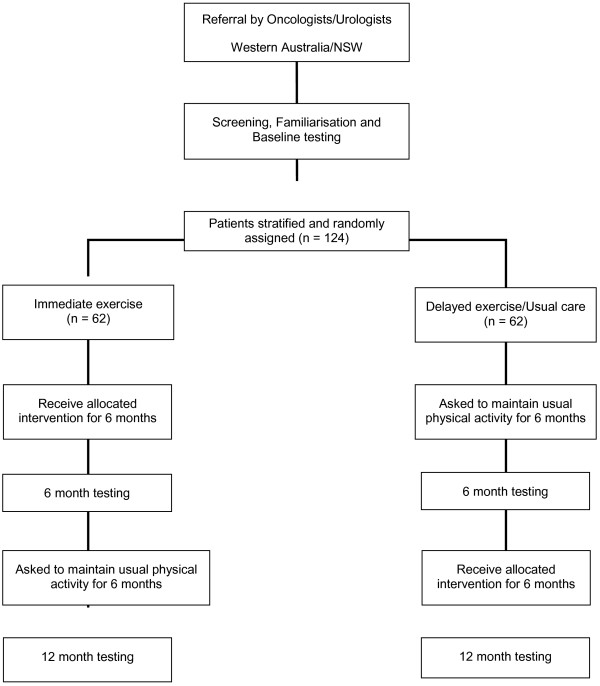
METHODS/DESIGN: We are proposing a multi-site randomized controlled trial with partial crossover to examine the effects of timing of exercise implementation (immediate or delayed) on preserving long-term skeletal health, reversing short- and long-term metabolic and cardiovascular risk factors, and supporting mental health in men receiving androgen deprivation therapy. 124 men who are about to initiate androgen deprivation for prostate cancer will be randomized to immediate or delayed groups. Immediate will commence a 6-month exercise program within 7-10 days of their first dose. Delayed will receive usual care for 6 months and then commence the exercise program for 6 months (partial cross-over). Immediate will be free to adopt the lifestyle of their choosing following the initial 6-month intervention. Measurements for primary and secondary endpoints will take place at baseline, 6 months and 12 months.
This project is unique as it explores a fundamental question of when exercise implementation will be of most benefit and addresses both physical and psychological consequences of androgen deprivation initiation. The final outcome may be adjunct treatment which will reduce if not prevent the toxicities of androgen deprivation, ultimately resulting in reduced morbidity and mortality for men with prostate cancer.
ACTRN12612000097842.
雄激素剥夺疗法在前列腺癌的辅助治疗中得到了广泛应用。然而,这会导致一系列肌肉骨骼毒性,包括骨量减少和骨折风险增加,同时还伴有快速的代谢改变,包括体脂增加、瘦体重减少、胰岛素抵抗和脂蛋白谱恶化、心血管和代谢发病率增加、更大的痛苦和生活质量下降。大量研究表明,某些运动处方可以有效地预防甚至逆转这些治疗毒性。然而,迄今为止,所有的干预措施都是康复性的,都是在开始雄激素剥夺治疗至少 3 个月后实施的,此时已经出现了相当多的身体和心理健康问题。迫切的问题是,是否在开始雄激素剥夺治疗的同时开始运动疗法更有效,这样可以立即减轻或预防治疗引起的不良反应。
方法/设计:我们正在提出一项多地点随机对照试验,部分交叉设计,以检验运动实施时间(即时或延迟)对长期骨骼健康、短期和长期代谢和心血管危险因素的逆转以及接受雄激素剥夺治疗的男性心理健康的影响。124 名即将开始雄激素剥夺治疗前列腺癌的男性将被随机分为即时组或延迟组。即时组将在首次剂量后 7-10 天内开始 6 个月的运动计划。延迟组将在 6 个月内接受常规护理,然后开始 6 个月的运动计划(部分交叉)。即时组在初始 6 个月干预结束后,可以自由选择自己的生活方式。主要和次要终点的测量将在基线、6 个月和 12 个月进行。
该项目是独特的,因为它探讨了运动实施何时最有益的基本问题,并解决了雄激素剥夺开始的身体和心理后果。最终的结果可能是辅助治疗,可以减少(如果不能预防)雄激素剥夺的毒性,最终降低前列腺癌男性的发病率和死亡率。
ACTRN12612000097842。