Capacity Plus, IntraHealth International Inc, 1776 I Street NW, Suite 650, Washington DC, USA, 20006.
Hum Resour Health. 2012 Sep 27;10:38. doi: 10.1186/1478-4491-10-38.
Community health workers (CHWs) are increasingly recognized as a critical link in improving access to services and achieving the health-related Millennium Development Goals. Given the financial and human resources constraints in developing countries, CHWs are expected to do more without necessarily receiving the needed support to do their jobs well. How much can be expected of CHWs before work overload and reduced organizational support negatively affect their productivity, the quality of services, and in turn the effectiveness of the community-based programmes that rely on them? This article presents policy-makers and programme managers with key considerations for a model to improve the work environment as an important approach to increase CHW productivity and, ultimately, the effectiveness of community-based strategies.
A desk review of selective published and unpublished articles and reports on CHW programs in developing countries was conducted to analyse and organize findings on the elements that influence CHW productivity. The search was not exhaustive but rather was meant to gather information on general themes that run through the various documents to generate perspectives on the issue and provide evidence on which to formulate ideas. After an initial search for key terminology related to CHW productivity, a snowball technique was used where a reference in one article led to the discovery of additional documents and reports.
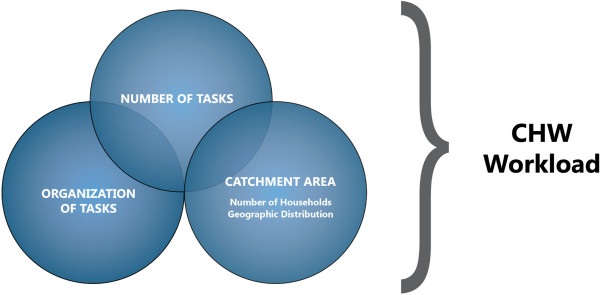
CHW productivity is determined in large part by the conditions under which they work. Attention to the provision of an enabling work environment for CHWs is essential for achieving high levels of productivity. We present a model in which the work environment encompasses four essential elements-workload, supportive supervision, supplies and equipment, and respect from the community and the health system-that affect the productivity of CHWs. We propose that when CHWs have a manageable workload in terms of a realistic number of tasks and clients, an organized manner of carrying out these tasks, a reasonable geographic distance to cover, the needed supplies and equipment, a supportive supervisor, and respect and acceptance from the community and the health system, they can function more productively and contribute to an effective community-based strategy.
As more countries look to scale up CHW programmes or shift additional tasks to CHWs, it is critical to pay attention to the elements that affect CHW productivity during programme design as well as implementation. An enabling work environment is crucial to maximize CHW productivity. Policy-makers, programme managers, and other stakeholders need to carefully consider how the productivity elements related to the work environment are defined and incorporated in the overall CHW strategy. Establishing a balance among the four elements that constitute a CHW's work environment will help make great strides in improving the effectiveness and quality of the services provided by CHWs.

社区卫生工作者(CHW)越来越被认为是改善服务获取和实现与卫生相关的千年发展目标的关键环节。考虑到发展中国家的财政和人力资源限制,CHW 预计将承担更多的工作,而不一定会得到做好工作所需的支持。在工作负荷过重和组织支持减少对他们的生产力、服务质量产生负面影响之前,CHW 能承担多少工作?本文为决策者和方案管理人员提供了一个改善工作环境的模式的关键考虑因素,这是提高 CHW 生产力的重要方法,最终也提高了依赖他们的基于社区的策略的效果。
对发展中国家的 CHW 计划的选择性出版和未出版的文章和报告进行了案头审查,以分析和组织影响 CHW 生产力的因素。搜索并非详尽无遗,而是旨在收集贯穿各种文件的一般主题信息,以产生对该问题的看法,并提供制定想法的证据。在对与 CHW 生产力相关的关键术语进行初步搜索后,使用了滚雪球技术,即一篇文章中的一个参考文献导致发现了其他文件和报告。
CHW 的生产力在很大程度上取决于他们的工作条件。关注为 CHW 提供有利的工作环境对于实现高水平的生产力至关重要。我们提出了一个模型,其中工作环境包括四个基本要素-工作量、支持性监督、用品和设备以及社区和卫生系统的尊重-这些要素影响 CHW 的生产力。我们建议,当 CHW 承担的工作量在现实任务和客户数量方面是可以管理的、完成这些任务的组织方式合理、覆盖的合理地理距离、所需的用品和设备、支持性监督以及社区和卫生系统的尊重和接受时,他们可以更有效地发挥作用,并为有效的基于社区的策略做出贡献。
随着越来越多的国家寻求扩大 CHW 计划或向 CHW 转移更多任务,在方案设计以及实施过程中,关注影响 CHW 生产力的因素至关重要。有利的工作环境对于最大限度地提高 CHW 生产力至关重要。政策制定者、方案管理人员和其他利益攸关方需要仔细考虑与工作环境相关的生产力要素如何定义,并将其纳入 CHW 总体战略。在构成 CHW 工作环境的四个要素之间建立平衡,将有助于在提高 CHW 提供的服务的效果和质量方面取得重大进展。