School of Life Sciences, Northeast Forestry University, Harbin, China.
PLoS One. 2012;7(10):e46785. doi: 10.1371/journal.pone.0046785. Epub 2012 Oct 8.
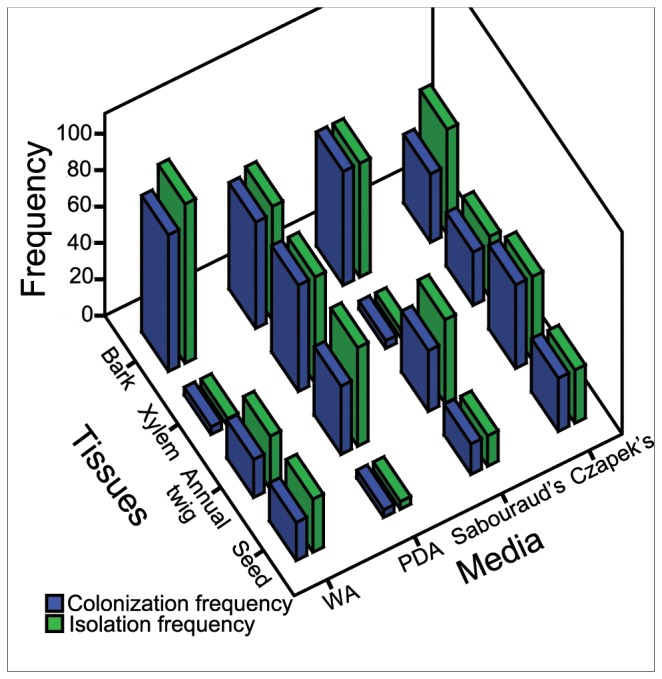
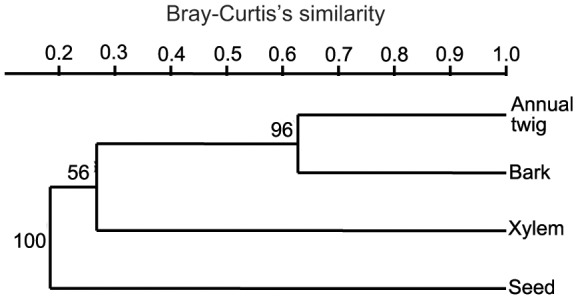
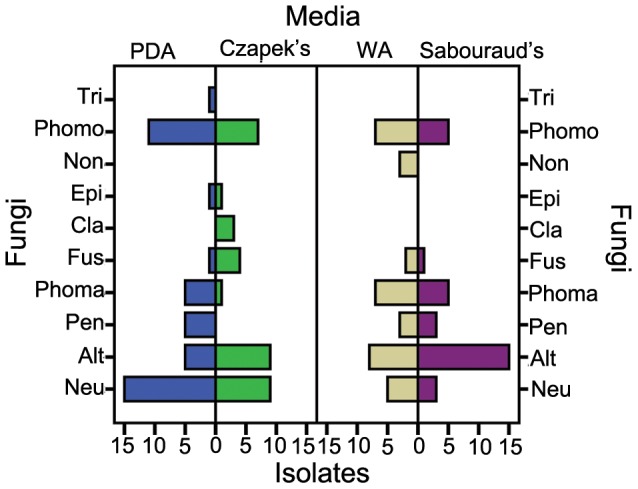
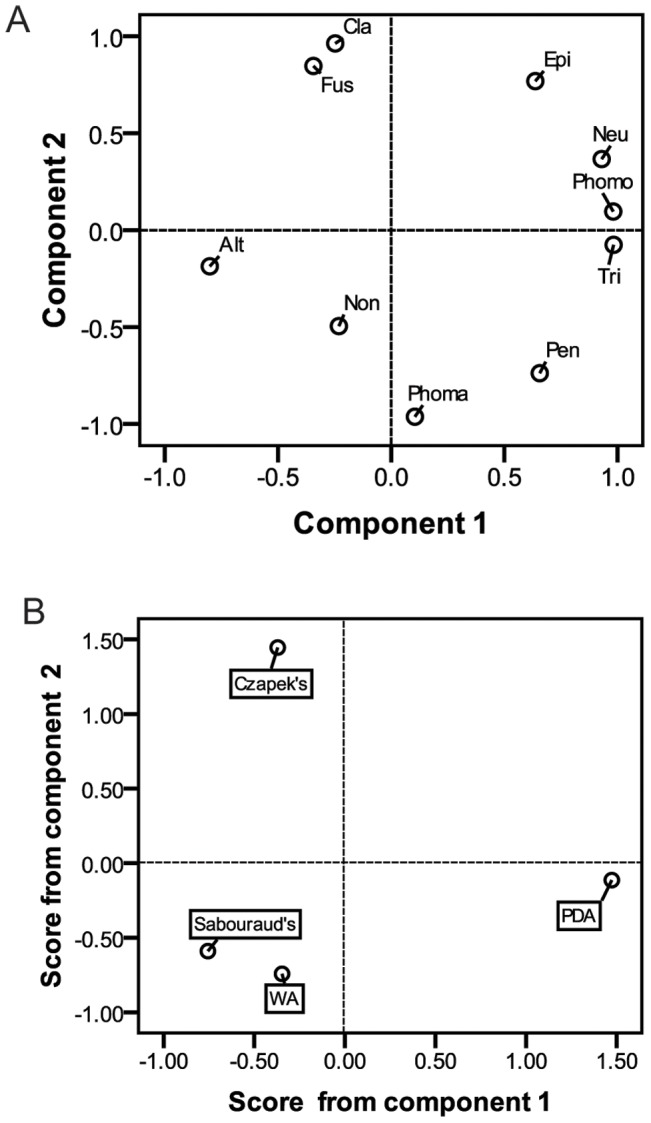
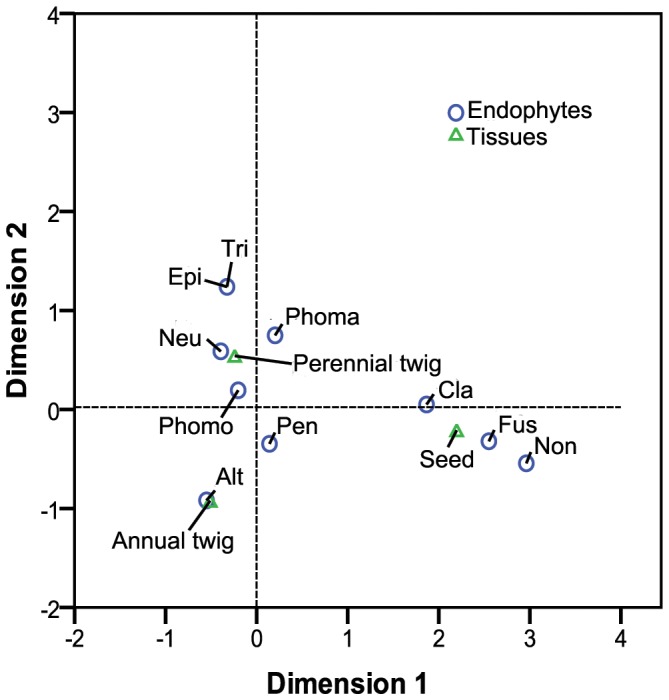
The community of endophytic fungi associated with Acer ginnala, a common tree in northeastern China, was investigated. Four media, PDA, Czapek's, WA and Sabouraud's, were used to inoculate explants from seeds, annual twigs and perennial twigs (xylem and bark). Media strongly affected the isolated species number, but not colonization frequency (CF) or isolation frequency (IF). To investigate media effect further, a Principal Component Analysis (PCA) was done. As a result, two components accounted for 86.502% of the total variance were extracted. These two components were named as PDA-determined factor (accounted for 45.139% of the total variance) and Czapek's-determined factor (accounted for 41.363% of the total variance), respectively. This result suggested that only two media, PDA and Czapek's, could be used instead of all four media in this study without affecting the isolation results significantly. In total, ten taxa were isolated in this study. Alternaria sp., Phomopsis sp., Neurospora sp. and Phoma sp. were dominant endophytes while Pleosporales Incertae Sedis sp., Cladosporium sp., Trichoderma sp. and Epicoccum sp. were rare taxa. Different tissues/organs had different endophyte assemblages. All tissue/organ pairs had low Bray-Curtis indices (<0.3) except for bark and annual twigs (0.63). Compared to perennial twigs, annual twigs had a lower taxon number, lower isolate number, lower endophyte dominance and diversity indices. Seeds had distinct assemblage, lower similarity and similar low diversity indices to annual twigs. These results suggested that tissue type determines the endophyte assemblage while age determines the diversity.
本研究调查了中国东北地区常见树种色木槭( Acer ginnala )的内生真菌群落。使用 PDA、Czapek's、WA 和 Sabouraud's 四种培养基来接种种子、一年生和多年生枝条(木质部和树皮)的外植体。培养基强烈影响分离物种的数量,但不影响定殖频率(CF)或分离频率(IF)。为了进一步研究培养基的影响,进行了主成分分析(PCA)。结果提取了两个占总方差 86.502%的成分。这两个成分分别命名为 PDA 决定因子(占总方差的 45.139%)和 Czapek's 决定因子(占总方差的 41.363%)。这一结果表明,在不显著影响分离结果的情况下,本研究只需使用 PDA 和 Czapek's 两种培养基,而无需使用所有四种培养基。本研究共分离出 10 个分类群。交替单胞菌属(Alternaria sp.)、拟茎点霉属(Phomopsis sp.)、丝孢纲菌属(Neurospora sp.)和茎点霉属(Phoma sp.)是优势内生真菌,而散囊菌目不定属(Pleosporales Incertae Sedis sp.)、枝孢属(Cladosporium sp.)、木霉属(Trichoderma sp.)和地衣孢属(Epicoccum sp.)则是罕见分类群。不同的组织/器官具有不同的内生菌组合。除了树皮和一年生枝条(0.63)外,所有组织/器官对之间的 Bray-Curtis 指数均较低(<0.3)。与多年生枝条相比,一年生枝条的分类群数量较低,分离株数量较低,内生菌优势度和多样性指数较低。种子具有独特的组合,与一年生枝条的相似性较低,多样性指数也相似。这些结果表明,组织类型决定内生菌组合,而年龄决定多样性。