School of Biosciences, Cardiff University Cardiff, UK.
Front Comput Neurosci. 2012 Sep 27;6:75. doi: 10.3389/fncom.2012.00075. eCollection 2012.
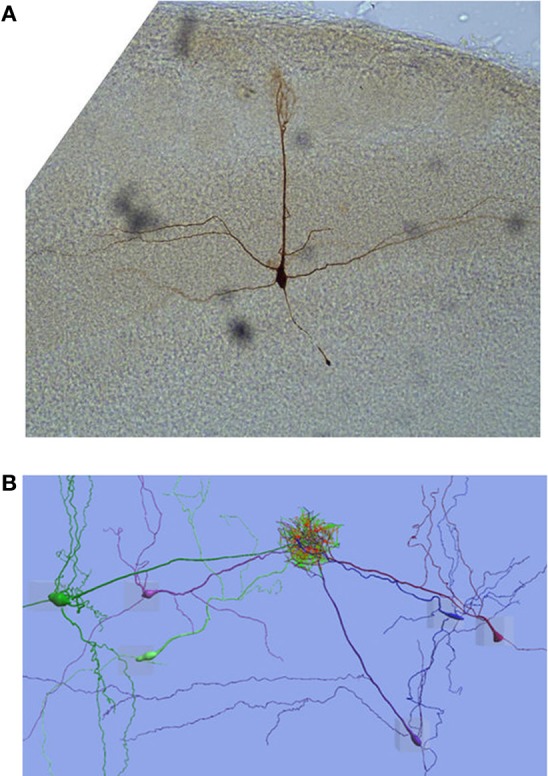
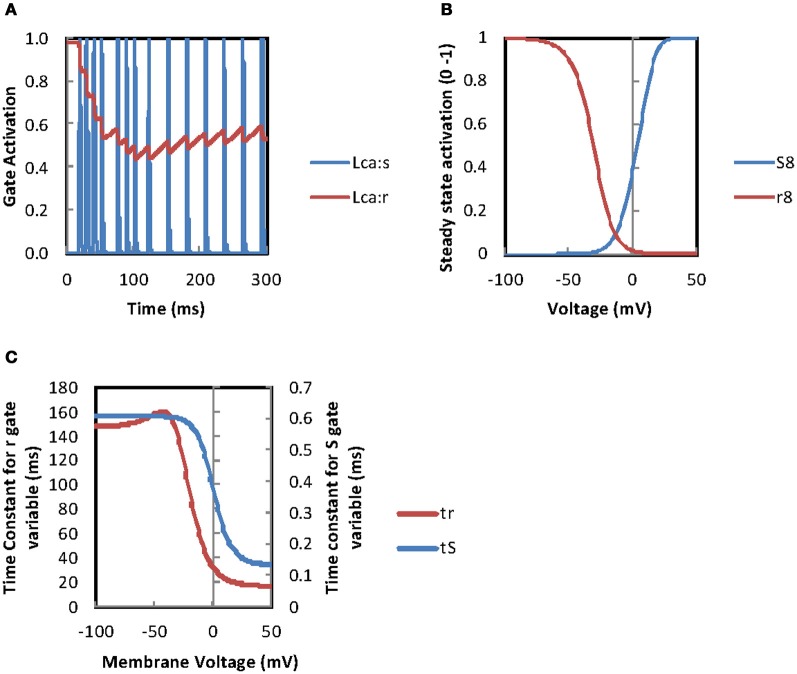
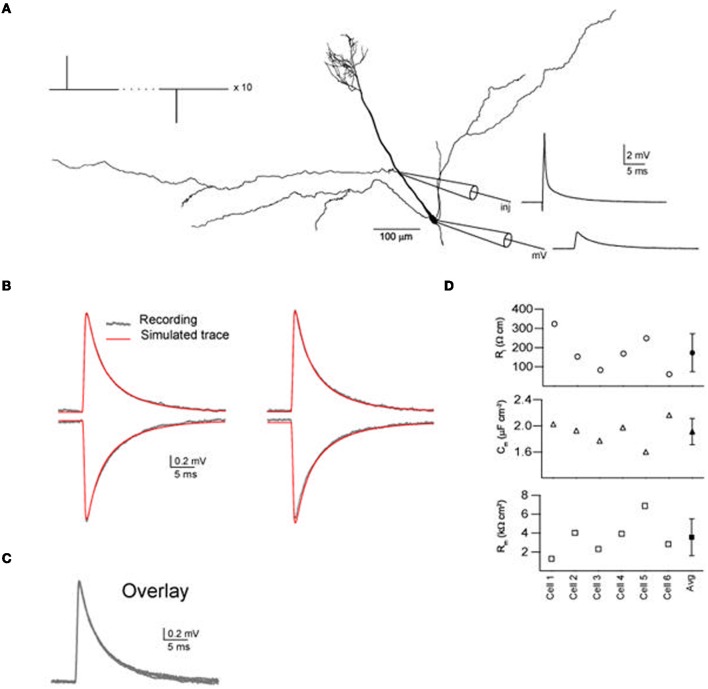
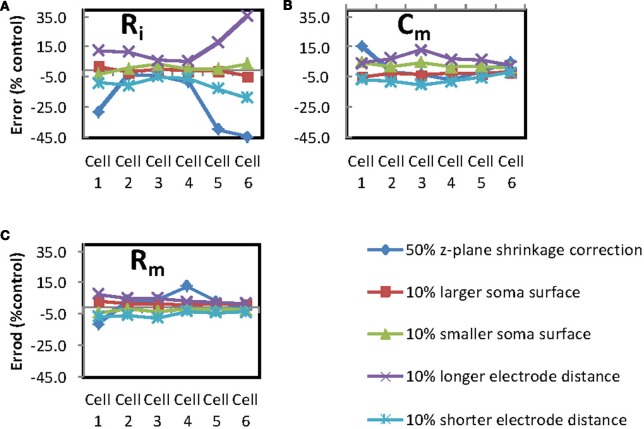
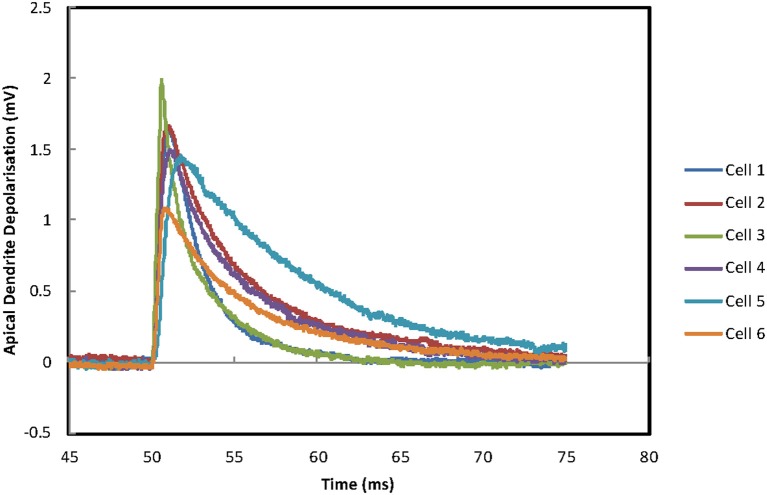
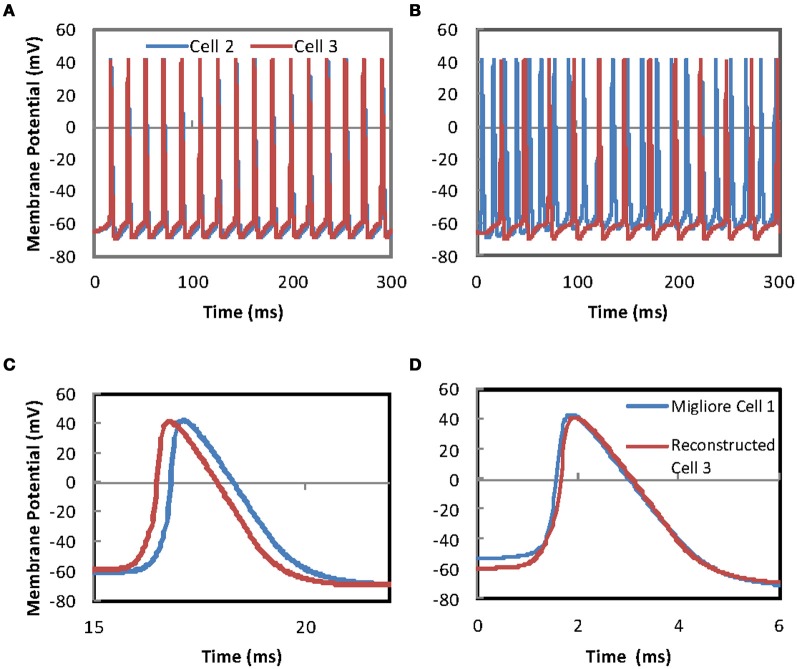
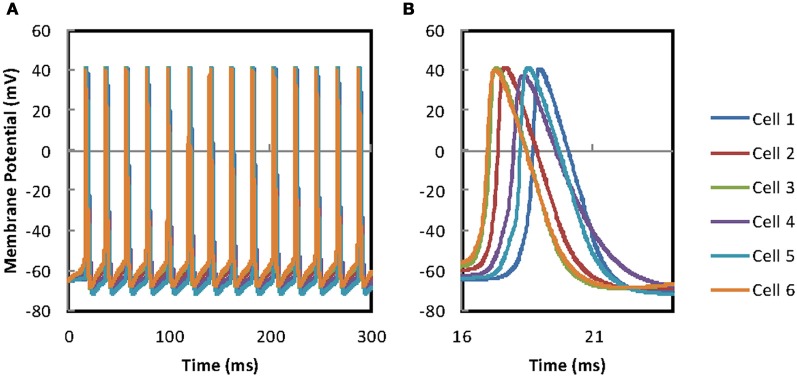
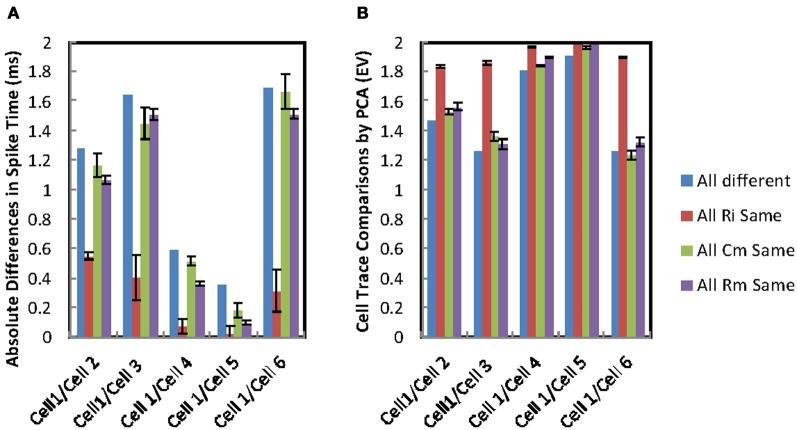
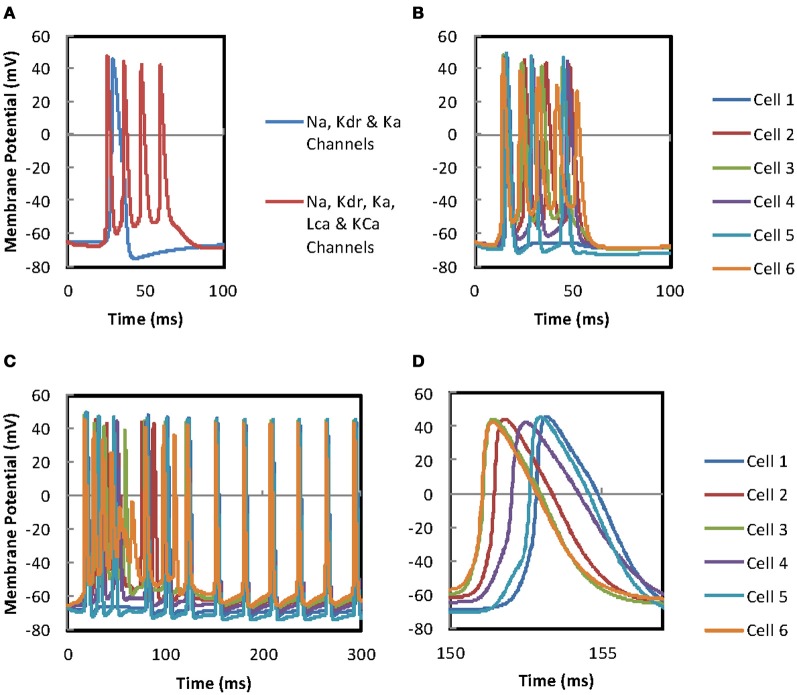
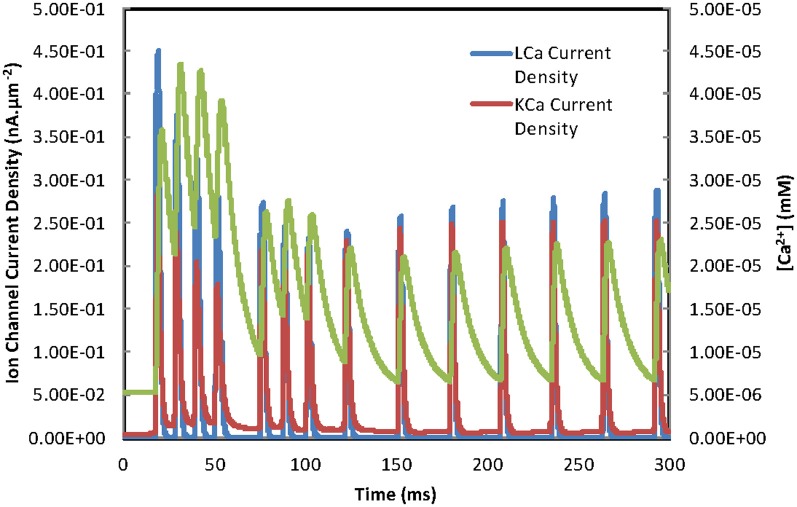
A key player in olfactory processing is the olfactory bulb (OB) mitral cell (MC). We have used dual whole-cell patch-clamp recordings from the apical dendrite and cell soma of MCs to develop a passive compartmental model based on detailed morphological reconstructions of the same cells. Matching the model to traces recorded in experiments we find: C(m) = 1.91 ± 0.20 μF cm(-2), R(m) = 3547 ± 1934 Ω cm(2) and R(i) = 173 ± 99 Ω cm. We have constructed a six MC gap-junction (GJ) network model of morphologically accurate MCs. These passive parameters (PPs) were then incorporated into the model with Na(+), Kdr, and KA conductances and GJs from Migliore et al. (2005). The GJs were placed in the apical dendrite tuft (ADT) and their conductance adjusted to give a coupling ratio between MCs consistent with experimental findings (~0.04). Firing at ~50 Hz was induced in all six MCs with continuous current injections (0.05-0.07 nA) at 20 locations to the ADT of two of the MCs. It was found that MCs in the network synchronized better when they shared identical PPs rather than using their own PPs for the fit suggesting that the OB may have populations of MCs tuned for synchrony. The addition of calcium-activated potassium channels (iKCa) and L-type calcium channels (iCa(L)) (Bhalla and Bower, 1993) to the model enabled MCs to generate burst firing. However, the GJ coupling was no longer sufficient to synchronize firing. When cells were stimulated by a continuous current injection there was an initial period of asynchronous burst firing followed after ~120 ms by synchronous repetitive firing. This occurred as intracellular calcium fell due to reduced iCa(L) activity. The kinetics of one of the iCa(L) gate variables, which had a long activation time constant (τ ~ range 18-150 ms), was responsible for this fall in iCa(L). The model makes predictions about the nature of the kinetics of the calcium current that will need experimental verification.
嗅觉处理中的关键角色是嗅球(OB)的僧帽细胞(MC)。我们使用来自 MC 树突顶和细胞体的双全细胞膜片钳记录,根据同一细胞的详细形态重建,开发了一个基于被动隔室的模型。将模型与实验中记录的轨迹相匹配,我们发现:C(m)=1.91±0.20μF/cm(-2),R(m)=3547±1934Ω/cm(2)和 R(i)=173±99Ω/cm。我们构建了一个具有形态准确 MC 的六个 MC 缝隙连接(GJ)网络模型。这些被动参数(PP)然后与 Migliore 等人的钠(Na(+))、钾延迟整流(Kdr) 和 KA 电导和 GJ 一起被纳入模型。GJ 被放置在树突顶丛(ADT)中,其电导被调整以给出与实验结果一致的 MC 之间的耦合比(0.04)。通过在两个 MC 的 ADT 的 20 个位置连续电流注入(0.05-0.07nA),在所有六个 MC 中诱导约 50Hz 的放电。结果发现,当网络中的 MC 使用相同的 PP 而不是使用自己的 PP 进行拟合时,它们的同步性更好,这表明 OB 可能有一群 MC 对同步进行调谐。向模型中添加钙激活钾通道(iKCa)和 L 型钙通道(iCa(L))(Bhalla 和 Bower,1993)使 MC 能够产生爆发式放电。然而,GJ 耦合不再足以同步放电。当细胞被连续电流刺激时,首先是异步爆发放电,然后在大约 120ms 后是同步重复放电。这是由于细胞内钙由于 iCa(L)活性降低而下降所致。一个 iCa(L)门变量的动力学,其具有长激活时间常数(τ范围 18-150ms),负责钙电流的下降。该模型对钙电流动力学的性质做出了预测,这需要实验验证。