Centre for Functional Magnetic Resonance Imaging of the Brain (FMRIB), University of Oxford, Oxford, OX3 9DU, UK.
Brain. 2012 Oct;135(Pt 10):2938-51. doi: 10.1093/brain/aws242.
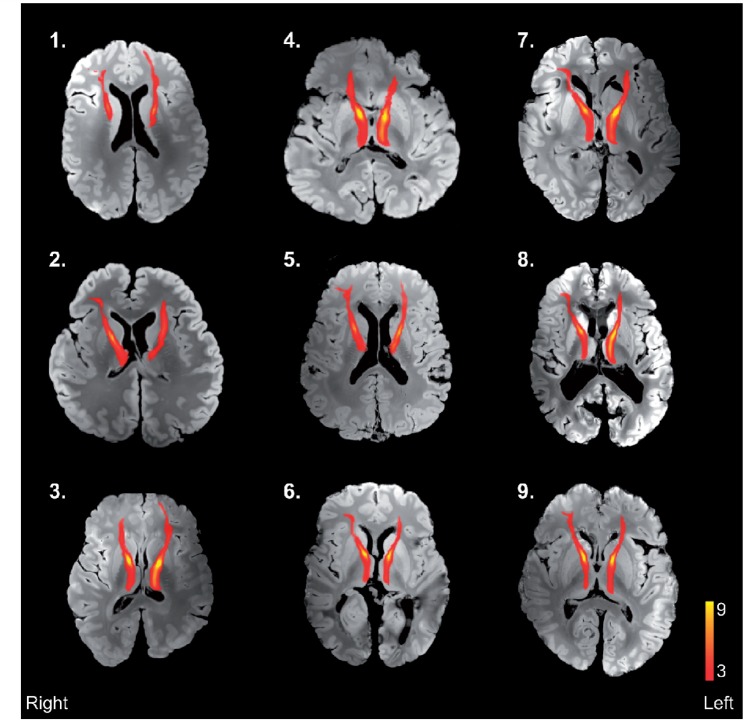
Multiple sclerosis is a chronic inflammatory neurological condition characterized by focal and diffuse neurodegeneration and demyelination throughout the central nervous system. Factors influencing the progression of pathology are poorly understood. One hypothesis is that anatomical connectivity influences the spread of neurodegeneration. This predicts that measures of neurodegeneration will correlate most strongly between interconnected structures. However, such patterns have been difficult to quantify through post-mortem neuropathology or in vivo scanning alone. In this study, we used the complementary approaches of whole brain post-mortem magnetic resonance imaging and quantitative histology to assess patterns of multiple sclerosis pathology. Two thalamo-cortical projection systems were considered based on their distinct neuroanatomy and their documented involvement in multiple sclerosis: lateral geniculate nucleus to primary visual cortex and mediodorsal nucleus of the thalamus to prefrontal cortex. Within the anatomically distinct thalamo-cortical projection systems, magnetic resonance imaging derived cortical thickness was correlated significantly with both a measure of myelination in the connected tract and a measure of connected thalamic nucleus cell density. Such correlations did not exist between these markers of neurodegeneration across different thalamo-cortical systems. Magnetic resonance imaging lesion analysis depicted clearly demarcated subcortical lesions impinging on the white matter tracts of interest; however, quantitation of the extent of lesion-tract overlap failed to demonstrate any appreciable association with the severity of markers of diffuse pathology within each thalamo-cortical projection system. Diffusion-weighted magnetic resonance imaging metrics in both white matter tracts were correlated significantly with a histologically derived measure of tract myelination. These data demonstrate for the first time the relevance of functional anatomical connectivity to the spread of multiple sclerosis pathology in a 'tract-specific' pattern. Furthermore, the persisting relationship between metrics from post-mortem diffusion-weighted magnetic resonance imaging and histological measures from fixed tissue further validates the potential of imaging for future neuropathological studies.
多发性硬化症是一种慢性炎症性神经系统疾病,其特征是中枢神经系统内的局灶性和弥漫性神经退行性变和脱髓鞘。影响病理学进展的因素尚未完全了解。一种假设是解剖连接性影响神经退行性变的扩散。这表明,神经退行性变的测量值将在相互连接的结构之间具有最强的相关性。然而,通过死后神经病理学或单独的活体扫描,很难对这种模式进行量化。在这项研究中,我们使用了全脑死后磁共振成像和定量组织学的互补方法来评估多发性硬化症病理学的模式。根据其独特的神经解剖结构及其在多发性硬化症中的记载,考虑了两个丘脑皮质投射系统:外侧膝状体到初级视觉皮层和丘脑内侧背核到前额叶皮层。在解剖上不同的丘脑皮质投射系统内,磁共振成像衍生的皮质厚度与连接束中的髓鞘化测量值和连接丘脑核细胞密度的测量值显著相关。在不同的丘脑皮质系统之间,这些神经退行性变标志物之间不存在这种相关性。磁共振成像病变分析清晰地描绘了影响感兴趣的白质束的皮质下病变;然而,病变-束重叠程度的定量分析未能证明与每个丘脑皮质投射系统内弥漫性病变标志物的严重程度有任何明显的关联。两条白质束中的弥散加权磁共振成像指标与组织学衍生的束髓鞘化测量值显著相关。这些数据首次证明了功能解剖连接性与多发性硬化症病理学在“束特异性”模式下的扩散相关性。此外,来自死后弥散加权磁共振成像的指标与固定组织的组织学测量之间的持续关系进一步验证了成像在未来神经病理学研究中的潜力。