STIVORO, Dutch Expert Centre on Tobacco Control, The Hague, The Netherlands.
BMC Public Health. 2012 Oct 15;12:876. doi: 10.1186/1471-2458-12-876.
Because of the magnitude of the global tobacco epidemic, the World Health Organisation developed the Framework Convention on Tobacco Control (FCTC), an international legally binding treaty to control tobacco use. Adoption and implementation of specific tobacco control measures within FCTC is an outcome of a political process, where social norms and public opinion play important roles. The objective of our study was to examine how a country's level of tobacco control is associated with smoking prevalence, two markers of denormalisation of smoking (social disapproval of smoking and concern about passive smoking), and societal support for tobacco control.
An ecological study was conducted, using data from two sources. The first source was the Tobacco Control Scale (TCS) from 2011, which quantifies the implementation of tobacco control policies in European Union (EU) countries. Data on smoking prevalence, societal disapproval of smoking, concern about passive smoking, and societal support for policy measures were taken from the Eurobarometer survey of 2009. Data from Eurobarometer surveys were aggregated to country level. Data from the 27 European Union member states were used.
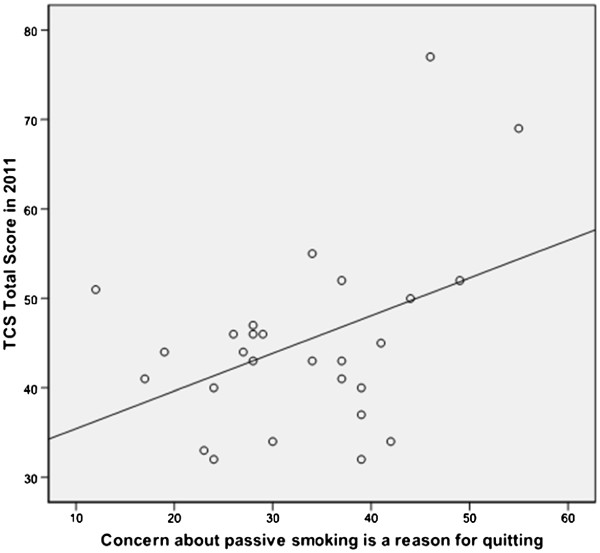
Smoking prevalence rates in 2009 were negatively associated with a country's TCS 2011 score, although not statistically significant (r = -.25; p = .21). Experience of societal disapproval was positively associated with higher TCS scores, though not significantly (r = .14; p = .48). The same was true for societal support for tobacco control (r = .27; p = .18). The TCS score in 2011 was significantly correlated with concern about passive smoking (r = .42; p =.03). Support for tobacco control measures was also strongly correlated with concern about passive smoking (r = .52, p = .006).
Smokers in countries with a higher TCS score were more concerned about whether their smoke harms others. Further, support for tobacco control measures is higher in countries that have more of these concerned smokers. Concerns about passive smoking seem central in the implementation of tobacco control measures, stressing the importance of continuing to educate the public about the harm from passive smoking.
由于全球烟草流行的规模巨大,世界卫生组织制定了《烟草控制框架公约》(FCTC),这是一项控制烟草使用的具有国际法律约束力的条约。FCTC 内特定的烟草控制措施的通过和实施是一个政治进程的结果,其中社会规范和公众意见发挥着重要作用。我们研究的目的是检验一个国家的烟草控制水平与吸烟流行率、吸烟去正常化的两个标志(对吸烟的社会反对和对被动吸烟的关注)以及对烟草控制的社会支持之间的关系。
本研究采用生态学研究方法,使用了两个来源的数据。第一个来源是 2011 年的烟草控制量表(TCS),它量化了欧盟国家实施烟草控制政策的情况。2009 年的 Eurobarometer 调查提供了吸烟流行率、对吸烟的社会反对、对被动吸烟的关注以及对政策措施的社会支持的数据。Eurobarometer 调查的数据被汇总到国家层面。研究使用了来自 27 个欧盟成员国的数据。
2009 年的吸烟流行率与一个国家的 2011 年 TCS 评分呈负相关,但无统计学意义(r = -.25;p =.21)。对社会反对的体验与更高的 TCS 评分呈正相关,但无统计学意义(r =.14;p =.48)。对烟草控制的社会支持也是如此(r =.27;p =.18)。2011 年的 TCS 评分与对被动吸烟的关注显著相关(r =.42;p =.03)。对烟草控制措施的支持也与对被动吸烟的关注密切相关(r =.52,p =.006)。
在 TCS 评分较高的国家,吸烟者更担心他们的烟雾是否会伤害他人。此外,在有更多这类关注吸烟者的国家,对烟草控制措施的支持也更高。对被动吸烟的关注似乎在烟草控制措施的实施中起着核心作用,这强调了继续向公众宣传被动吸烟危害的重要性。