Laboratory for Biomechanics and Experimental Orthopaedics, Orthopaedic and Trauma Surgery Centre, University Medical Centre Mannheim (OUZ), Heidelberg University, Mannheim, Germany.
PLoS One. 2012;7(10):e46978. doi: 10.1371/journal.pone.0046978. Epub 2012 Oct 12.
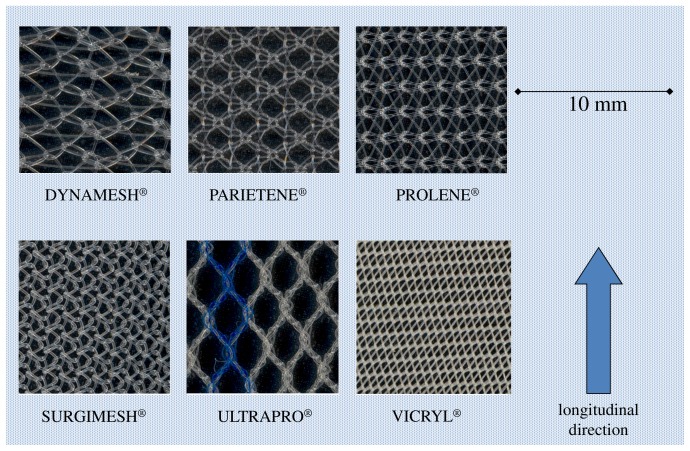
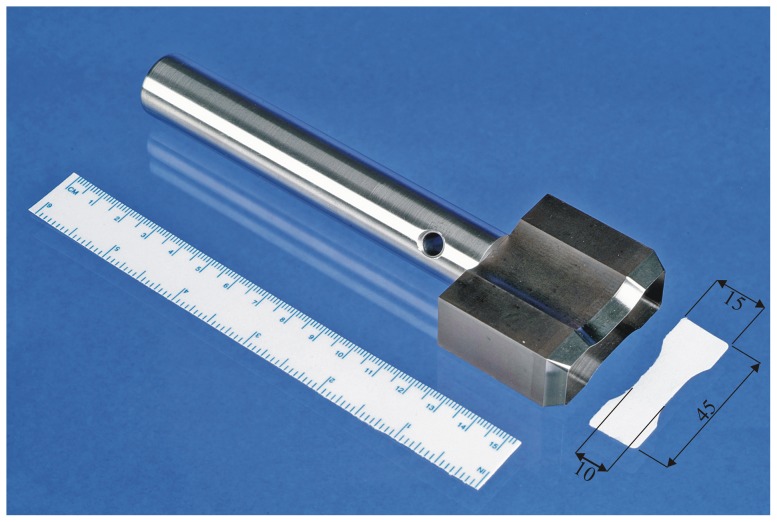
Hernia repair is the most common surgical procedure in the world. Augmentation with synthetic meshes has gained importance in recent decades. Most of the published work about hernia meshes focuses on the surgical technique, outcome in terms of mortality and morbidity and the recurrence rate. Appropriate biomechanical and engineering terminology is frequently absent. Meshes are under continuous development but there is little knowledge in the public domain about their mechanical properties. In the presented experimental study we investigated the mechanical properties of several widely available meshes according to German Industrial Standards (DIN ISO).
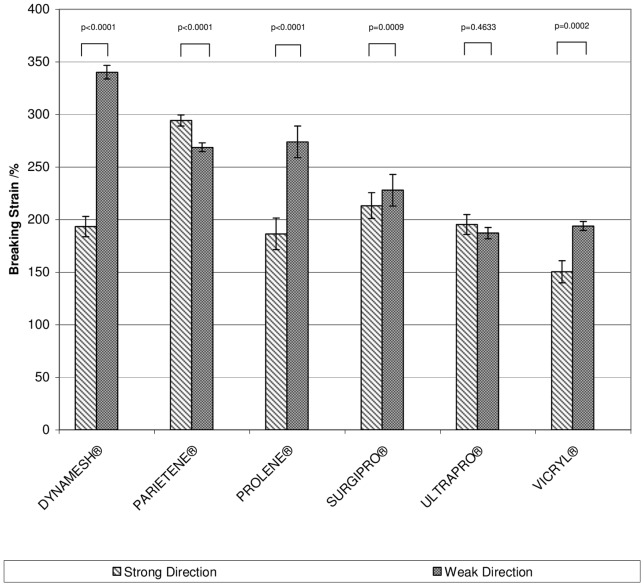
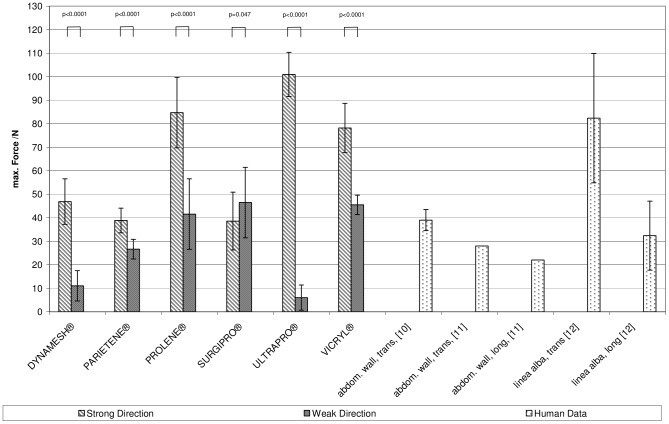
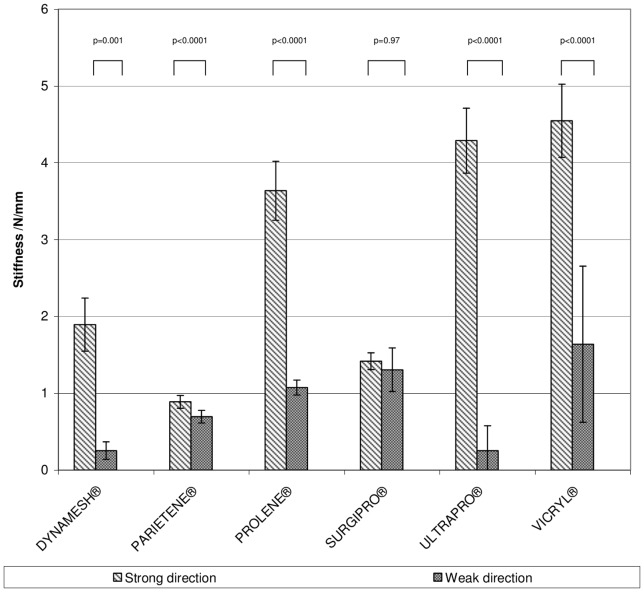
METHODOLOGY/PRINCIPAL FINDINGS: Six different meshes were assessed considering longitudinal and transverse direction in a uni-axial tensile test. Based on the force/displacement curve, the maximum force, breaking strain, and stiffness were computed. According to the maximum force the values were assigned to the groups weak and strong to determine a base for comparison. We discovered differences in the maximum force (11.1±6.4 to 100.9±9.4 N/cm), stiffness (0.3±0.1 to 4.6±0.5 N/mm), and breaking strain (150±6% to 340±20%) considering the direction of tension.
CONCLUSIONS/SIGNIFICANCE: The measured stiffness and breaking strength vary widely among available mesh materials for hernia repair, and most of the materials show significant anisotropy in their mechanical behavior. Considering the forces present in the abdominal wall, our results suggest that some meshes should be implanted in an appropriate orientation, and that information regarding the directionality of their mechanical properties should be provided by the manufacturers.
疝修补术是世界上最常见的手术。在最近几十年中,合成补片的增强作用变得越来越重要。大多数关于疝补片的已发表工作都集中在手术技术、死亡率和发病率以及复发率方面。适当的生物力学和工程术语经常缺失。补片在不断发展,但关于其机械性能的知识在公众中很少。在本实验研究中,我们根据德国工业标准(DIN ISO)研究了几种广泛使用的补片的机械性能。
方法/主要发现:在单轴拉伸试验中,评估了六个不同的补片在纵向和横向方向上的性能。根据力/位移曲线,计算了最大力、断裂应变和刚度。根据最大力,将值分配到弱组和强组,以确定比较的基础。我们发现,在张力方向上,最大力(11.1±6.4 至 100.9±9.4 N/cm)、刚度(0.3±0.1 至 4.6±0.5 N/mm)和断裂应变(150±6%至 340±20%)存在差异。
结论/意义:用于疝修补的现有补片材料的测量刚度和断裂强度差异很大,大多数材料在机械性能方面表现出明显的各向异性。考虑到腹壁上的力,我们的结果表明,一些补片应该以适当的方向植入,并且制造商应该提供有关其机械性能方向性的信息。