Key Laboratory of Public Health Safety of Ministry of Education, School of Public Health, Fudan University, Shanghai, 200032, China.
Environ Health. 2012 Oct 19;11:79. doi: 10.1186/1476-069X-11-79.
There is increasing evidence suggesting that Bisphenol A (BPA), one of the highest volume chemicals produced worldwide, can interfere with the body's natural weight control mechanisms to promote obesity. However, epidemiological studies for this are limited, especially for children.
A cross-sectional study was conducted to investigate the association between BPA exposure and body mass index (BMI) in school children. Three primary and three middle schools were randomly selected from 26 primary and 30 middle candidate schools in Changning District of Shanghai City in China. According to the BMI-based criteria by age and sex for screening of overweight or obese children, we randomly chose 20 obese, 10 overweight, and 30 normal weight children aged 8-15 years of age from each selected school. First morning urine was collected and total urine BPA concentrations were determined by ultra-performance liquid chromatography tandem mass spectrometry. Multiple linear regression analysis was conducted to examine the association of urine BPA concentrations and daily intake estimates with BMI.
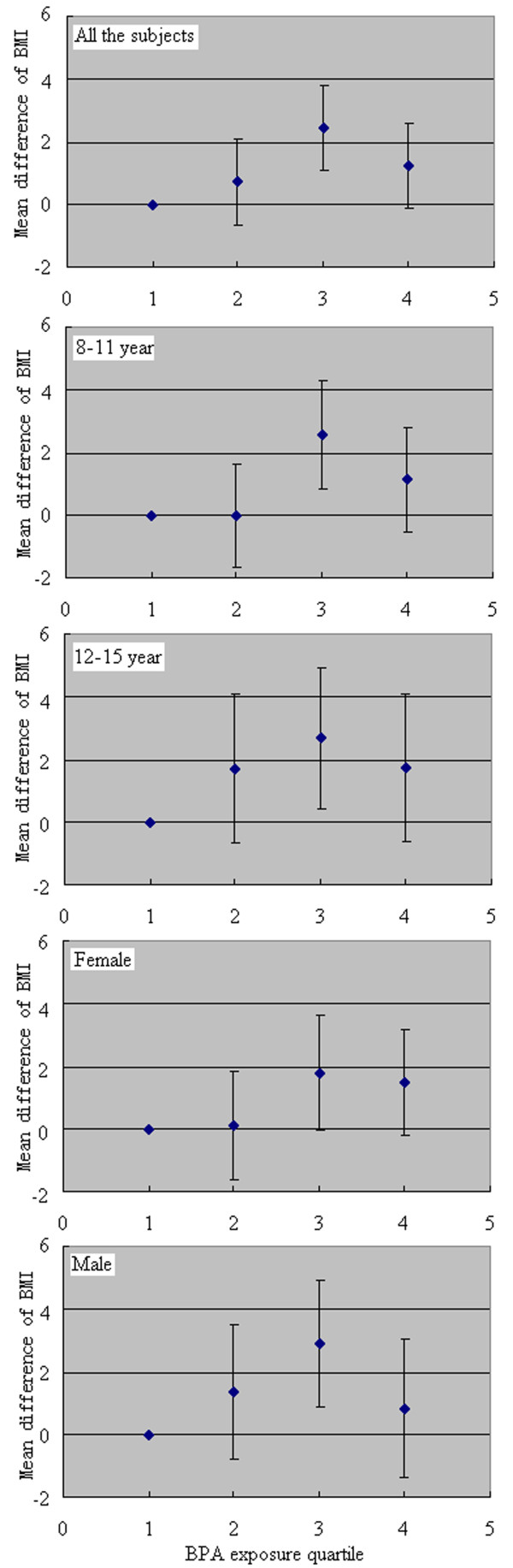
BPA was detected in 84.9% of urine samples with a geometric mean of 0.45 ng/mL. The daily intake estimates ranged from 0.03 μg/day to 1.96 μg/day with a geometric mean of 0.37 μg/day. The average urine BPA concentrations and daily intake estimates were similar for boys and girls, but significantly higher in older children than younger ones, and showed an increasing trend with BMI. Multiple linear regression analyses showed that urine BPA concentrations were significantly associated with increasing BMI values in all subjects after adjustment for age and sex and the results were similar before and after corrected by urine specific gravity. When stratified by age or sex, the associations remained significant in females and in those 8-11 years of age before corrected by specific gravity. Similar results were shown for the association between BMI and daily intake estimates.
There is a possibility that BPA exposure increases BMI in school children. Given the cross-sectional nature of this study, longitudinal studies are warranted to confirm BPA exposure as a contributor to increased BMI in children.
有越来越多的证据表明,双酚 A(BPA)是世界上产量最高的化学物质之一,它可以干扰人体的自然体重控制机制,导致肥胖。然而,针对这方面的流行病学研究有限,尤其是针对儿童的研究。
本研究采用横断面研究调查了上海市长宁区 26 所小学和 30 所中学中选定的 3 所小学和 3 所中学的儿童中 BPA 暴露与体重指数(BMI)之间的关系。根据超重或肥胖儿童的年龄和性别 BMI 筛查标准,我们从每所选定的学校中随机选择了 20 名肥胖儿童、10 名超重儿童和 30 名正常体重儿童,共 60 名 8-15 岁的儿童。采集儿童的晨尿,采用超高效液相色谱串联质谱法测定尿液中总 BPA 浓度。采用多元线性回归分析方法,检验尿 BPA 浓度与日摄入量估计值与 BMI 的相关性。
尿液样本中 BPA 的检出率为 84.9%,几何均数为 0.45ng/ml。日摄入量估计值范围为 0.03μg/天至 1.96μg/天,几何均数为 0.37μg/天。男孩和女孩的平均尿 BPA 浓度和日摄入量估计值相似,但年龄较大的儿童高于年龄较小的儿童,且随着 BMI 的增加而呈上升趋势。多元线性回归分析显示,在校正年龄和性别后,所有受试者的尿 BPA 浓度与 BMI 值的增加呈显著正相关,且经尿比重校正前后的结果相似。在校正比重之前,按年龄或性别分层,该相关性在女性和 8-11 岁的儿童中仍具有统计学意义。BMI 与日摄入量估计值之间的相关性也存在类似的结果。
BPA 暴露有可能导致在校儿童 BMI 增加。鉴于本研究的横断面性质,需要进行纵向研究来证实 BPA 暴露是导致儿童 BMI 增加的一个因素。