Department of Surgery, Kyungpook National University Hospital, Daegu, Korea.
J Gastric Cancer. 2012 Sep;12(3):194-200. doi: 10.5230/jgc.2012.12.3.194. Epub 2012 Sep 30.
The aim of this study was to evaluate chronological change of quality of life after surgery in patients with gastric cancer during one year postoperatively.
Quality of life data were obtained from 272 gastric cancer patients who underwent curative gastrectomy between September 2008 and February 2011 at the Kyungpook National University Hospital. The Korean versions of the European Organization for Research and Treatment of Cancer (EORTC) Quality of Life Questionnaire Core (QLQ) 30 with gastric cancer-specific module, the EORTC QLQ-STO22 were used to assess quality of life. All patients had no evidence of recurrence or metastasis during the first postoperative year. Patients were asked to complete the questionnaire, by themselves preoperatively, 3-, 6-, 9-, and 12-months postoperatively.
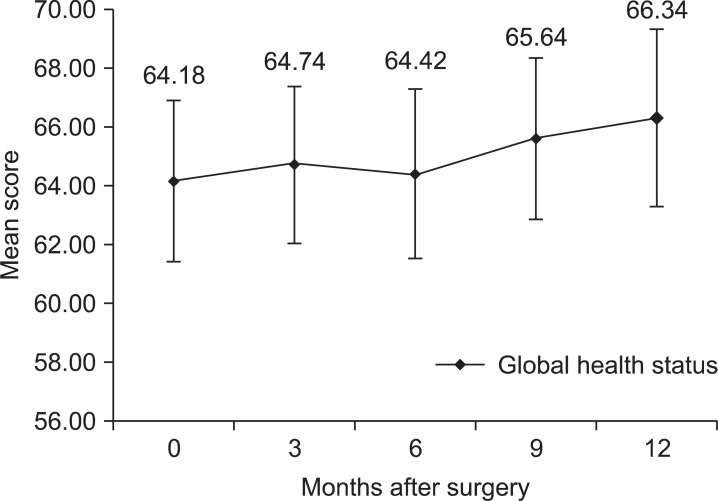
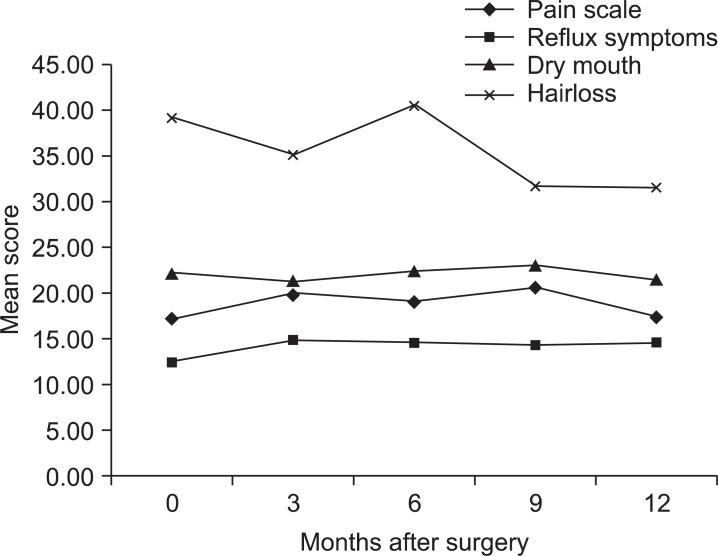
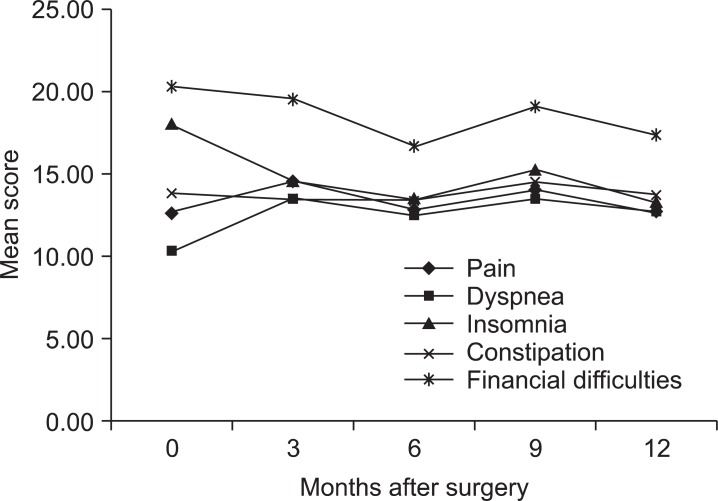
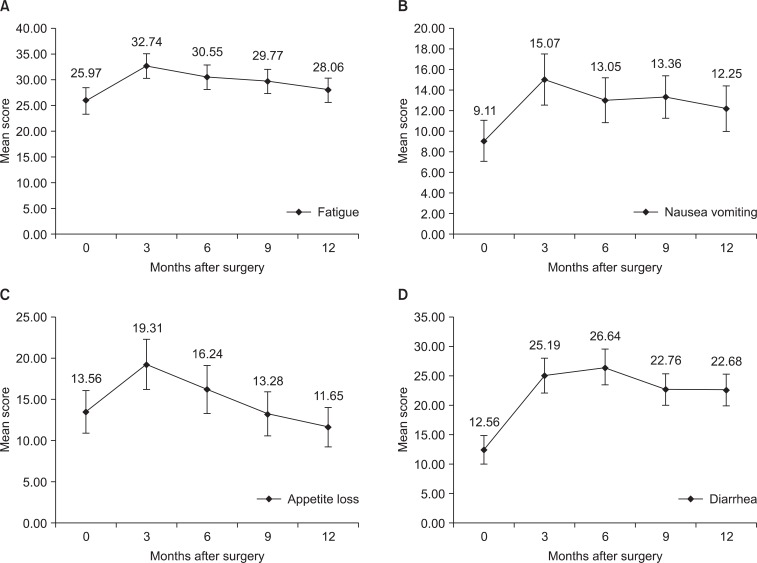
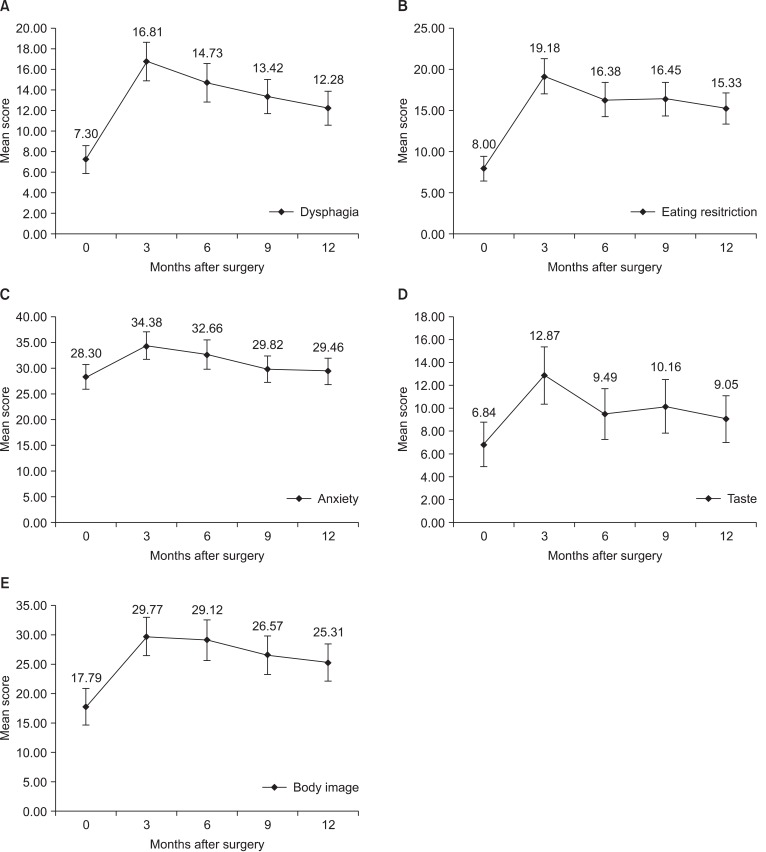
Physical functioning score and role functioning score significantly decreased at first 3 months after surgery and the significant differences were noticed until 12 months after surgery. Emotional functioning score started with the lowest score before surgery and significant improvement was shown 6 months after surgery. Most symptom scores and STO-22 scores were highest at 3 months after surgery and gradually decreased, thereafter. Eating restriction, anxiety, taste, body image scores was highest at 3 months after surgery without significant decrease afterwards.
Most scales worsened after surgery and gradually recovered afterwards with some differences in rate of recovery. However the scales did not fully recover by 1 year period. Further follow-up after 1 year would be helpful in determining which scales are permanently damaged and which are just taking longer time to recover.
本研究旨在评估胃癌患者术后一年内生活质量随时间的变化。
我们收集了 272 例 2008 年 9 月至 2011 年 2 月在庆北国立大学医院接受根治性胃切除术的胃癌患者的生活质量数据。采用欧洲癌症研究与治疗组织(EORTC)生活质量问卷核心模块(QLQ-C30)和胃癌特异性模块(QLQ-STO22)的韩国版评估生活质量。所有患者在术后 1 年内均无复发或转移证据。患者被要求在术前、术后 3、6、9 和 12 个月自行完成问卷。
术后 3 个月内,身体功能和角色功能评分显著下降,术后 12 个月内仍存在显著差异。情绪功能评分在术前最低,术后 6 个月后显著改善。大多数症状评分和 STO-22 评分在术后 3 个月最高,此后逐渐下降。术后 3 个月时,进食受限、焦虑、味觉、体像评分最高,此后无明显下降。
大多数术后生活质量量表评分恶化,随后逐渐恢复,但恢复速度存在差异。然而,1 年内并未完全恢复。术后 1 年以上的进一步随访有助于确定哪些量表永久性受损,哪些量表只是需要更长时间恢复。