Flink Maria, Hesselink Gijs, Pijnenborg Loes, Wollersheim Hub, Vernooij-Dassen Myrra, Dudzik-Urbaniak Ewa, Orrego Carola, Toccafondi Giulio, Schoonhoven Lisette, Gademan Petra J, Johnson Julie K, Öhlén Gunnar, Hansagi Helen, Olsson Mariann, Barach Paul
Department of Neurobiology, Care Sciences and Society, Karolinska Institutet, B44, Karolinska Sjukhuset Huddinge, Stockholm 14186, Sweden.
BMJ Qual Saf. 2012 Dec;21 Suppl 1(Suppl_1):i89-96. doi: 10.1136/bmjqs-2012-001171. Epub 2012 Oct 30.
Patient safety experts have postulated that increasing patient participation in communications during patient handovers will improve the quality of patient transitions, and that this may reduce hospital readmissions. Choosing strategies that enhance patient safety through improved handovers requires better understanding of patient experiences and preferences for participation.
The aim of this paper is to explore the patients' experiences and perspectives related to the handovers between their primary care providers and the inpatient hospital.
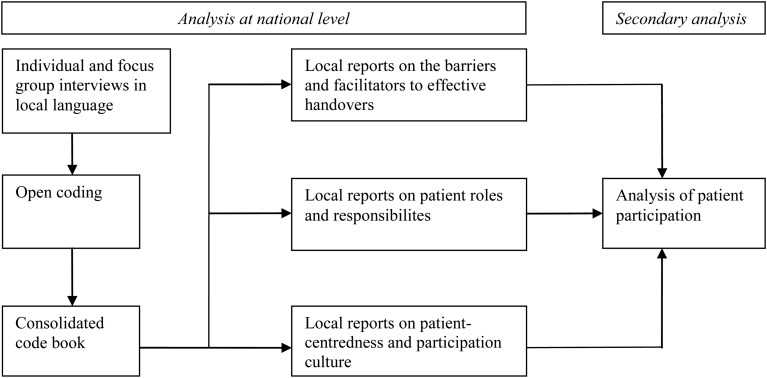
A qualitative secondary analysis was performed, based on individual and focus group patient interviews with 90 patients in five European countries.
The analysis revealed three themes: patient positioning in the handover process; prerequisites for patient participation and patient preferences for the handover process. Patients' participation ranged from being the key actor, to sharing the responsibility with healthcare professional(s), to being passive participants. For active participation patients required both personal and social resources as well as prerequisites such as information and respect. Some patients preferred to be the key actor in charge; others preferred their healthcare professionals to be the key actors in the handover.
Patients' participation is related to the healthcare system, the activity of healthcare professionals' and patients' capacity for participation. Patients prefer a handover process where the responsibility is clear and unambiguous. Healthcare organisations need a clear and well-considered system of responsibility for handover processes, that takes into account the individual patient's need of clarity, and support in relation to his/hers own recourses.
患者安全专家推测,在患者交接过程中增加患者参与沟通将提高患者转诊的质量,并且这可能会减少医院再入院率。选择通过改善交接来提高患者安全的策略需要更好地了解患者的经历以及参与交接的偏好。
本文旨在探讨患者在其初级保健提供者与住院医院之间交接过程中的经历和观点。
基于对五个欧洲国家90名患者进行的个人访谈和焦点小组访谈,进行了定性二次分析。
分析揭示了三个主题:患者在交接过程中的定位;患者参与的先决条件以及患者对交接过程的偏好。患者的参与程度从成为关键角色,到与医护人员分担责任,再到成为被动参与者不等。对于积极参与,患者既需要个人和社会资源,也需要诸如信息和尊重等先决条件。一些患者更喜欢成为负责的关键角色;另一些患者则希望他们的医护人员成为交接中的关键角色。
患者的参与与医疗保健系统、医护人员的活动以及患者的参与能力有关。患者更喜欢责任明确无误的交接过程。医疗保健机构需要一个清晰且经过深思熟虑的交接过程责任体系,该体系要考虑到个体患者对清晰性的需求以及对其自身资源的支持。