National Creative Research Initiative Center for Memory, Department of Biological Sciences, College of Natural Sciences, Seoul National University, Seoul 151-747, Korea.
Korean J Physiol Pharmacol. 2012 Oct;16(5):293-6. doi: 10.4196/kjpp.2012.16.5.293. Epub 2012 Oct 18.
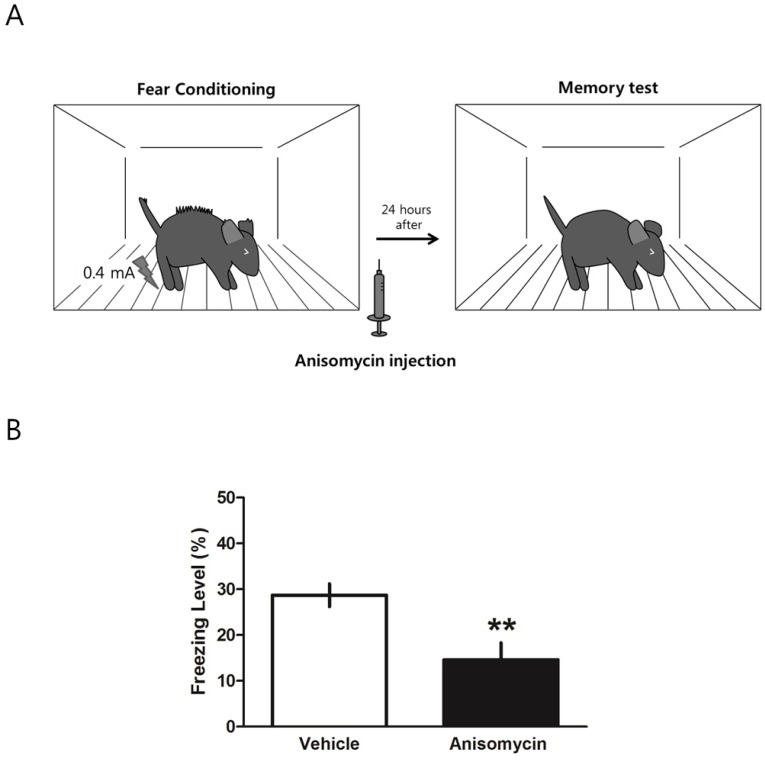
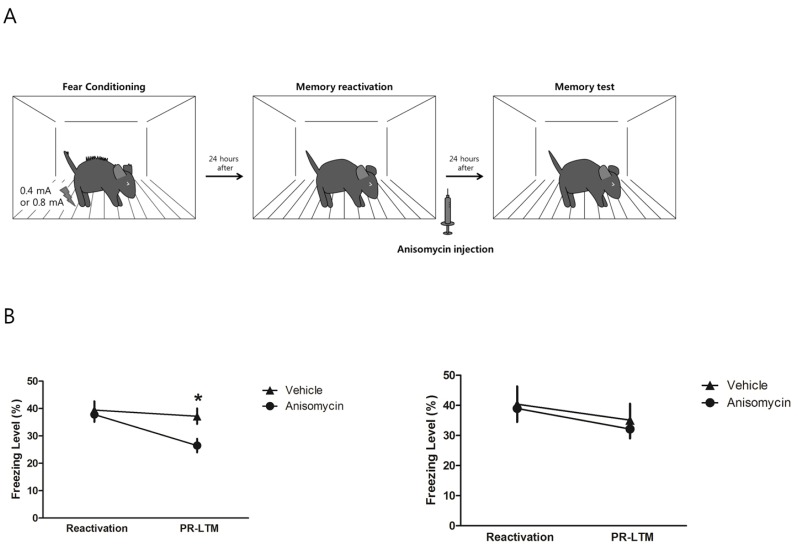
Memory reconsolidation is ubiquitous across species and various memory tasks. It is a dynamic process in which memory is modified and/or updated. In experimental conditions, memory reconsolidation is usually characterized by the fact that the consolidated memory is disrupted by a combination of memory reactivation and inhibition of protein synthesis. However, under some experimental conditions, the reactivated memory is not disrupted by inhibition of protein synthesis. This so called "boundary condition" of reconsolidation may be related to memory strength. In Pavlovian fear conditioning, the intensity of unconditional stimulus (US) determines the strength of the fear memory. In this study, we examined the effect of the intensity of US on the reconsolidation of contextual fear memory. Strong contextual fear memory, which is conditioned with strong US, is not disrupted by inhibition of protein synthesis after its reactivation; however, a weak fear memory is often disrupted. This suggests that a US of strong intensity can inhibit reconsolidation of contextual fear memory.
记忆再巩固在不同物种和各种记忆任务中普遍存在。它是一个动态的过程,在此过程中记忆被修改和/或更新。在实验条件下,记忆再巩固通常的特点是,通过记忆再激活和蛋白质合成抑制的组合,破坏已巩固的记忆。然而,在某些实验条件下,再激活的记忆不会被蛋白质合成抑制所破坏。这种再巩固的所谓“边界条件”可能与记忆强度有关。在条件性恐惧反应中,无条件刺激(US)的强度决定了恐惧记忆的强度。在这项研究中,我们研究了 US 强度对情境恐惧记忆再巩固的影响。用强 US 条件化的强烈情境恐惧记忆在再激活后不会被蛋白质合成抑制所破坏;然而,弱恐惧记忆往往会被破坏。这表明,高强度的 US 可以抑制情境恐惧记忆的再巩固。