Department of Psychology, University of Massachusetts, Amherst, Amherst, Massachusetts, United States of America.
PLoS One. 2012;7(11):e49353. doi: 10.1371/journal.pone.0049353. Epub 2012 Nov 7.
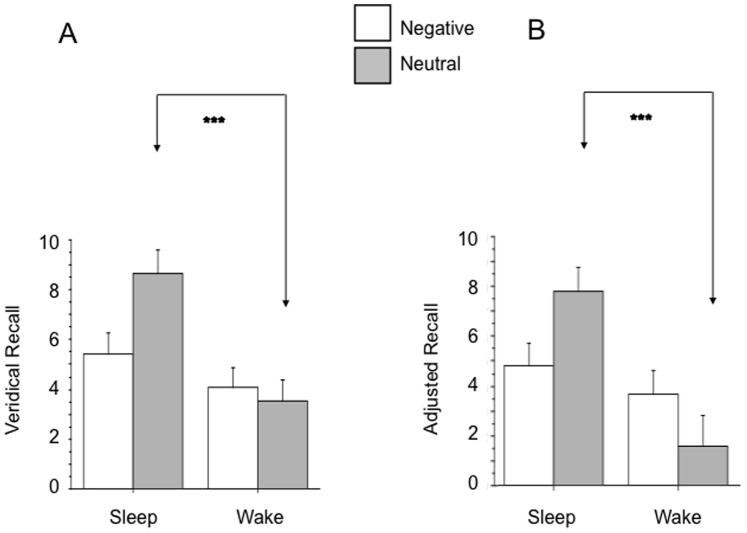
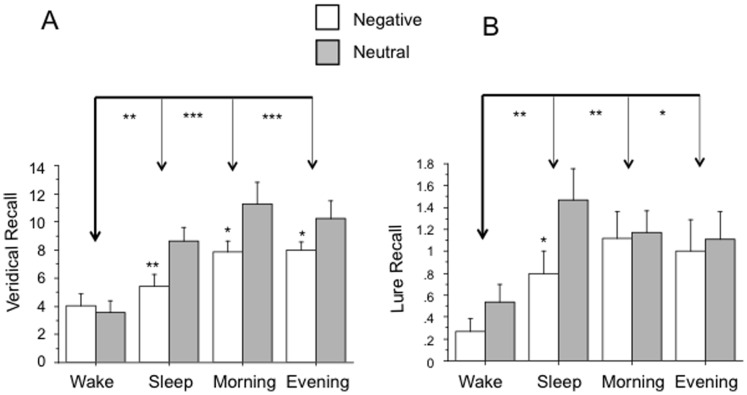
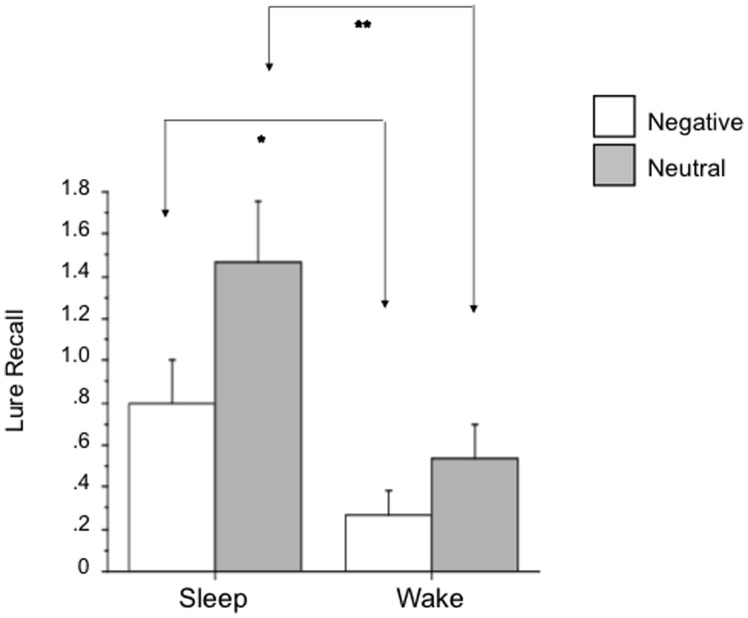
Sleep benefits veridical memories, resulting in superior recall relative to off-line intervals spent awake. Sleep also increases false memory recall in the Deese-Roediger-McDermott (DRM) paradigm. Given the suggestion that emotional veridical memories are prioritized for consolidation over sleep, here we examined whether emotion modulates sleep's effect on false memory formation. Participants listened to semantically related word lists lacking a critical lure representing each list's "gist." Free recall was tested after 12 hours containing sleep or wake. The Sleep group recalled more studied words than the Wake group but only for emotionally neutral lists. False memories of both negative and neutral critical lures were greater following sleep relative to wake. Morning and Evening control groups (20-minute delay) did not differ ruling out circadian accounts for these differences. These results support the adaptive function of sleep in both promoting the consolidation of veridical declarative memories and in extracting unifying aspects from memory details.
睡眠有益于真实记忆,从而使回忆相对于离线时的清醒状态更为优越。睡眠还会增加德西-罗德里格-麦克德莫特(DRM)范式中的错误记忆召回率。鉴于情绪真实记忆在巩固过程中优先于睡眠的观点,我们在此研究了情绪是否调节睡眠对错误记忆形成的影响。参与者听了语义相关的单词列表,但没有代表每个列表“主旨”的关键诱饵。12 小时后,在包含睡眠或清醒的时间段进行自由回忆测试。睡眠组比清醒组回忆起更多的学习过的单词,但仅对情绪中性的列表如此。与清醒相比,睡眠后对负面和中性关键诱饵的错误记忆更多。早晨和晚上的对照组(20 分钟延迟)没有差异,排除了这些差异的昼夜节律解释。这些结果支持了睡眠的适应性功能,它既能促进真实陈述性记忆的巩固,又能从记忆细节中提取统一的方面。