Graduate Institute of Microbiology and Public Health, College of Veterinary Medicine, National Chung Hsing University, Taichung, Taiwan.
Department of Veterinary Medicine, College of Veterinary Medicine, National Chung Hsing University, Taichung, Taiwan.
PLoS Negl Trop Dis. 2021 Dec 3;15(12):e0009977. doi: 10.1371/journal.pntd.0009977. eCollection 2021 Dec.
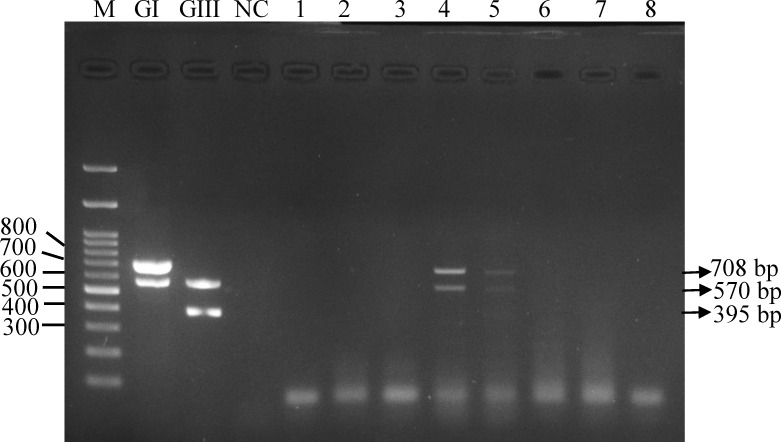
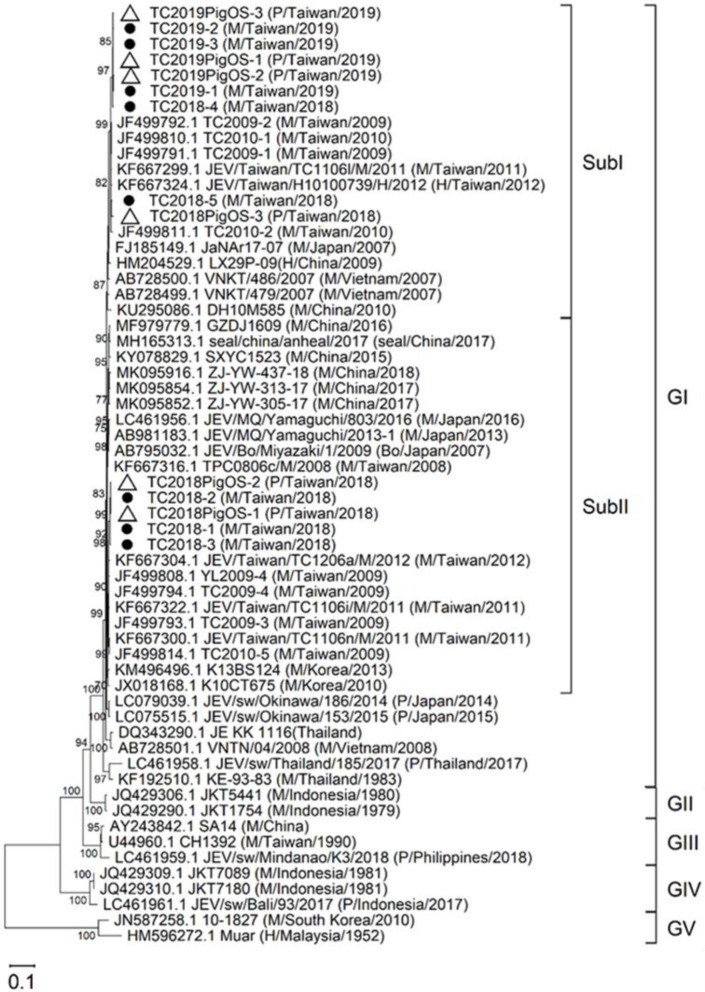
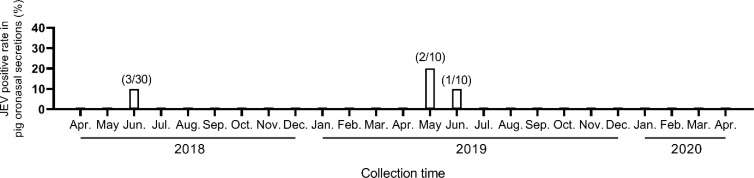
Virologic surveillance of Japanese encephalitis virus (JEV) relies on collecting pig blood specimens and adult mosquitoes in the past. Viral RNAs extracted from pig blood specimens suffer from low detecting positivity by reverse transcription PCR (RT-PCR). The oronasal transmission of the virus has been demonstrated in experimentally infected pigs. This observation suggested oronasal specimens could be useful source in the virus surveillance. However, the role of this unusual route of transmission remains unproven in the operational pig farm. In this study, we explore the feasibility of using pig oronasal secretions collected by chewing ropes to improve the positivity of detection in commercial pig farms. The multiplex genotype-specific RT-PCR was used in this study to determine and compare the positivity of detecting JEV viral RNAs in pig's oronasal secretions and blood specimens, and the primary mosquito vector. Oronasal specimens had the overall positive rate of 6.0% (95% CI 1.3%-16.6%) (3/50) to 10.0% (95% CI 2.1%-26.5%) (3/30) for JEV during transmission period despite the negative results of all blood-derived specimens (n = 2442). Interestingly, pig oronasal secretions and female Culex tritaeniorhynchus mosquito samples collected from the same pig farm showed similar viral RNA positive rates, 10.0% (95% CI 2.1%-26.5%) (3/30) and 8.9% (95% CI 2.5%-21.2%) (4/45), respectively (p> 0.05). Pig oronasal secretion-based surveillance revealed the seasonality of viral activity and identified closely related genotype I virus derived from the mosquito isolates. This finding indicates oronasal secretion-based RT-PCR assay can be a non-invasive, alternative method of implementing JEV surveillance in the epidemic area prior to the circulation of virus-positive mosquitoes.
日本脑炎病毒(JEV)的病毒学监测过去依赖于采集猪的血液样本和成年蚊子。从猪的血液样本中提取的病毒 RNA 通过逆转录 PCR(RT-PCR)检测的阳性率较低。在实验感染的猪中已经证明了病毒的经口-鼻传播。这一观察结果表明,经口-鼻样本可能是病毒监测的有用来源。然而,在经营性养猪场中,这种不寻常的传播途径的作用尚未得到证实。在本研究中,我们探讨了使用咀嚼绳采集的猪经口-鼻分泌物来提高商业养猪场检测阳性率的可行性。本研究采用多重基因型特异性 RT-PCR 来确定和比较 JEV 病毒 RNA 在猪经口-鼻分泌物和血液样本以及主要媒介蚊子中的检测阳性率。在传播期,猪经口-鼻样本的总体阳性率为 6.0%(95%CI 1.3%-16.6%)(3/50)至 10.0%(95%CI 2.1%-26.5%)(3/30),尽管所有血液衍生样本(n=2442)均为阴性。有趣的是,从同一养猪场采集的猪经口-鼻分泌物和雌性三带喙库蚊样本的病毒 RNA 阳性率相似,分别为 10.0%(95%CI 2.1%-26.5%)(3/30)和 8.9%(95%CI 2.5%-21.2%)(4/45)(p>0.05)。基于猪经口-鼻分泌物的监测揭示了病毒活动的季节性,并鉴定了源自蚊子分离株的密切相关的基因型 I 病毒。这一发现表明,基于经口-鼻分泌物的 RT-PCR 检测可以作为一种非侵入性的替代方法,在病毒阳性蚊子传播之前,在疫区实施 JEV 监测。