Department of Health Statistics and Information Systems, World Health Organization, Geneva, Switzerland.
Popul Health Metr. 2012 Nov 20;10(1):22. doi: 10.1186/1478-7954-10-22.
Overweight and obesity prevalence are commonly used for public and policy communication of the extent of the obesity epidemic, yet comparable estimates of trends in overweight and obesity prevalence by country are not available.
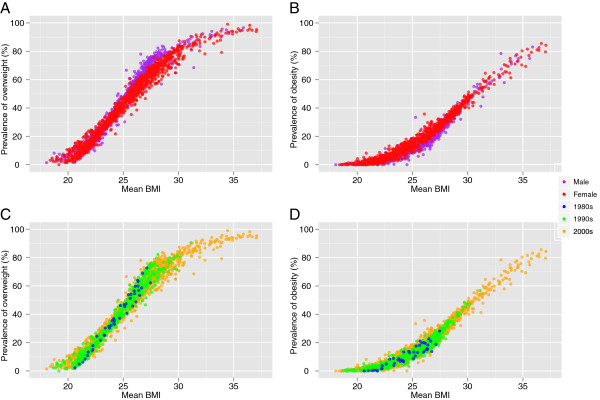
We estimated trends between 1980 and 2008 in overweight and obesity prevalence and their uncertainty for adults 20 years of age and older in 199 countries and territories. Data were from a previous study, which used a Bayesian hierarchical model to estimate mean body mass index (BMI) based on published and unpublished health examination surveys and epidemiologic studies. Here, we used the estimated mean BMIs in a regression model to predict overweight and obesity prevalence by age, country, year, and sex. The uncertainty of the estimates included both those of the Bayesian hierarchical model and the uncertainty due to cross-walking from mean BMI to overweight and obesity prevalence.
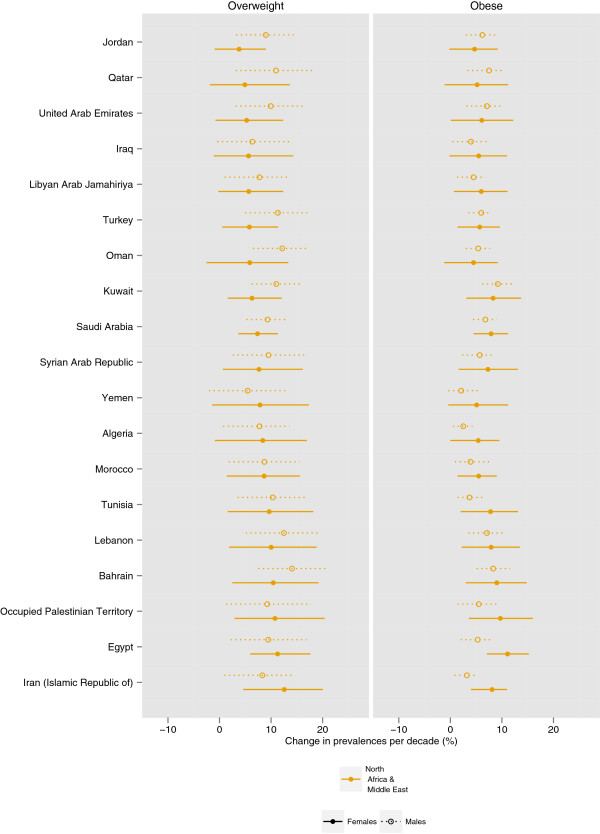
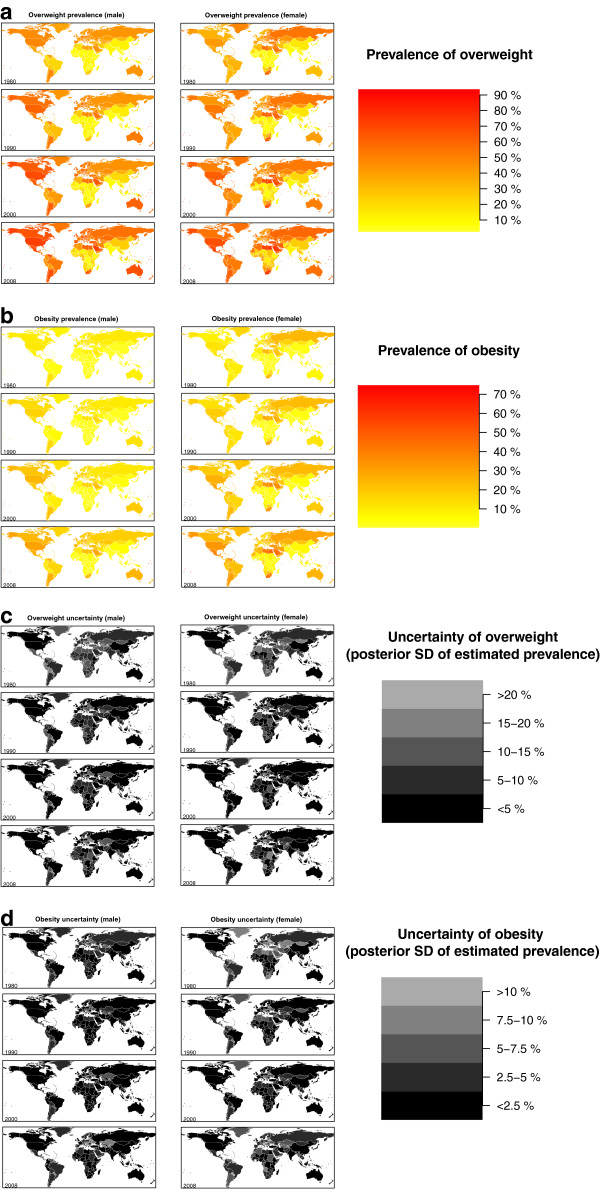
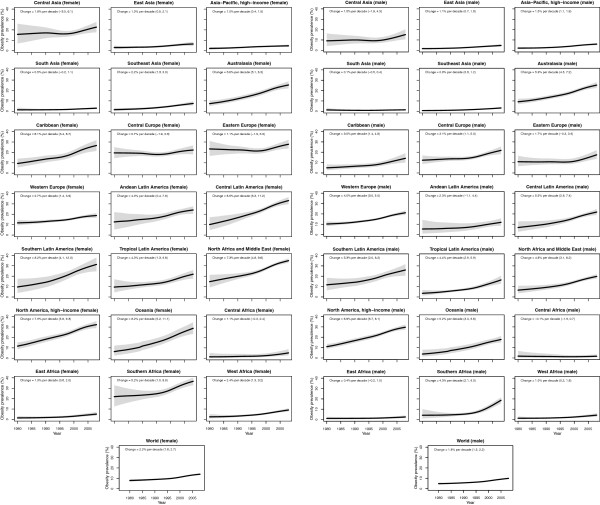
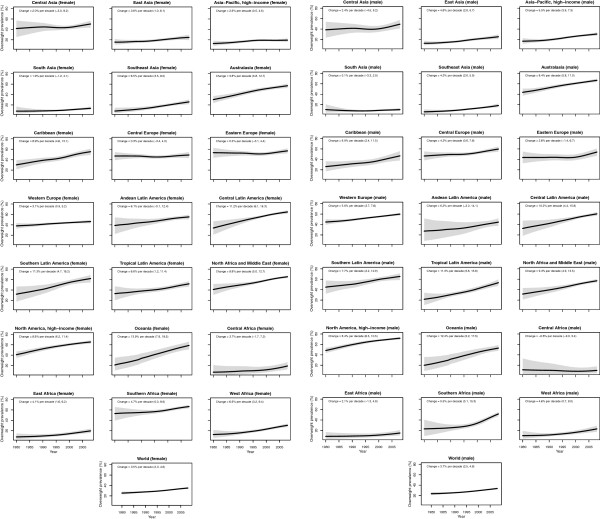
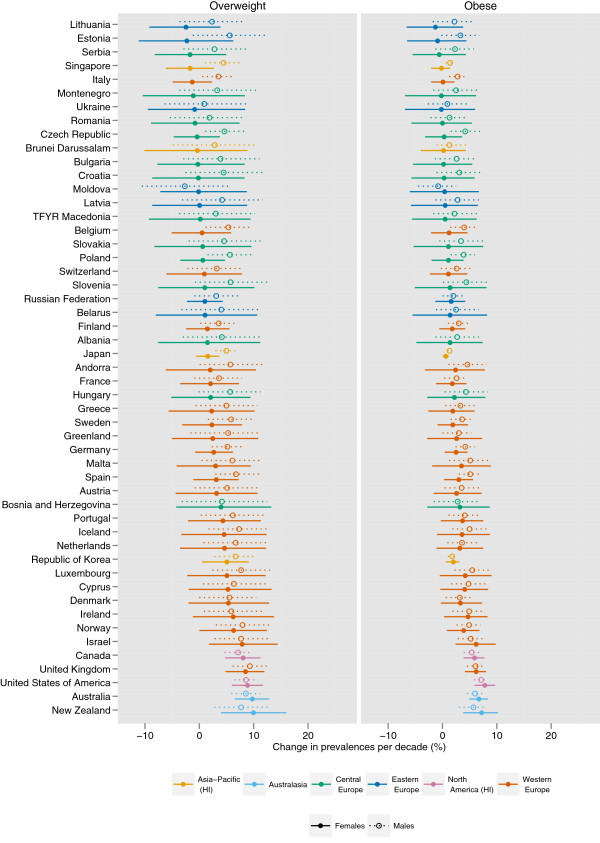
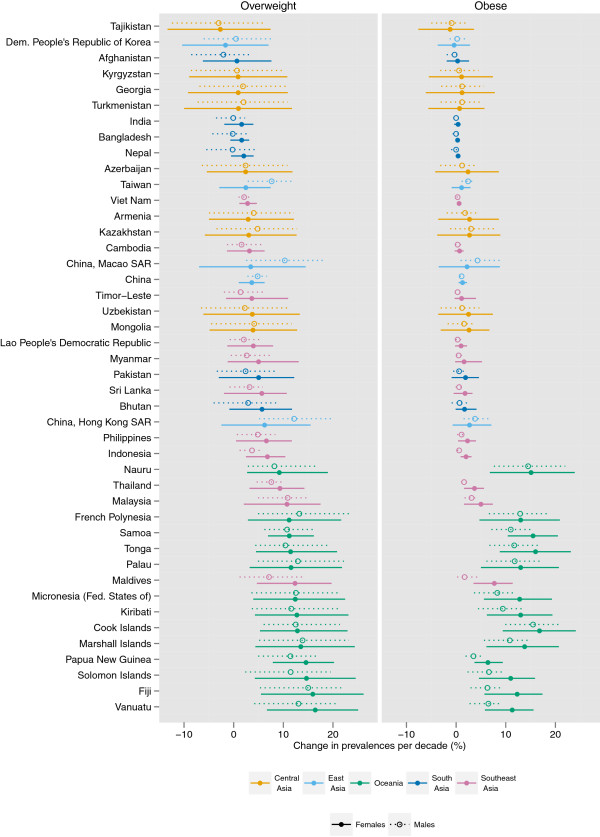
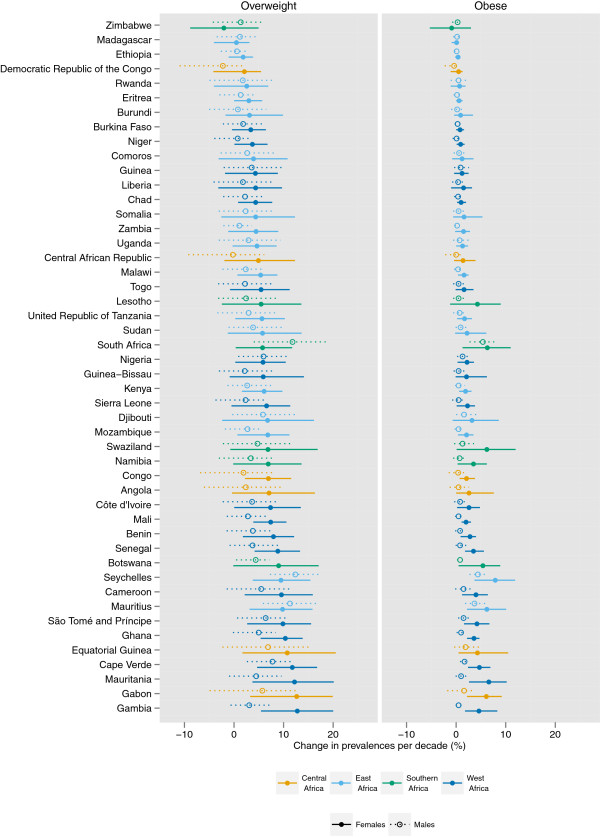
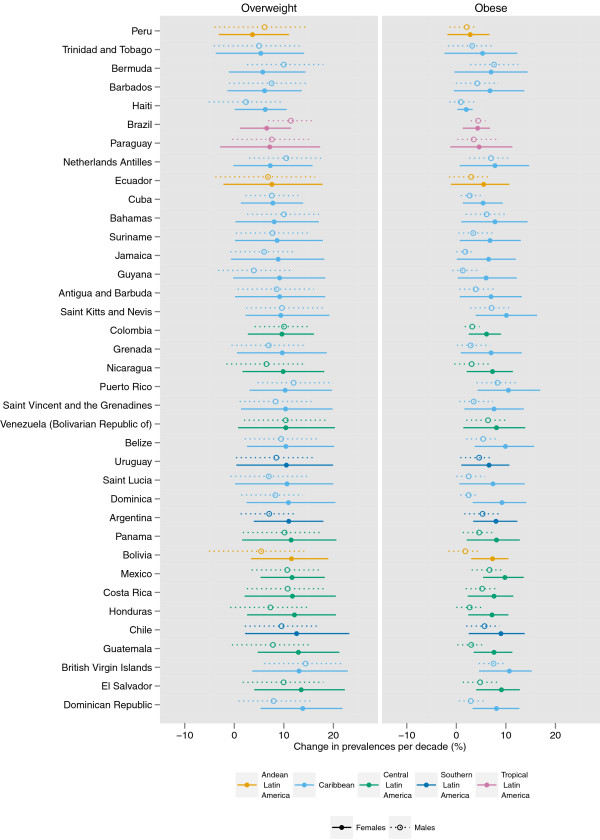
The global age-standardized prevalence of obesity nearly doubled from 6.4% (95% uncertainty interval 5.7-7.2%) in 1980 to 12.0% (11.5-12.5%) in 2008. Half of this rise occurred in the 20 years between 1980 and 2000, and half occurred in the 8 years between 2000 and 2008. The age-standardized prevalence of overweight increased from 24.6% (22.7-26.7%) to 34.4% (33.2-35.5%) during the same 28-year period. In 2008, female obesity prevalence ranged from 1.4% (0.7-2.2%) in Bangladesh and 1.5% (0.9-2.4%) in Madagascar to 70.4% (61.9-78.9%) in Tonga and 74.8% (66.7-82.1%) in Nauru. Male obesity was below 1% in Bangladesh, Democratic Republic of the Congo, and Ethiopia, and was highest in Cook Islands (60.1%, 52.6-67.6%) and Nauru (67.9%, 60.5-75.0%).
Globally, the prevalence of overweight and obesity has increased since 1980, and the increase has accelerated. Although obesity increased in most countries, levels and trends varied substantially. These data on trends in overweight and obesity may be used to set targets for obesity prevalence as requested at the United Nations high-level meeting on Prevention and Control of NCDs.
超重和肥胖的流行率通常用于公众和政策交流来描述肥胖流行的程度,但各国超重和肥胖流行率的可比估计值并不存在。
我们估算了 1980 年至 2008 年期间 199 个国家和地区 20 岁及以上成年人超重和肥胖流行率的变化趋势及其不确定性。数据来自先前的一项研究,该研究使用贝叶斯层次模型,根据已发表和未发表的健康检查调查和流行病学研究来估算平均体重指数(BMI)。在此,我们使用估算的平均 BMI 值,通过年龄、国家、年份和性别,预测超重和肥胖的流行率。这些估计的不确定性既包括贝叶斯层次模型的不确定性,也包括由平均 BMI 到超重和肥胖流行率的交叉评估引起的不确定性。
全球年龄标准化肥胖患病率从 1980 年的 6.4%(95%置信区间 5.7-7.2%)几乎翻了一番,达到 2008 年的 12.0%(11.5-12.5%)。这一增长的一半发生在 1980 年至 2000 年的 20 年间,另一半发生在 2000 年至 2008 年的 8 年间。同一时期,超重的年龄标准化流行率从 24.6%(22.7-26.7%)增加到 34.4%(33.2-35.5%)。2008 年,女性肥胖流行率在孟加拉国(1.4%,0.7-2.2%)和马达加斯加(1.5%,0.9-2.4%)之间波动,而在汤加(70.4%,61.9-78.9%)和瑙鲁(74.8%,66.7-82.1%)则达到了顶峰。孟加拉国、刚果民主共和国和埃塞俄比亚的男性肥胖率低于 1%,而库克群岛(60.1%,52.6-67.6%)和瑙鲁(67.9%,60.5-75.0%)的肥胖率最高。
自 1980 年以来,全球超重和肥胖的流行率一直在上升,而且上升速度在加快。尽管大多数国家的肥胖率都有所上升,但水平和趋势差异很大。这些关于超重和肥胖趋势的数据可用于根据联合国预防和控制非传染性疾病高级别会议的要求,为肥胖流行率设定目标。