HIV-NAT, the Thai Red Cross AIDS Research Centre, 104 Ratchadamri Road, Pathumwan, Bangkok, 10330, Thailand.
AIDS Res Ther. 2012 Nov 24;9(1):34. doi: 10.1186/1742-6405-9-34.
Human APOBEC3G is a host defense factor that potently inhibits HIV replication. We hypothesize that HIV-infected children with a genetic variant of APOBEC3G will have a more rapid disease progression.
Antiretroviral therapy (ART)-naïve children, aged 1-12 years old with CD4 15-24% and without severe HIV-related symptoms were enrolled. The children had CD4% and absolute CD4 counts every 12 weeks and HIV-RNA every 24 weeks until 144 weeks. ART was started when CD4% declined to < 15% or AIDS-related events developed.APOBEC3G genetic variants were performed by PCR-based restriction fragment length polymorphism techniques from peripheral blood mononuclear cells. Random-effect linear regression analysis was performed to correlate APOBEC3G genotypes and disease progression.
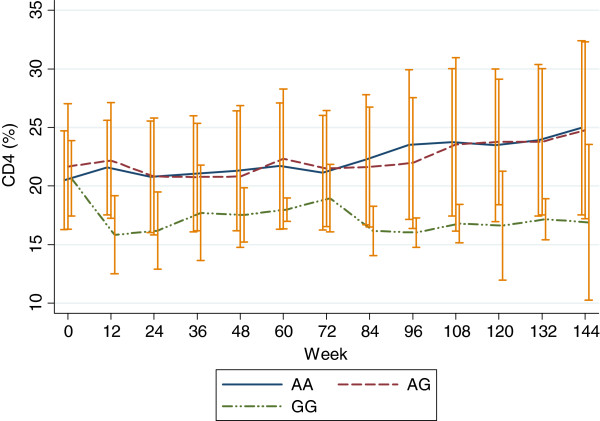
147 children, 35% male, with a median (IQR) age of 6.5 (4.3-8.8) years were enrolled. CDC N:A:B were 1:63:36%. Median baseline values were 20% for CD4% 605 cells/mm3 for CD4 count and 4.7 log10copies/mL for HIV-RNA.The frequencies of APOBEC3G genotypes AA (186H/H), AG (186H/R), GG (186R/R) were 86%, 12%, and 2% respectively. The APOBEC3G genotype GG was associated with a significant decline in CD4% -5.1% (-8.9 to -1.2%), p<0.001, and CD4 counts -226 (-415 to -34) cells/mm3, p<0.001 by random-effect liner regression analysis. No significant associations of APOBEC3G genotypes with HIV-RNA changes overtime (p=0.16) or progression to CDC B and C (p=0.49) were observed.
APOBEC3G genotype GG was significantly associated with a more rapid decline in CD4. APOBEC3G's antiviral effects on HIV disease progression in children should be further explored.
人类 APOBEC3G 是一种强大的抑制 HIV 复制的宿主防御因子。我们假设,携带 APOBEC3G 遗传变异的 HIV 感染儿童会有更快的疾病进展。
招募了 1-12 岁、CD4%为 15-24%、无严重 HIV 相关症状的、未接受过抗逆转录病毒治疗(ART)的儿童。每隔 12 周检测一次 CD4%和绝对 CD4 计数,每隔 24 周检测一次 HIV-RNA,直至 144 周。当 CD4%下降至<15%或出现 AIDS 相关事件时,开始进行 ART。通过聚合酶链反应(PCR)-基于限制片段长度多态性技术,从外周血单核细胞中提取 APOBEC3G 遗传变异。采用随机效应线性回归分析来关联 APOBEC3G 基因型和疾病进展。
共纳入了 147 名儿童,其中 35%为男性,中位(IQR)年龄为 6.5(4.3-8.8)岁。CDC N:A:B 为 1:63:36%。基线中位值分别为 20%的 CD4%,605 个细胞/mm3的 CD4 计数和 4.7 log10 拷贝/mL的 HIV-RNA。APOBEC3G 基因型 AA(186H/H)、AG(186H/R)、GG(186R/R)的频率分别为 86%、12%和 2%。APOBEC3G 基因型 GG 与 CD4%显著下降相关,下降 5.1%(-8.9 至-1.2%),p<0.001,CD4 计数下降 226 个细胞/mm3(-415 至-34),p<0.001。随机效应线性回归分析未发现 APOBEC3G 基因型与 HIV-RNA 随时间的变化(p=0.16)或进展为 CDC B 和 C(p=0.49)有关。
APOBEC3G 基因型 GG 与 CD4 的快速下降显著相关。APOBEC3G 对儿童 HIV 疾病进展的抗病毒作用需要进一步探索。