Department of Molecular, Cell and Developmental Biology, University of California, Santa Cruz, Santa Cruz, CA 95064, USA.
J Cell Biol. 2012 Nov 26;199(5):745-53. doi: 10.1083/jcb.201208041.
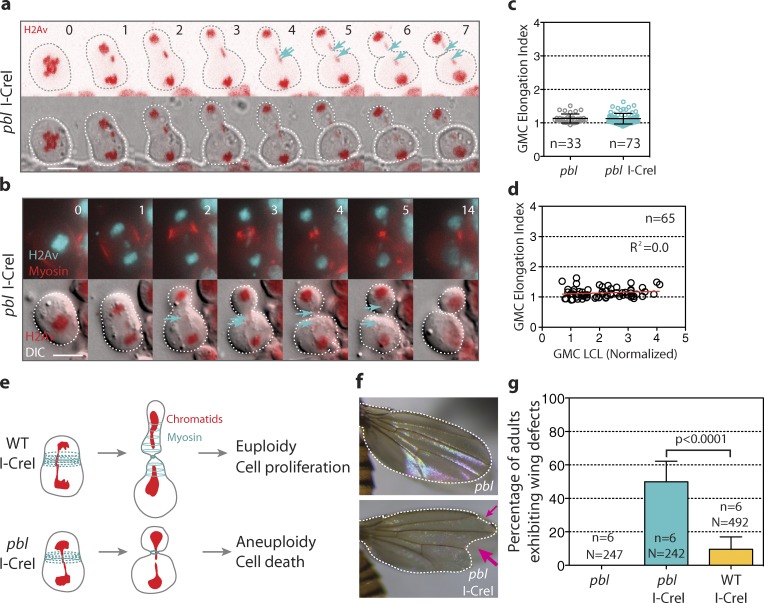
Chromosome segregation must be coordinated with cell cleavage to ensure correct transmission of the genome to daughter cells. Here we identify a novel mechanism by which Drosophila melanogaster neuronal stem cells coordinate sister chromatid segregation with cleavage furrow ingression. Cells adapted to a dramatic increase in chromatid arm length by transiently elongating during anaphase/telophase. The degree of cell elongation correlated with the length of the trailing chromatid arms and was concomitant with a slight increase in spindle length and an enlargement of the zone of cortical myosin distribution. Rho guanine-nucleotide exchange factor (Pebble)-depleted cells failed to elongate during segregation of long chromatids. As a result, Pebble-depleted adult flies exhibited morphological defects likely caused by cell death during development. These studies reveal a novel pathway linking trailing chromatid arms and cortical myosin that ensures the clearance of chromatids from the cleavage plane at the appropriate time during cytokinesis, thus preserving genome integrity.
染色体分离必须与细胞分裂协调,以确保基因组正确传递给子细胞。在这里,我们发现了一种新的机制,即黑腹果蝇神经元干细胞如何协调姐妹染色单体的分离与分裂沟的内陷。细胞在后期/末期通过短暂延长来适应染色体臂长度的急剧增加。细胞伸长的程度与尾随染色单体臂的长度相关,并伴随着纺锤体长度的轻微增加和皮质肌球蛋白分布区的扩大。Rho 鸟嘌呤核苷酸交换因子(Pebble)耗竭的细胞在长染色单体的分离过程中不能伸长。结果,Pebble 耗竭的成年果蝇表现出形态缺陷,可能是由于发育过程中的细胞死亡引起的。这些研究揭示了一种新的途径,将尾随染色单体臂和皮质肌球蛋白联系起来,确保在细胞分裂过程中适当的时间从分裂平面清除染色体,从而保持基因组的完整性。