Na So-Young, Roh Joo-Young, Kim Jeung-Min, Tamang Migma Dorgi, Lee Jong-Rok
Department of Dermatology, Ajou University School of Medicine, Suwon, Korea.
Ann Dermatol. 2012 Nov;24(4):413-9. doi: 10.5021/ad.2012.24.4.413. Epub 2012 Nov 8.
The skin of atopic dermatitis (AD) patients has a high susceptibility to Staphylococcus aureus colonization, and the toxins produced by S. aureus may aggravate AD by acting as superantigens.
The purpose of this study was to evaluate the relationship of the skin barrier function, colonization of S. aureus, and the clinical severity of AD. We also examined the predominant toxin genes produced in Korean AD patients.
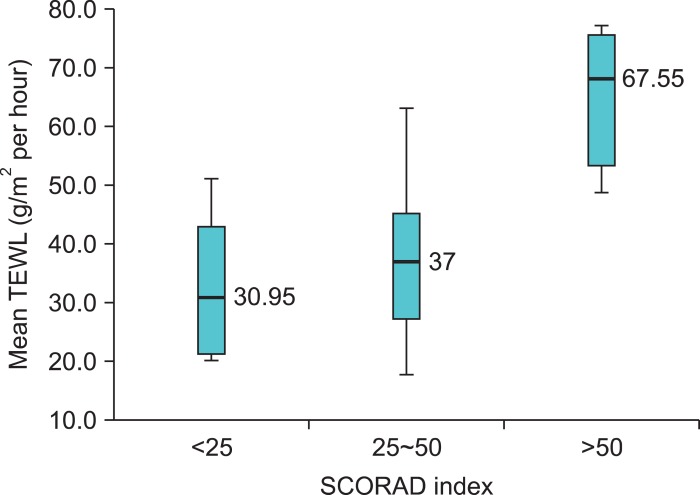
Thirty-nine patients with AD were evaluated for clinical severity and skin barrier function by using Severity Scoring of Atopic Dermatitis (SCORAD) index and transepidermal water loss (TEWL). S. aureus was isolated from the forearm, popliteal fossa, and anterior nares of AD patients (n=39) and age-matched controls (n=40); the toxin genes were analyzed by performing multiplex polymerase chain reaction.
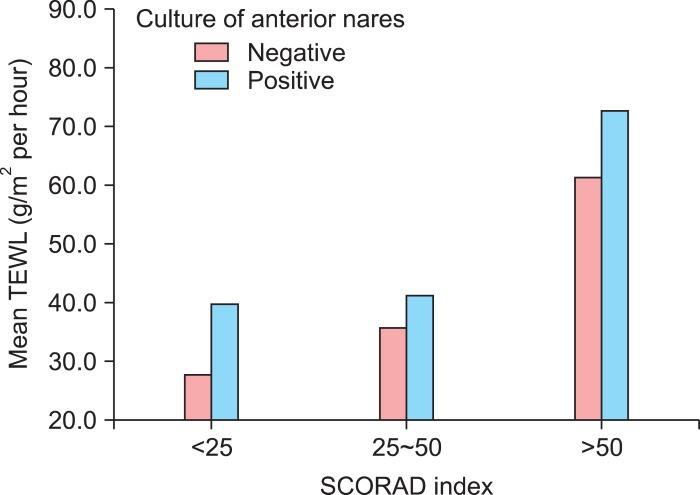
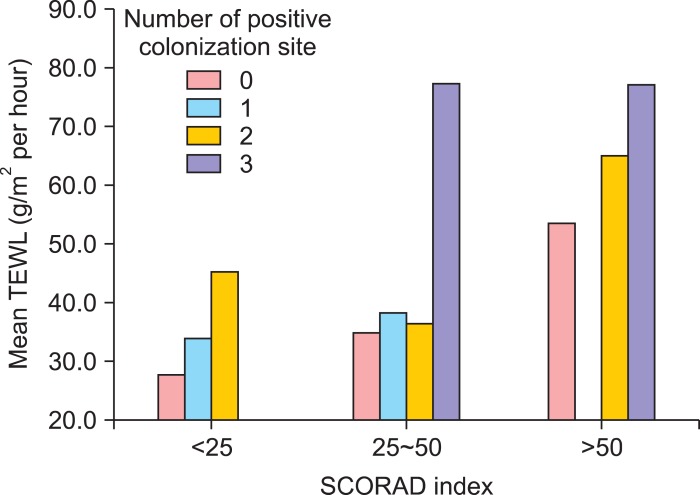
TEWL showed a statistically significant correlation with clinical severity in patients with AD (p<0.05). TEWL was correlated with the number of S. aureus colonization sites and the presence of nasal colonization, but these results were not statistically significant. S. aureus strains were isolated in 64.1% of the 39 AD patients. The SCORAD index and AD severity were strongly correlated with the number of colonization sites. The predominant toxin gene found in AD patients was staphylococcal enterotoxin a (sea) only, which was produced in 52.6% of patients. The toxin genes sea and toxic shock syndrome toxin-1 (tsst-1) were found together in 42.1%, while tsst-1 only was found in 5.3% of the patients.
S. aureus strains were isolated in 64.1% of the 39 AD patients. Skin barrier function, as measured by TEWL, revealed a statistically significant correlation with clinical severity in AD patients. The SCORAD index and severity of AD was strongly correlated with the number of colonization. The most common toxin gene was sea in the Korean AD patients and this gene might have an important role in the pathogenesis of AD.
特应性皮炎(AD)患者的皮肤对金黄色葡萄球菌定植高度敏感,金黄色葡萄球菌产生的毒素可能作为超抗原加重AD。
本研究旨在评估皮肤屏障功能、金黄色葡萄球菌定植与AD临床严重程度之间的关系。我们还检测了韩国AD患者中产生的主要毒素基因。
采用特应性皮炎严重程度评分(SCORAD)指数和经表皮水分流失(TEWL)对39例AD患者的临床严重程度和皮肤屏障功能进行评估。从AD患者(n = 39)和年龄匹配的对照组(n = 40)的前臂、腘窝和前鼻孔分离出金黄色葡萄球菌;通过多重聚合酶链反应分析毒素基因。
AD患者中TEWL与临床严重程度呈统计学显著相关性(p < 0.05)。TEWL与金黄色葡萄球菌定植部位数量和鼻腔定植情况相关,但这些结果无统计学显著性。39例AD患者中有64.1%分离出金黄色葡萄球菌菌株。SCORAD指数和AD严重程度与定植部位数量密切相关。AD患者中发现的主要毒素基因仅为葡萄球菌肠毒素a(sea),52.6%的患者产生该毒素。毒素基因sea和中毒性休克综合征毒素-1(tsst-1)同时存在于42.1%的患者中,而仅tsst-1存在于5.3%的患者中。
39例AD患者中有64.1%分离出金黄色葡萄球菌菌株。以TEWL衡量的皮肤屏障功能在AD患者中与临床严重程度呈统计学显著相关性。SCORAD指数和AD严重程度与定植数量密切相关。韩国AD患者中最常见的毒素基因是sea,该基因可能在AD发病机制中起重要作用。