Geomicrobiology and Symbiosis Group, Courant Research Center Geobiology, University of Göttingen, Göttingen, Germany.
PLoS One. 2012;7(11):e50254. doi: 10.1371/journal.pone.0050254. Epub 2012 Nov 29.
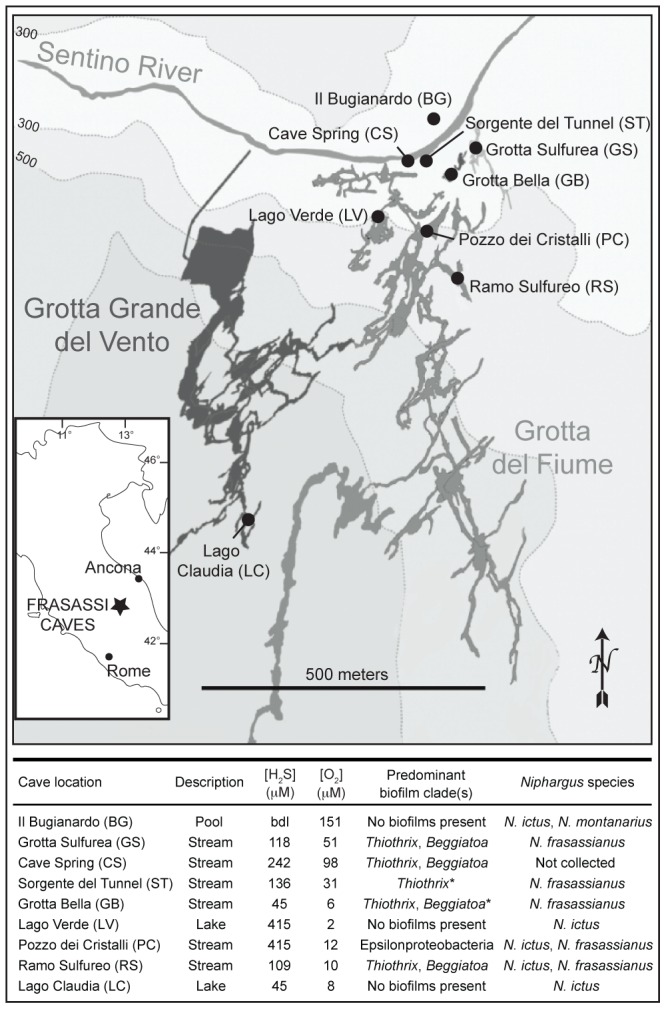
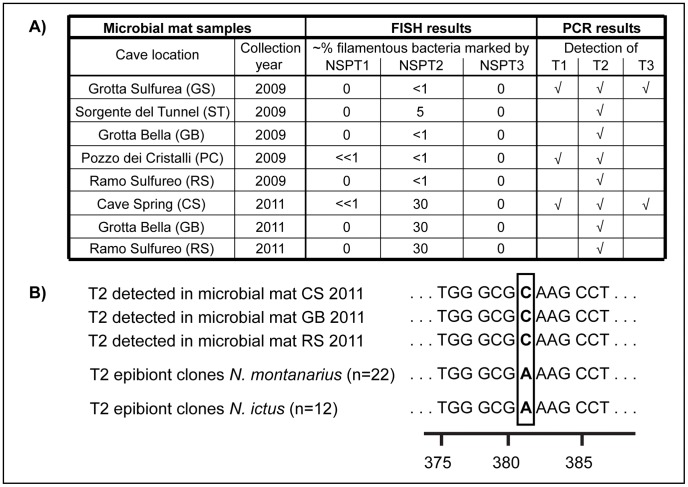
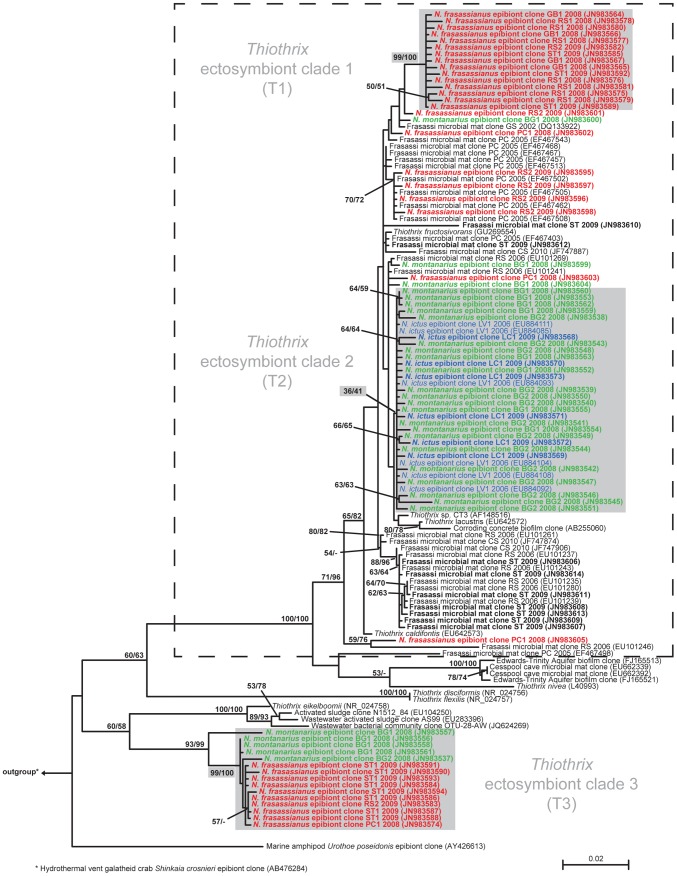
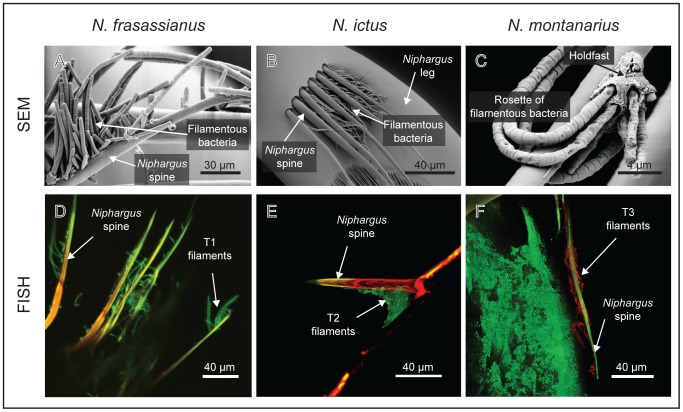
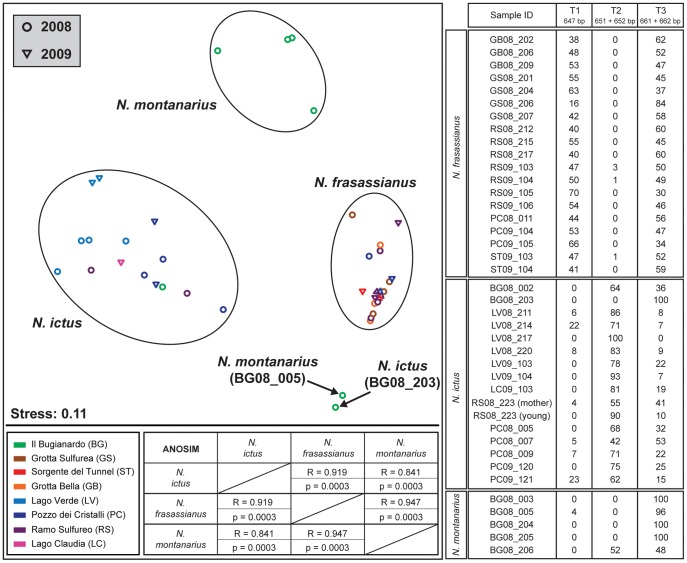
Ectosymbioses between invertebrates and sulfur-oxidizing bacteria are widespread in sulfidic marine environments and have evolved independently in several invertebrate phyla. The first example from a freshwater habitat, involving Niphargus ictus amphipods and filamentous Thiothrix ectosymbionts, was recently reported from the sulfide-rich Frasassi caves in Italy. Subsequently, two new Niphargus species, N. frasassianus and N. montanarius, were discovered within Frasassi and found to co-occur with N. ictus. Using a variety of microscopic and molecular techniques, we found that all three Frasassi-dwelling Niphargus species harbor Thiothrix ectosymbionts, which belong to three distinct phylogenetic clades (named T1, T2, and T3). T1 and T3 Thiothrix dominate the N. frasassianus ectosymbiont community, whereas T2 and T3 are prevalent on N. ictus and N. montanarius. Relative distribution patterns of the three ectosymbionts are host species-specific and consistent over different sampling locations and collection years. Free-living counterparts of T1-T3 are rare or absent in Frasassi cave microbial mats, suggesting that ectosymbiont transmission among Niphargus occurs primarily through inter- or intraspecific inoculations. Phylogenetic analyses indicate that the Niphargus-Thiothrix association has evolved independently at least two times. While ectosymbioses with T1 and T2 may have been established within Frasassi, T3 ectosymbionts seem to have been introduced to the cave system by Niphargus.
无脊椎动物与硫氧化细菌之间的外共生关系在富含硫的海洋环境中广泛存在,并在几个无脊椎动物门中独立进化。最近,在意大利富含硫化物的 Frasassi 洞穴中发现了第一个来自淡水生境的例子,涉及 Niphargus ictus 端足类动物和丝状 Thiothrix 外共生体。随后,在 Frasassi 中发现了两种新的 Niphargus 物种,N. frasassianus 和 N. montanarius,并发现它们与 N. ictus 共现。使用各种显微镜和分子技术,我们发现所有三种 Frasassi 栖息的 Niphargus 物种都携带有 Thiothrix 外共生体,这些外共生体属于三个不同的系统发育分支(命名为 T1、T2 和 T3)。T1 和 T3 Thiothrix 主导 N. frasassianus 外共生体群落,而 T2 和 T3 在 N. ictus 和 N. montanarius 上更为普遍。三种外共生体的相对分布模式是宿主种特异性的,并且在不同的采样地点和采集年份都保持一致。自由生活的 T1-T3 的对应物在 Frasassi 洞穴微生物垫中很少或不存在,这表明 Niphargus 之间的外共生体传播主要通过种间或种内接种进行。系统发育分析表明,Niphargus-Thiothrix 共生关系至少独立进化了两次。虽然 T1 和 T2 的外共生关系可能在 Frasassi 中建立,但 T3 的外共生体似乎是由 Niphargus 引入洞穴系统的。