Courant Research Center Geobiology, Georg-August-Universität Göttingen, Göttingen, Germany.
ISME J. 2013 Dec;7(12):2411-23. doi: 10.1038/ismej.2013.126. Epub 2013 Aug 8.
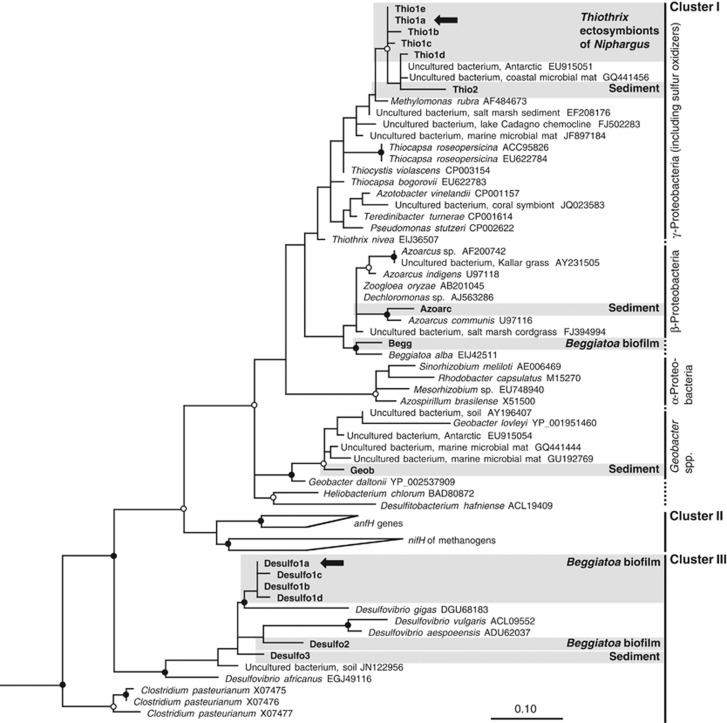
Microbial sulfur and carbon cycles in ecosystems driven by chemoautotrophy-present at deep-sea hydrothermal vents, cold seeps and sulfidic caves-have been studied to some extent, yet little is known about nitrogen fixation in these systems. Using a comprehensive approach comprising of (15)N2 isotope labeling, acetylene reduction assay and nitrogenase gene expression analyses, we investigated nitrogen fixation in the sulfide-rich, chemoautotrophy-based Frasassi cave ecosystem (Italy). Nitrogen fixation was examined in three different microbial niches within the cave waters: (1) symbiotic bacterial community of Niphargus amphipods, (2) Beggiatoa-dominated biofilms, which occur at the sulfide-oxygen interface, and (3) sulfidic sediment. We found evidence for nitrogen fixation in all the three niches, and the nitrogenase gene (homologs of nifH) expression data clearly show niche differentiation of diazotrophic Proteobacteria within the water streams. The nifH transcript originated from the symbiotic community of Niphargus amphipods might belong to the Thiothrix ectosymbionts. Two abundantly expressed nifH genes in the Beggiatoa-dominated biofilms are closely related to those from Beggiatoa- and Desulfovibrio-related bacteria. These two diazotrophs were consistently found in Beggiatoa-dominated biofilms collected at various time points, thus illustrating species-specific associations of the diazotrophs in biofilm formation, and micron-scale niche partitioning of sulfur-oxidizing and sulfate-reducing bacteria driven by steep redox gradients within the biofilm. Finally, putative heterotrophs (Geobacter, Azoarcus and Desulfovibrio related) were the active diazotrophs in the sulfidic sediment. Our study is the first to shed light on nitrogen fixation in permanently dark caves and suggests that diazotrophy may be widespread in chemosynthetic communities.
在由化能自养驱动的生态系统中,微生物的硫和碳循环——存在于深海热液喷口、冷渗口和硫化洞穴中——已经在一定程度上得到了研究,但对于这些系统中的氮固定却知之甚少。本研究采用综合方法,包括(15)N2 同位素标记、乙炔还原测定和氮酶基因表达分析,研究了富含硫化物、基于化能自养的意大利 Frasassi 洞穴生态系统中的氮固定。在洞穴水中的三个不同微生物小生境中检查了氮固定:(1)Niphargus 十足目动物的共生细菌群落,(2)在硫-氧界面处存在的 Beggiatoa 为主的生物膜,以及(3)硫化沉积物。我们在所有三个小生境中都发现了氮固定的证据,并且氮酶基因(nifH 同源物)表达数据清楚地表明了水溪流中固氮菌的生态位分化。源自 Niphargus 十足目动物共生群落的 nifH 转录本可能属于硫丝菌外共生体。在 Beggiatoa 为主的生物膜中大量表达的两个 nifH 基因与 Beggiatoa 和脱硫弧菌相关细菌的基因密切相关。这两个固氮菌在不同时间采集的以 Beggiatoa 为主的生物膜中始终被发现,因此说明了生物膜形成过程中固氮菌的种特异性关联,以及由生物膜内陡的氧化还原梯度驱动的硫氧化和硫酸盐还原细菌的微米级生态位分区。最后,在硫化沉积物中,可能的异养菌(Geobacter、Azoarcus 和脱硫弧菌相关)是活跃的固氮菌。本研究首次揭示了永久性黑暗洞穴中的氮固定,并表明固氮作用可能在化能合成群落中广泛存在。