Centre of Genomics and Policy, Faculty of Medicine, Dept of Human Genetics, McGill University, 740 Dr, Penfield Avenue, 5th Floor, Suite 5200, Montreal, (QC) H3A 1A4, Canada.
BMC Med Ethics. 2012 Dec 5;13:33. doi: 10.1186/1472-6939-13-33.
Non-therapeutic trials in which terminally ill cancer patients are asked to undergo procedures such as biopsies or venipunctures for research purposes, have become increasingly important to learn more about how cancer cells work and to realize the full potential of clinical research. Considering that implementing non-therapeutic studies is not likely to result in direct benefits for the patient, some authors are concerned that involving patients in such research may be exploitive of vulnerable patients and should not occur at all, or should be greatly restricted, while some proponents doubt whether such restrictions are appropriate. Our objective was to explore clinician-researcher attitudes and concerns when recruiting patients who are in advanced stages of cancer into non-therapeutic research.
We conducted a qualitative exploratory study by carrying out open-ended interviews with health professionals, including physicians, research nurses, and study coordinators. Interviews were audio-recorded and transcribed. Analysis was carried out using grounded theory.
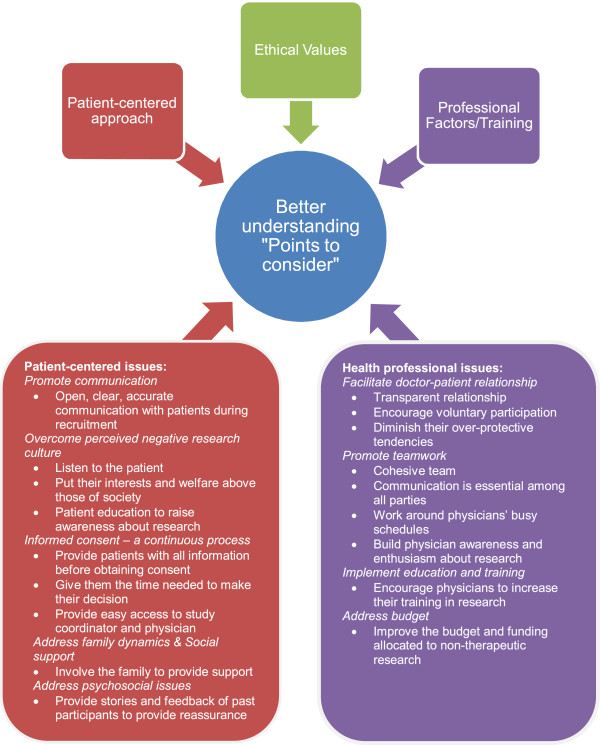
The analysis of the interviews unveiled three prominent themes: 1) ethical considerations; 2) patient-centered issues; 3) health professional issues. Respondents identified ethical issues surrounding autonomy, respect for persons, beneficence, non-maleficence, discrimination, and confidentiality; bringing to light that patients contribute to science because of a sense of altruism and that they want reassurance before consenting. Several patient-centered and health professional issues are having an impact on the recruitment of patients for non-therapeutic research. Facilitators were most commonly associated with patient-centered issues enhancing communication, whereas barriers in non-therapeutic research were most often professionally based, including the doctor-patient relationship, time constraints, and a lack of education and training in research.
This paper aims to contribute to debates on the overall challenges of recruiting patients to non-therapeutic research. This exploratory study identified general awareness of key ethical issues, as well as key facilitators and barriers to the recruitment of patients to non-therapeutic studies. Due to the important role played by clinicians and clinician-researchers in the recruitment of patients, it is essential to facilitate a greater understanding of the challenges faced; to promote effective communication; and to encourage educational research training programs.
非治疗性试验越来越重要,这些试验要求绝症癌症患者接受活检或静脉穿刺等程序,以了解癌细胞的工作方式并充分发挥临床研究的潜力。由于实施非治疗性研究不太可能直接使患者受益,一些作者担心让患者参与此类研究可能会剥削弱势患者,因此不应进行此类研究,或者应严格限制此类研究,而一些支持者则怀疑是否应该对此类限制进行限制。我们的目的是探讨临床医生-研究人员在招募处于癌症晚期的患者参加非治疗性研究时的态度和关注。
我们进行了一项定性探索性研究,对包括医生、研究护士和研究协调员在内的卫生专业人员进行了开放式访谈。访谈进行了录音和转录。使用扎根理论进行分析。
对访谈的分析揭示了三个突出的主题:1)伦理考虑;2)以患者为中心的问题;3)卫生专业人员问题。受访者确定了围绕自主权、尊重人、善行、不伤害、歧视和保密性的伦理问题;表明患者因为利他主义而为科学做出贡献,并且在同意之前希望得到保证。一些以患者为中心和卫生专业人员的问题正在影响非治疗性研究患者的招募。促进因素通常与增强沟通的以患者为中心的问题有关,而非治疗性研究中的障碍主要是基于专业的,包括医患关系、时间限制以及缺乏研究方面的教育和培训。
本文旨在为关于招募患者参加非治疗性研究的总体挑战的辩论做出贡献。这项探索性研究确定了对关键伦理问题的普遍认识,以及招募患者参加非治疗性研究的主要促进因素和障碍。由于临床医生和临床医生-研究人员在招募患者方面发挥着重要作用,因此必须促进对所面临挑战的更深入了解;促进有效的沟通;并鼓励教育研究培训计划。