Department of Medical Psychology and Medical Sociology, Friedrich-Alexander-Universität Erlangen-Nürnberg, Clinic for Psychiatry and Psychotherapy, Schwabachanlage 6, Erlangen 91054, Germany.
BMC Neurol. 2012 Dec 5;12:151. doi: 10.1186/1471-2377-12-151.
Little is known about the long-term success of non-drug therapies for treating dementia, especially whether the effects are sustained after therapy ends. Here, we examined the effects of a one-year multimodal therapy 10 months after patients completed the therapy.
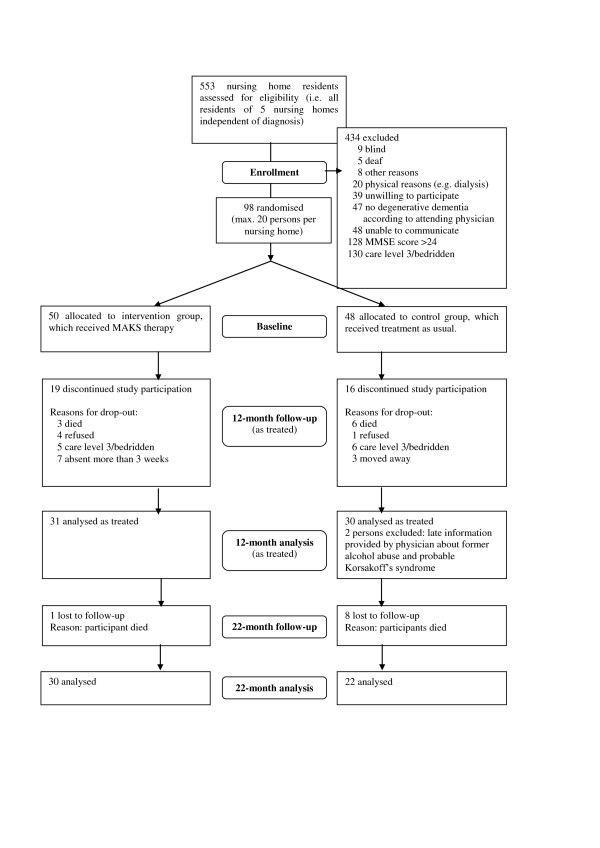
This randomised, controlled, single-blind, longitudinal trial involved 61 patients (catamnesis: n = 52) with primary degenerative dementia in five nursing homes in Bavaria, Germany. The highly standardised intervention, MAKS, consisted of motor stimulation, practice of activities of daily living (ADLs), and cognitive stimulation. Each group of 10 patients was treated for 2 h, 6 days a week for 12 months. Control patients received standard nursing home care. At baseline, at the end of therapy (month 12), and 10 months thereafter (month 22), cognitive functioning was assessed using the cognitive subscale of the Alzheimer's Disease Assessment Scale, and the ability to perform ADLs was assessed using the Erlangen Test of Activities of Daily Living.
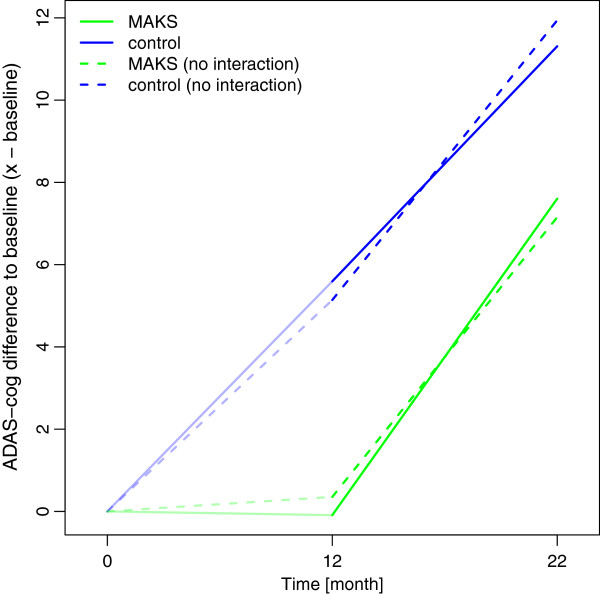
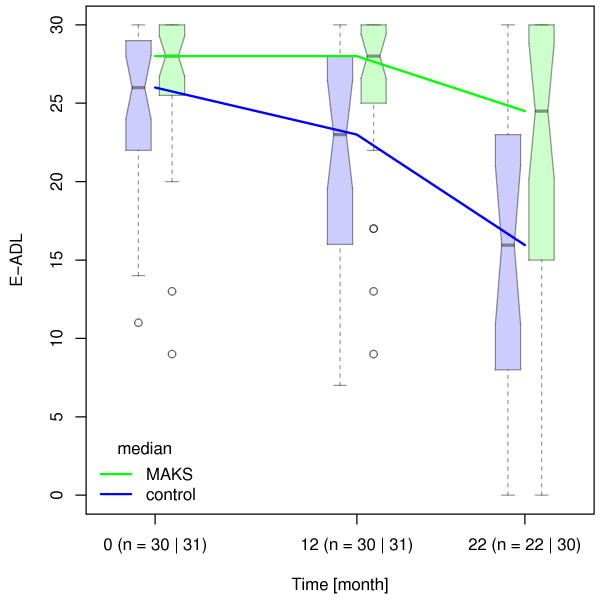
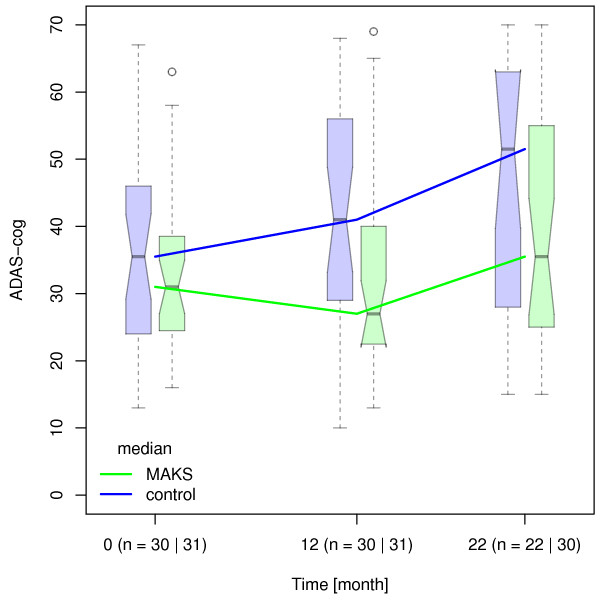
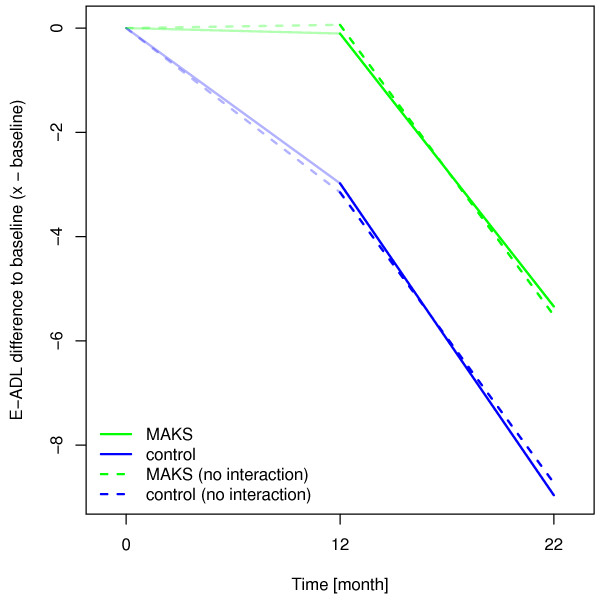
During the therapy phase, the MAKS patients maintained their cognitive function and ability to carry out ADLs. After the end of therapy, both the control and the MAKS groups deteriorated in both their cognitive function (control, p = 0.02; MAKS, p < 0.001) and their ability to carry out ADLs (control, p < 0.001; MAKS, p = 0.001). However, in a confound-adjusted multiple regression model, the ability of the MAKS group to perform ADLs remained significantly higher than that of the control group even 10 months after the end of therapy (H0: βMAKS + βMAKS month 22 = 0; χ2 = 3.8568, p = 0.0496). Cohen's d for the difference between the two groups in ADLs and cognitive abilities 10 months after the end of therapy was 0.40 and 0.22, respectively.
A multimodal non-drug therapy of dementia resulted in stabilisation of the ability to perform ADLs, even beyond the end of therapy. To prevent functional decline for as long as possible, therapy should be performed continuously until the benefit for the patient ends. Follow-up studies on larger numbers of patients are needed to definitively confirm these results.
http://www.isrctn.com Identifier: ISRCTN87391496.
对于治疗痴呆症的非药物疗法的长期疗效知之甚少,尤其是在治疗结束后,其疗效是否能够持续。在这里,我们研究了为期一年的多模式治疗在患者完成治疗 10 个月后的效果。
这是一项在德国巴伐利亚州的五家养老院进行的随机、对照、单盲、纵向试验,共涉及 61 名原发性退行性痴呆患者(随访:n=52)。高度标准化的干预措施 MAKS 包括运动刺激、日常生活活动(ADL)练习和认知刺激。每组 10 名患者每周接受 6 天、每天 2 小时的治疗,持续 12 个月。对照组患者接受常规养老院护理。在基线时、治疗结束时(第 12 个月)和此后 10 个月(第 22 个月),使用阿尔茨海默病评估量表的认知子量表评估认知功能,使用埃尔朗根日常生活活动测试评估 ADL 能力。
在治疗阶段,MAKS 患者保持了认知功能和进行 ADL 的能力。治疗结束后,对照组和 MAKS 组的认知功能(对照组,p=0.02;MAKS,p<0.001)和进行 ADL 的能力(对照组,p<0.001;MAKS,p=0.001)都出现了恶化。然而,在经过混杂因素调整的多元回归模型中,即使在治疗结束 10 个月后,MAKS 组进行 ADL 的能力仍显著高于对照组(H0:βMAKS+βMAKS month 22=0;χ2=3.8568,p=0.0496)。治疗结束 10 个月后,两组在 ADL 和认知能力方面的 Cohen's d 分别为 0.40 和 0.22。
针对痴呆症的多模式非药物疗法可稳定患者进行 ADL 的能力,甚至在治疗结束后也能保持。为了尽可能长时间地防止功能下降,治疗应该持续进行,直到对患者的益处结束。需要对更多患者进行后续研究,以最终确认这些结果。
http://www.isrctn.com 标识符:ISRCTN87391496。