Department of Molecular and Human Genetics, Baylor College of Medicine, Houston, TX 77030-3411, USA.
Science. 2012 Dec 7;338(6112):1344-8. doi: 10.1126/science.1226683.
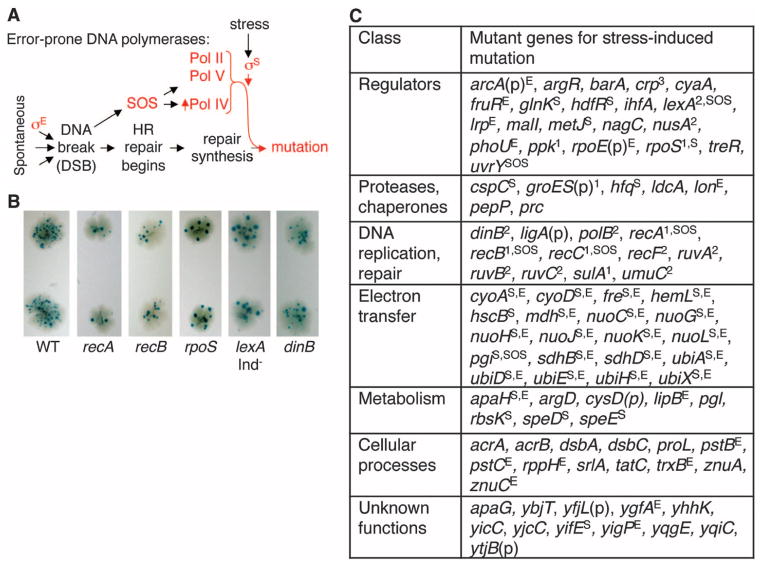
Mechanisms of DNA repair and mutagenesis are defined on the basis of relatively few proteins acting on DNA, yet the identities and functions of all proteins required are unknown. Here, we identify the network that underlies mutagenic repair of DNA breaks in stressed Escherichia coli and define functions for much of it. Using a comprehensive screen, we identified a network of ≥93 genes that function in mutation. Most operate upstream of activation of three required stress responses (RpoS, RpoE, and SOS, key network hubs), apparently sensing stress. The results reveal how a network integrates mutagenic repair into the biology of the cell, show specific pathways of environmental sensing, demonstrate the centrality of stress responses, and imply that these responses are attractive as potential drug targets for blocking the evolution of pathogens.
DNA 修复和突变机制是基于为数相对较少的作用于 DNA 的蛋白质来定义的,但所有必需蛋白质的身份和功能尚不清楚。在这里,我们确定了应激状态下大肠杆菌中 DNA 断裂的诱变修复所依赖的网络,并定义了其中的大部分功能。通过全面筛选,我们确定了一个在≥93 个基因中起作用的网络,这些基因参与突变。大多数基因在激活三种必需应激反应(RpoS、RpoE 和 SOS,关键网络枢纽)之前起作用,显然是在感知压力。结果揭示了网络如何将诱变修复整合到细胞的生物学中,展示了环境感应的具体途径,证明了应激反应的核心地位,并暗示这些反应可能作为阻止病原体进化的潜在药物靶点具有吸引力。