Electrical and Computer Engineering Department, University of Victoria, Victoria, BC, Canada.
Sci Rep. 2012;2:966. doi: 10.1038/srep00966. Epub 2012 Dec 12.
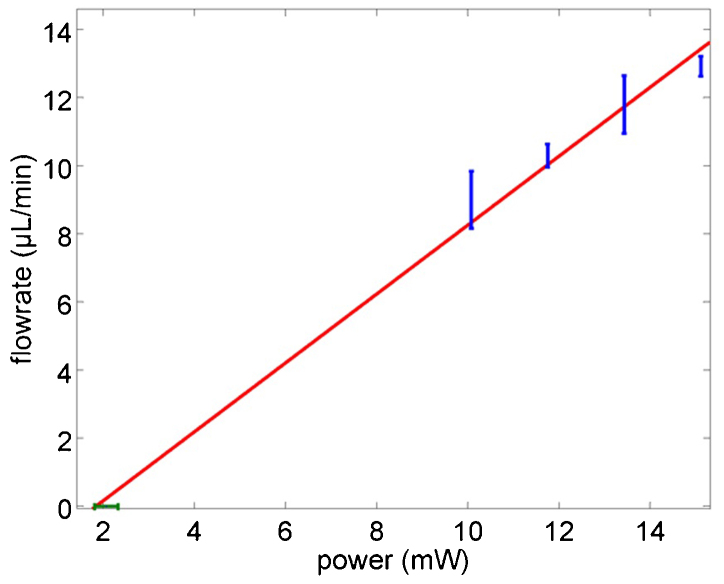
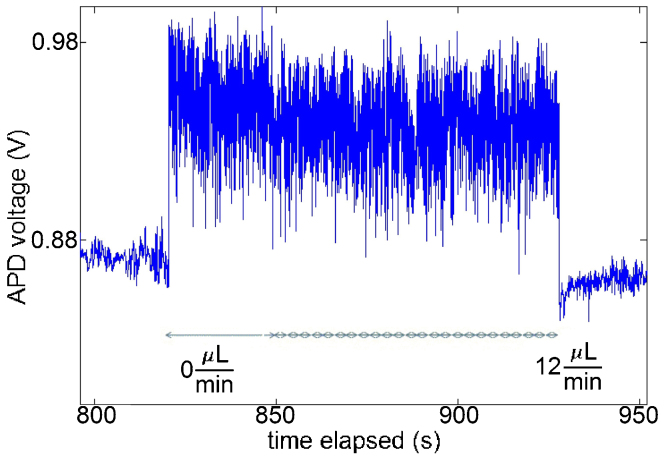
We study the influence of fluid flow on the ability to trap optically a 20 nm polystyrene particle from a stationary microfluidic environment and then hold it against flow. Increased laser power is required to hold nanoparticles as the flow rate is increased, with an empirical linear dependence of 1 μl/(min×mW). This is promising for the delivery of additional nanoparticles to interact with a trapped nanoparticle; for example, to study protein-protein interactions, and for the ability to move the trapped particle in solution from one location to another.
我们研究了流体流动对捕获静止微流环境中 20nm 聚苯乙烯颗粒的能力的影响,然后将其固定在流动中。随着流速的增加,需要增加激光功率才能捕获纳米颗粒,经验上呈 1μl/(min×mW)的线性关系。这对于将额外的纳米颗粒输送到被捕获的纳米颗粒处以相互作用是有希望的;例如,用于研究蛋白质-蛋白质相互作用,以及能够将被捕获的颗粒在溶液中从一个位置移动到另一个位置。