Molecular Biology Institute, University of California, Los Angeles, CA 90095, USA.
BMC Microbiol. 2012 Dec 20;12:300. doi: 10.1186/1471-2180-12-300.
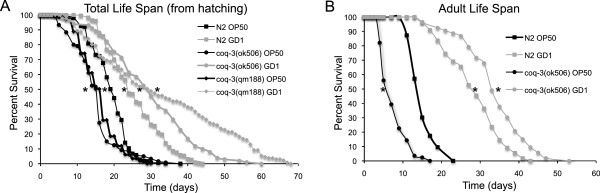
Studies with the nematode model Caenorhabditis elegans have identified conserved biochemical pathways that act to modulate life span. Life span can also be influenced by the composition of the intestinal microbiome, and C. elegans life span can be dramatically influenced by its diet of Escherichia coli. Although C. elegans is typically fed the standard OP50 strain of E. coli, nematodes fed E. coli strains rendered respiratory deficient, either due to a lack coenzyme Q or the absence of ATP synthase, show significant life span extension. Here we explore the mechanisms accounting for the enhanced nematode life span in response to these diets.
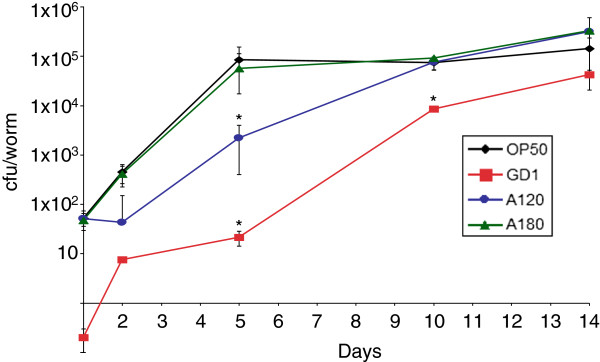
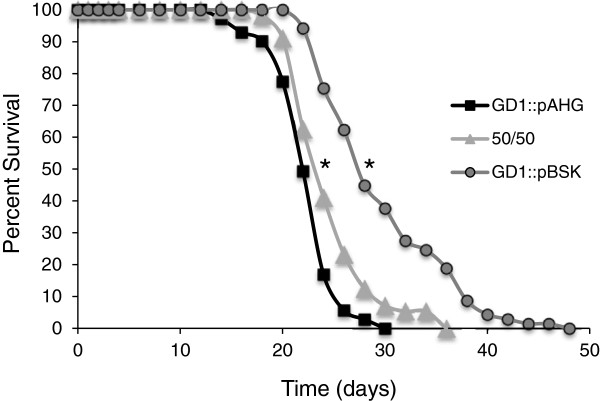
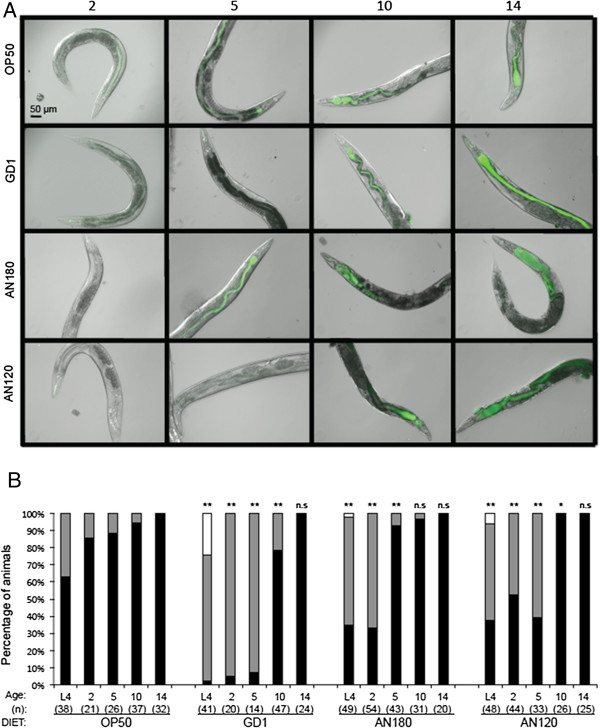
The intestinal load of E. coli was monitored by determination of worm-associated colony forming units (cfu/worm or coliform counts) as a function of age. The presence of GFP-expressing E. coli in the worm intestine was also monitored by fluorescence microscopy. Worms fed the standard OP50 E. coli strain have high cfu and GFP-labeled bacteria in their guts at the L4 larval stage, and show saturated coliform counts by day five of adulthood. In contrast, nematodes fed diets of respiratory deficient E. coli lacking coenzyme Q lived significantly longer and failed to accumulate bacteria within the lumen at early ages. Animals fed bacteria deficient in complex V showed intermediate coliform numbers and were not quite as long-lived. The results indicate that respiratory deficient Q-less E. coli are effectively degraded in the early adult worm, either at the pharynx or within the intestine, and do not accumulate in the intestinal tract until day ten of adulthood.
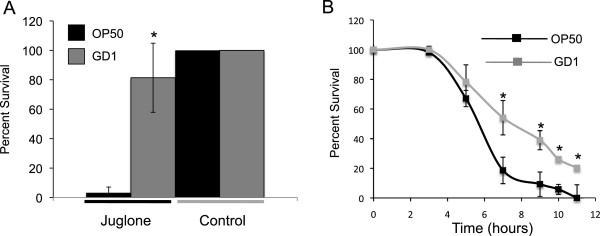
The findings of this study suggest that the nematodes fed the respiratory deficient E. coli diet live longer because the delay in bacterial colonization of the gut subjects the worms to less stress compared to worms fed the OP50 E. coli diet. This work suggests that bacterial respiration can act as a virulence factor, influencing the ability of bacteria to colonize and subsequently harm the animal host. Respiratory deficient bacteria may pose a useful model for probing probiotic relationships within the gut microbiome in higher organisms.
利用线虫模型秀丽隐杆线虫的研究已经确定了调节寿命的保守生化途径。寿命也可以受到肠道微生物组组成的影响,而秀丽隐杆线虫的寿命可以通过其大肠杆菌饮食显著影响。尽管秀丽隐杆线虫通常以大肠杆菌 OP50 标准菌株为食,但由于缺乏辅酶 Q 或缺乏 ATP 合酶,呼吸缺陷的大肠杆菌菌株喂养的线虫表现出显著的寿命延长。在这里,我们探讨了这些饮食对线虫寿命延长的机制。
通过测定与年龄相关的蠕虫相关集落形成单位(cfu/蠕虫或大肠菌群计数)来监测大肠杆菌的肠道负荷。通过荧光显微镜还监测了 GFP 表达的大肠杆菌在蠕虫肠道中的存在。在用标准 OP50 大肠杆菌菌株喂养的蠕虫中,在 L4 幼虫阶段其肠道中具有高 cfu 和 GFP 标记的细菌,并在成年期的第五天显示出饱和的大肠菌群计数。相比之下,用缺乏辅酶 Q 的呼吸缺陷大肠杆菌喂养的线虫寿命明显延长,并且在早期年龄时,肠道内没有细菌积累。用缺乏复合物 V 的细菌喂养的动物显示出中间大肠菌群数量,并且寿命也不是很长。结果表明,呼吸缺陷的 Q 缺乏大肠杆菌在早期成年线虫中有效降解,要么在咽中,要么在肠道中,并且直到成年期的第十天才在肠道中积累。
这项研究的结果表明,用呼吸缺陷大肠杆菌饮食喂养的线虫寿命更长,因为肠道细菌定植的延迟使线虫比用 OP50 大肠杆菌饮食喂养的线虫受到的压力更小。这项工作表明,细菌呼吸可以作为一种毒力因素,影响细菌在肠道微生物组中定植和随后伤害动物宿主的能力。呼吸缺陷细菌可能是探究高等生物肠道微生物组中益生菌关系的有用模型。