Institute for Medical Engineering and Science, Massachusetts Institute of Technology, Cambridge, MA 02139, USA.
Respir Physiol Neurobiol. 2013 Mar 1;186(1):114-30. doi: 10.1016/j.resp.2012.12.004. Epub 2012 Dec 27.
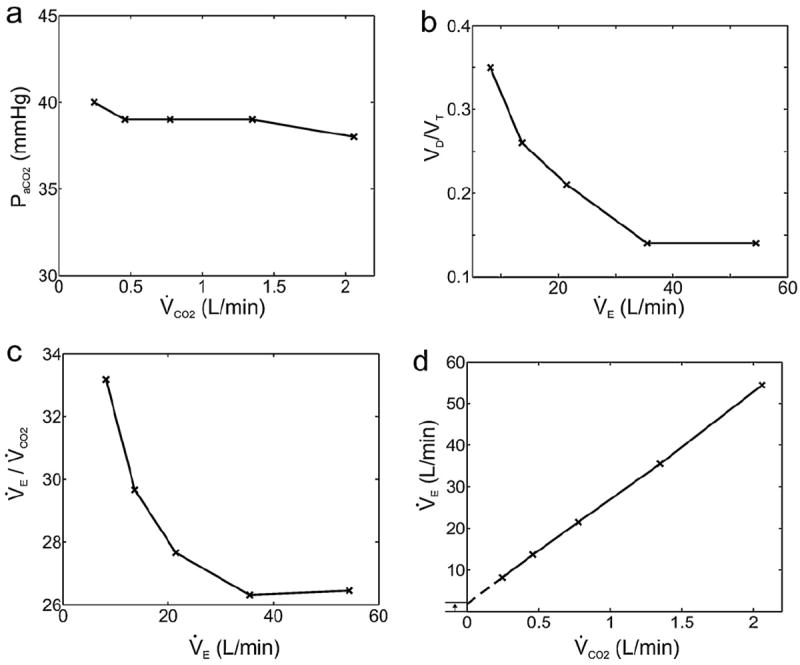
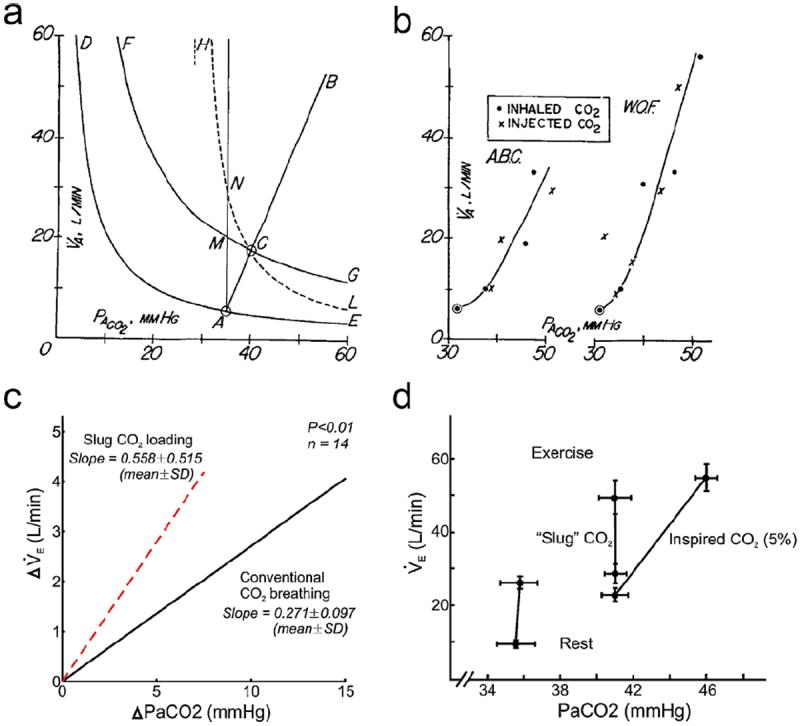
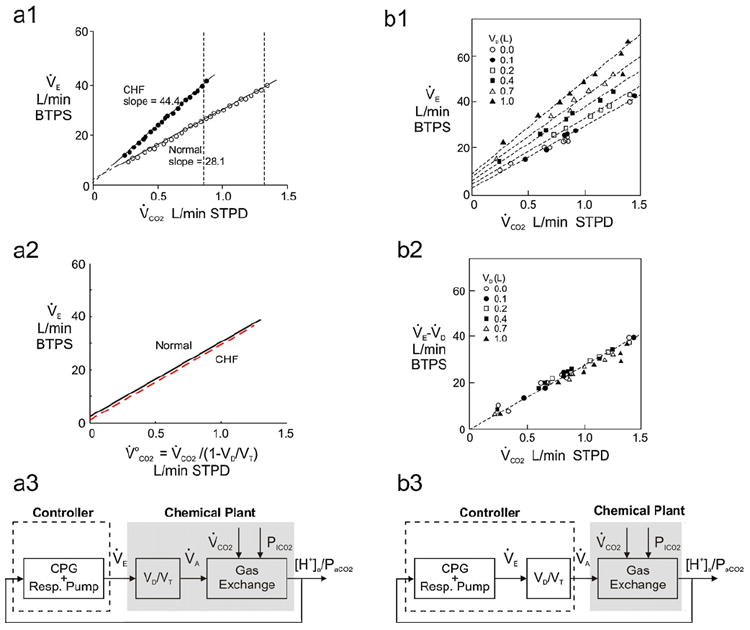
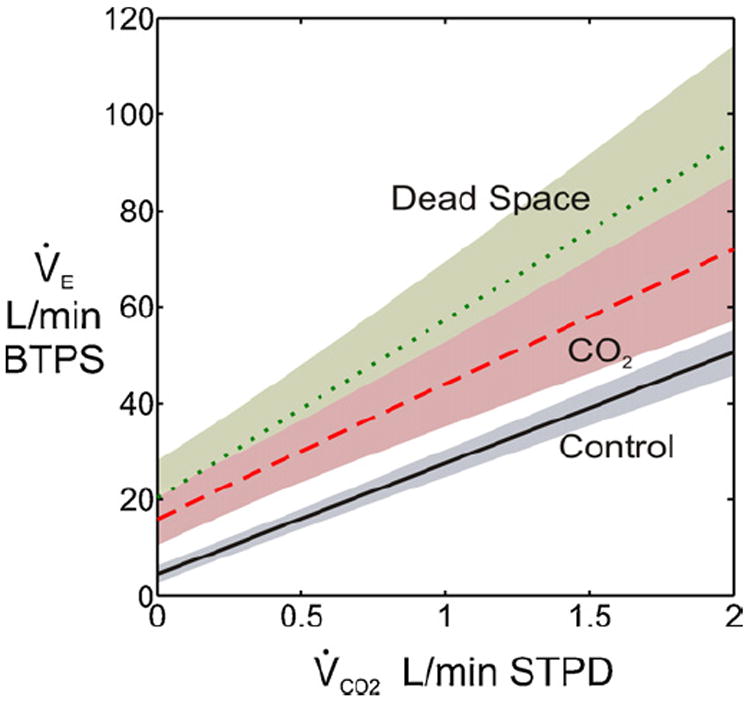
Patients with chronic heart failure (CHF) suffer increased alveolar VD/VT (dead-space-to-tidal-volume ratio), yet they demonstrate augmented pulmonary ventilation such that arterial [Formula: see text] ( [Formula: see text] ) remains remarkably normal from rest to moderate exercise. This paradoxical effect suggests that the control law governing exercise hyperpnea is not merely determined by metabolic CO2 production ( [Formula: see text] ) per se but is responsive to an apparent (real-feel) metabolic CO2 load ( [Formula: see text] ) that also incorporates the adverse effect of physiological VD/VT on pulmonary CO2 elimination. By contrast, healthy individuals subjected to dead space loading also experience augmented ventilation at rest and during exercise as with increased alveolar VD/VT in CHF, but the resultant response is hypercapnic instead of eucapnic, as with CO2 breathing. The ventilatory effects of dead space loading are therefore similar to those of increased alveolar VD/VT and CO2 breathing combined. These observations are consistent with the hypothesis that the increased series VD/VT in dead space loading adds to [Formula: see text] as with increased alveolar VD/VT in CHF, but this is through rebreathing of CO2 in dead space gas thus creating a virtual (illusory) airway CO2 load within each inspiration, as opposed to a true airway CO2 load during CO2 breathing that clogs the mechanism for CO2 elimination through pulmonary ventilation. Thus, the chemosensing mechanism at the respiratory controller may be responsive to putative drive signals mediated by within-breath [Formula: see text] oscillations independent of breath-to-breath fluctuations of the mean [Formula: see text] level. Skeletal muscle afferents feedback, while important for early-phase exercise cardioventilatory dynamics, appears inconsequential for late-phase exercise hyperpnea.
慢性心力衰竭(CHF)患者的肺泡死腔/潮气量比(VD/VT)增加,但他们的肺通气增加,以致动脉血二氧化碳分压([Formula: see text])在休息到中等运动期间仍保持显著正常。这种矛盾的影响表明,控制运动过度通气的控制规律不仅取决于代谢性 CO2 产生([Formula: see text])本身,还取决于对明显(实际感觉)代谢性 CO2 负荷([Formula: see text])的反应,而这种负荷还包括生理 VD/VT 对肺 CO2 清除的不利影响。相比之下,健康人在休息和运动时也会因肺泡 VD/VT 增加而出现通气增加,就像 CHF 中的情况一样,但由于生理 VD/VT 对肺 CO2 清除的不利影响,导致结果是高碳酸血症而不是低碳酸血症,就像 CO2 呼吸一样。死腔负荷的通气效应因此类似于肺泡 VD/VT 增加和 CO2 呼吸的综合效应。这些观察结果与假设一致,即死腔负荷中增加的串联 VD/VT 像 CHF 中增加的肺泡 VD/VT 一样增加了[Formula: see text],但这是通过在死腔气体中再呼吸 CO2 而产生的虚拟(错觉)气道 CO2 负荷,而不是在 CO2 呼吸期间的真实气道 CO2 负荷,后者通过肺通气阻塞 CO2 消除机制。因此,呼吸控制器的化学感觉机制可能对呼吸内[Formula: see text]振荡介导的假定驱动信号做出反应,而与平均[Formula: see text]水平的呼吸间波动无关。虽然骨骼肌传入反馈对于早期运动心血管动力学很重要,但对于后期运动过度通气似乎不重要。