Lifestyle and Life Course Epidemiology Group, School of Public Health, Li Ka Shing Faculty of Medicine, The University of Hong Kong, Hong Kong SAR, People's Republic of China.
PLoS One. 2012;7(12):e52575. doi: 10.1371/journal.pone.0052575. Epub 2012 Dec 20.
Observational studies, mainly from Western populations, suggest dairy consumption is inversely associated with adiposity. However, in these populations the intake range is limited and both diet and obesity may share social patterning. Evidence from non-Western developed settings with different social patterning, is valuable in distinguishing whether observed associations are biologically mediated or socially confounded.
To examine the associations of milk or other dairy product consumption with adolescent obesity.
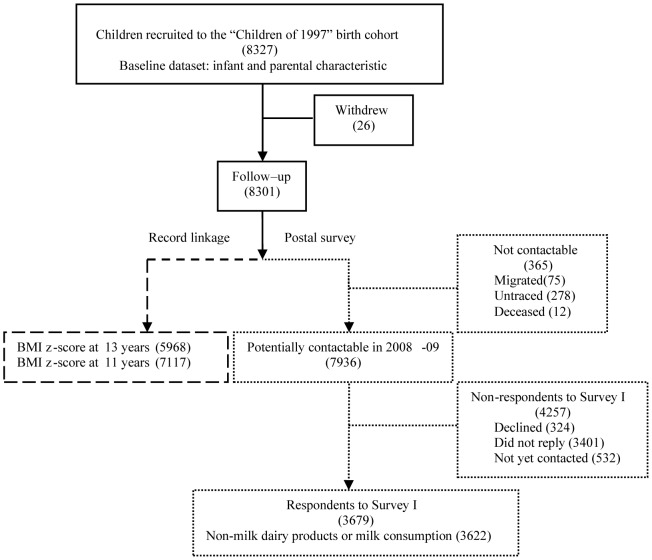
We used multivariable linear regression models to examine the associations of milk or other dairy product consumption, obtained from a food frequency questionnaire, at 11 years with body mass index (BMI) z-scores at 13 years and waist hip ratio (WHR) at 11 years, in 5,968 adolescents from a Chinese birth cohort, comprising 88% of births in April and May 1997. We used multiple imputation for missing exposures and confounders.
Only 65.7% regularly consumed milk and 72.4% other dairy products. Milk and other dairy product consumption was positively associated with socio-economic position but not with BMI z-score or WHR, with or without adjustment for sex, mother's birthplace, parental education, physical activity and other food consumption.
The lack of association of milk and other dairy product consumption with adiposity in a non-Western setting was not consistent with the majority of evidence from Western settings. Observed anti-obesigenic effects in Western settings may be due to socially patterned confounding.
观察性研究主要来自西方人群,表明乳制品的摄入量与肥胖呈负相关。然而,在这些人群中,摄入量范围有限,饮食和肥胖可能具有共同的社会模式。来自具有不同社会模式的非西方发达国家的证据对于区分观察到的相关性是生物介导的还是社会混淆的非常有价值。
研究牛奶或其他乳制品的摄入量与青少年肥胖之间的关系。
我们使用多变量线性回归模型,研究了来自食物频率问卷的牛奶或其他乳制品的摄入量与 11 岁时的体重指数(BMI)z 分数和 11 岁时的腰围臀围比(WHR)之间的关联,该队列包括 1997 年 4 月和 5 月出生的中国出生队列中的 5968 名青少年,占出生人数的 88%。我们使用多重插补法处理缺失的暴露和混杂因素。
只有 65.7%的人经常喝牛奶,72.4%的人经常食用其他乳制品。牛奶和其他乳制品的摄入量与社会经济地位呈正相关,但与 BMI z 分数或 WHR 无关,无论是否调整性别、母亲的出生地、父母的教育程度、体力活动和其他食物的摄入量。
在非西方环境中,牛奶和其他乳制品的摄入量与肥胖之间缺乏关联,这与大多数来自西方环境的证据不一致。在西方环境中观察到的抗肥胖作用可能是由于社会模式的混杂。