National Centre for Biological Sciences, Tata Institute of Fundamental Research, Bangalore, India.
PLoS One. 2012;7(12):e53031. doi: 10.1371/journal.pone.0053031. Epub 2012 Dec 28.
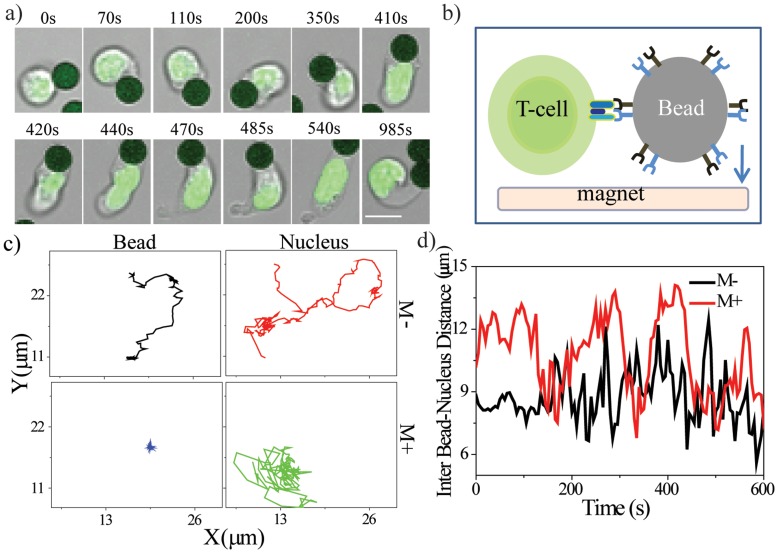
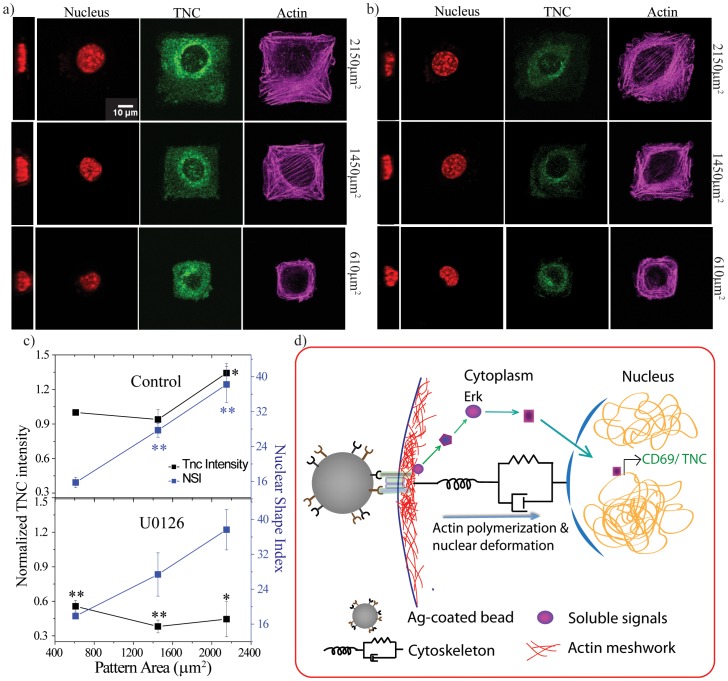
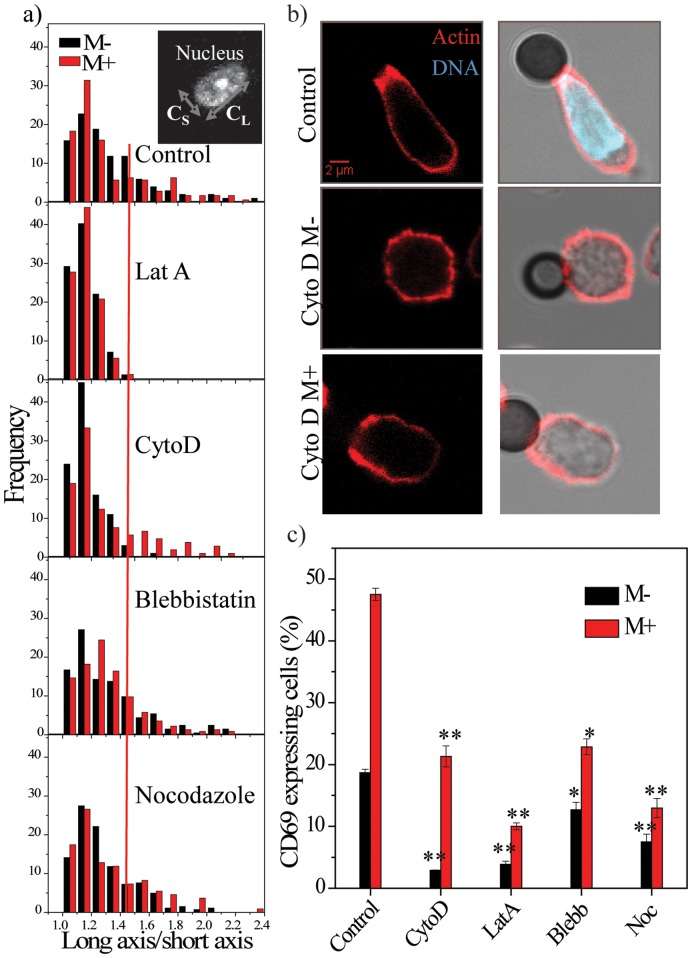
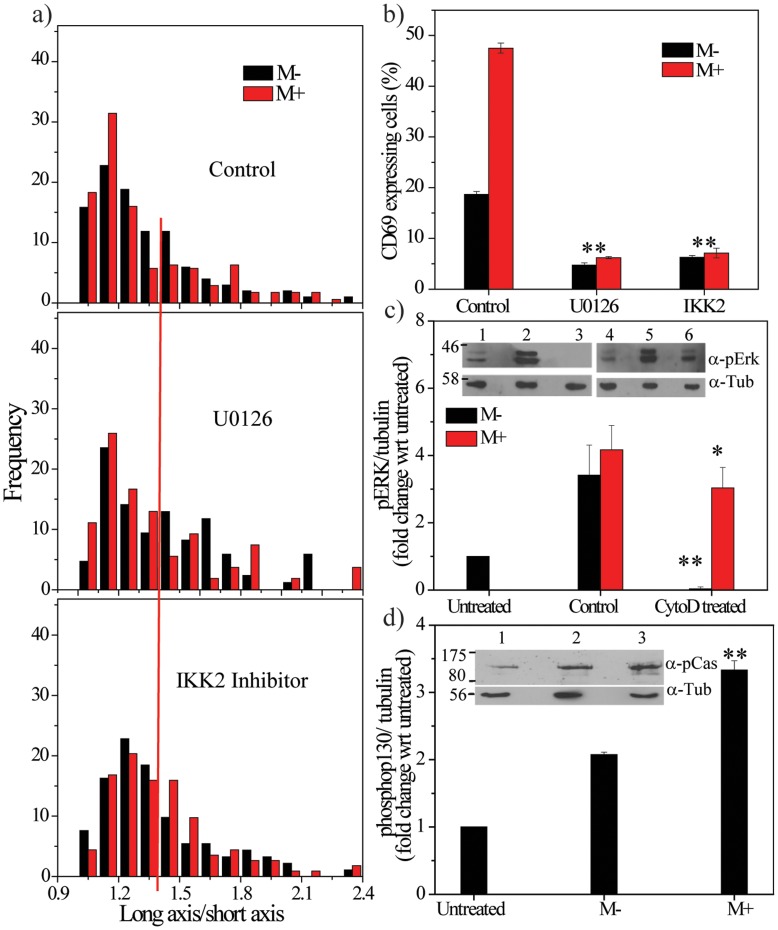
The nucleus of a living cell is constantly undergoing changes in shape and size as a result of various mechanical forces in physiology. These changes correlate with alterations in gene expression, however it is unclear whether nuclear deformation alone is sufficient to elicit these alterations. We used T-cell activation as a model system to test the coupling between nuclear deformation (elongation) and gene expression. Naïve T-cell activation with surrogate antigens resulted in actin dependent nuclear elongation. This was accompanied with Erk and NF-κB signaling to the nucleus to induce CD69 expression. Importantly, inhibiting actin polymerization abolished both nuclear elongation and CD69 expression, while inhibiting Erk, NF-κB or microtubule depolymerization only abolished expression but not elongation. Immobilization of antigen-coated beads, under conditions where actin polymerization was inhibited, rescued both nuclear elongation and CD69 expression. In addition, fibroblast cells plated on fibronectin micropatterns of different sizes showed correlation between nuclear shape index and tenascin C expression. Upon inhibiting the signaling intermediate Erk, tenascin C expression was down regulated although the nuclear shape index remained unaltered. Our results highlight the importance of specific signaling intermediates accompanied with nuclear deformation in the modulation of cellular genomic programs.
活细胞的核由于生理过程中的各种机械力而不断发生形状和大小的变化。这些变化与基因表达的改变相关,但核变形本身是否足以引起这些改变尚不清楚。我们使用 T 细胞激活作为模型系统来测试核变形(伸长)与基因表达之间的耦合。替代抗原激活幼稚 T 细胞导致肌动蛋白依赖性核伸长。这伴随着 Erk 和 NF-κB 信号向核内传递以诱导 CD69 的表达。重要的是,抑制肌动蛋白聚合不仅会破坏核伸长和 CD69 的表达,还会破坏微管解聚,但不会破坏表达而只破坏伸长。在抑制肌动蛋白聚合的情况下,固定包被有抗原的珠子,可挽救核伸长和 CD69 的表达。此外,在不同大小的纤维连接蛋白微图案上接种成纤维细胞显示核形状指数与腱蛋白 C 表达之间存在相关性。抑制信号中间物 Erk 后,腱蛋白 C 的表达下调,尽管核形状指数保持不变。我们的结果强调了特定信号中间物伴随着核变形在调节细胞基因组程序中的重要性。