Division of Cancer, Surgery and Transplantation, Oslo University Hospital, P.O. Box 4956, Oslo, 0424, Norway.
Support Care Cancer. 2013 Jun;21(6):1677-84. doi: 10.1007/s00520-012-1713-3. Epub 2013 Jan 13.
Patient-reported outcomes are important for clinical practice and research, and should reflect what patients perceive as important. The objective of this study was to develop and preliminarily validate a brief, patient-derived, disease-specific tool, the pancreatic cancer disease impact (PACADI) score.
The development was performed in two phases. Forty-one patients with confirmed pancreatic cancer (PC) selected dimensions of health related to the impact of the disease. A weighting of the eight most frequently reported dimensions was performed in a second sample of 80 PC patients who also rated the impact on eight numeric rating scales (NRS, range 0 to 10). The relative weights and the scores from the NRS were used to compute the PACADI score (range 0 to 10). The patients also completed Edmonton Symptom Assessment System (ESAS) and EQ-5D.
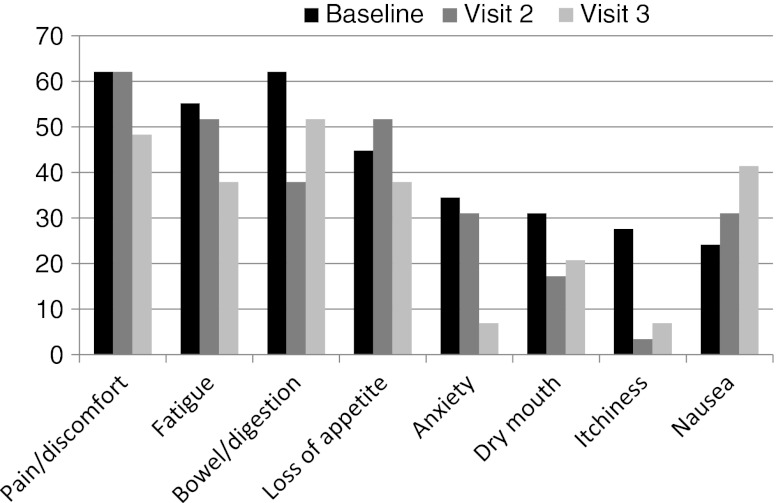
Dimensions reported by more than 20% of the patients were included in the PACADI score (relative weights in parenthesis): pain/discomfort (0.16), fatigue (0.16), anxiety (0.15), bowel/digestive problems (0.14), loss of appetite (0.13), dry mouth (0.11), itchiness (0.08), and nausea (0.07). The PACADI score in the 80 PC patients had a mean (SD) value of 3.26 (2.06) (95% CI 2.80, 3.71), was moderately to strongly correlated to ESAS sense of well-being (r = 0.69) and EQ-5D (r = -0.52), and discriminated significantly between patients with and without PC.
The PACADI score is a new eight-item, patient-derived, disease-specific measure. Preliminary validation regarding construct validity and discrimination encourages further validation in independent patient samples.
患者报告的结局对于临床实践和研究很重要,应该反映患者认为重要的内容。本研究的目的是开发并初步验证一种简短的、源自患者的、针对特定疾病的工具,即胰腺癌疾病影响(PACADI)评分。
该研究分两个阶段进行。41 名确诊为胰腺癌(PC)的患者选择了与疾病影响相关的健康维度。在第二组 80 名 PC 患者中,对这 8 个最常报告的维度进行了加权,这些患者还对 8 个数字评定量表(NRS,范围 0 到 10)的影响进行了评分。NRS 的相对权重和评分用于计算 PACADI 评分(范围 0 到 10)。患者还完成了埃德蒙顿症状评估系统(ESAS)和 EQ-5D 量表。
超过 20%的患者报告的维度被纳入 PACADI 评分(括号中为相对权重):疼痛/不适(0.16)、疲劳(0.16)、焦虑(0.15)、肠道/消化问题(0.14)、食欲减退(0.13)、口干(0.11)、瘙痒(0.08)和恶心(0.07)。80 名 PC 患者的 PACADI 评分均值(SD)为 3.26(2.06)(95%CI 2.80,3.71),与 ESAS 幸福感(r=0.69)和 EQ-5D(r=-0.52)中度至高度相关,并且能够显著区分有和无 PC 的患者。
PACADI 评分是一种新的八项、源自患者的、针对特定疾病的测量工具。初步验证了其结构有效性和区分能力,鼓励在独立患者样本中进一步验证。