Department of Public Health, Erasmus MC, University Medical Center Rotterdam, Rotterdam, The Netherlands.
Malar J. 2013 Jan 14;12:18. doi: 10.1186/1475-2875-12-18.
Malaria control has been dramatically scaled up the past decade, mainly thanks to increasing international donor financing since 2003. This study assessed progress up to 2010 towards global malaria impact targets, in relation to Global Fund, other donor and domestic malaria programme financing over 2003 to 2009.
Assessments used domestic malaria financing reported by national programmes, and Global Fund/OECD data on donor financing for 90 endemic low- and middle-income countries, WHO estimates of households owning one or more insecticide-treated mosquito net (ITN) for countries in sub-Saharan Africa, and WHO-estimated malaria case incidence and deaths in countries outside sub-Saharan Africa.
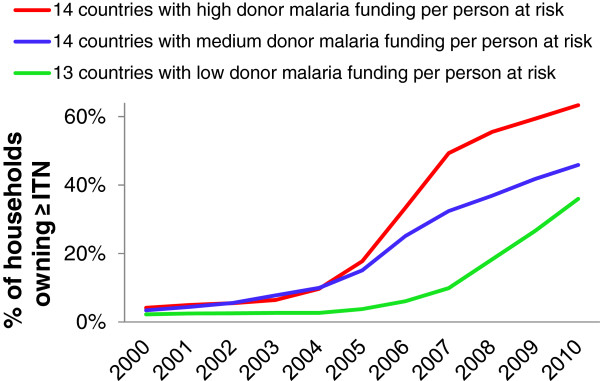
Global Fund and other donor funding is concentrated in a subset of the highest endemic African countries. Outside Africa, donor funding is concentrated in those countries with highest malaria mortality and case incidence rates over the years 2000 to 2003. ITN coverage in 2010 in Africa, and declines in case and death rates per person at risk over 2004 to 2010 outside Africa, were greatest in countries with highest donor funding per person at risk, and smallest in countries with lowest donor malaria funding per person at risk. Outside Africa, all-source malaria programme funding over 2003 to 2009 per case averted ($56-5,749) or per death averted ($58,000-3,900,000) over 2004 to 2010 tended to be lower (more favourable) in countries with higher donor malaria funding per person at risk.
Increases in malaria programme funding are associated with accelerated progress towards malaria control targets. Associations between programme funding per person at risk and ITN coverage increases and declines in case and death rates suggest opportunities to maximize the impact of donor funding, by strategic re-allocation to countries with highest continued need.
过去十年中,疟疾控制工作取得了显著进展,这主要得益于自 2003 年以来国际捐助者提供的资金不断增加。本研究评估了 2003 年至 2009 年期间,全球基金、其他捐助者和国内疟疾规划资金投入与全球疟疾影响目标之间的关系。
评估使用了国家规划报告的国内疟疾资金,全球基金/经合组织的捐助者为 90 个流行中低收入国家提供资金的数据,世界卫生组织对撒哈拉以南非洲国家拥有一个或多个驱虫蚊帐的家庭的估计,以及世界卫生组织对撒哈拉以南非洲以外国家疟疾发病和死亡的估计。
全球基金和其他捐助者的资金主要集中在一些疟疾流行程度最高的非洲国家。在非洲以外,捐助者的资金主要集中在那些疟疾死亡率和发病病例率最高的国家,这些国家在 2000 年至 2003 年期间。2010 年,非洲的驱虫蚊帐覆盖率以及 2004 年至 2010 年期间,非洲以外每有一人处于危险之中,疟疾发病率和死亡率的下降幅度最大的国家是那些人均受援资金最高的国家,而人均受援疟疾资金最低的国家则最小。在非洲以外,2003 年至 2009 年,每例病例避免发生(56 美元至 5749 美元)或每例死亡避免发生(58000 美元至 3900000 美元)的全源疟疾规划资金,在人均受援疟疾资金较高的国家往往较低(更有利)。
疟疾规划资金的增加与朝着疟疾控制目标的加速进展相关。人均风险规划资金与驱虫蚊帐覆盖率增加以及发病率和死亡率下降之间的关联表明,通过战略重新分配给持续需求最高的国家,有机会最大限度地发挥捐助者资金的影响。