University of Bordeaux, ISPED, Centre INSERM U897-Epidemiologie-Biostatistique, Bordeaux, France.
PLoS One. 2013;8(1):e52755. doi: 10.1371/journal.pone.0052755. Epub 2013 Jan 11.
Numerous studies have looked at the potential benefits of various nootropic drugs such as Ginkgo biloba extract (EGb761®; Tanakan®) and piracetam (Nootropyl®) on age-related cognitive decline often leading to inconclusive results due to small sample sizes or insufficient follow-up duration. The present study assesses the association between intake of EGb761® and cognitive function of elderly adults over a 20-year period.
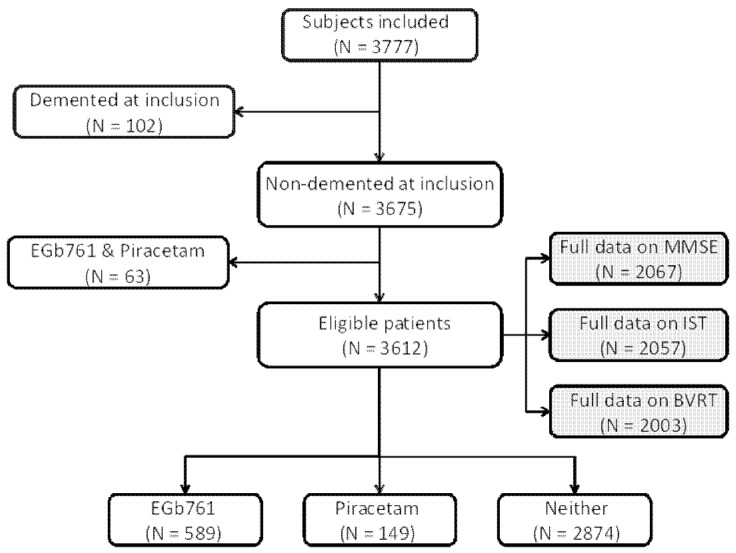
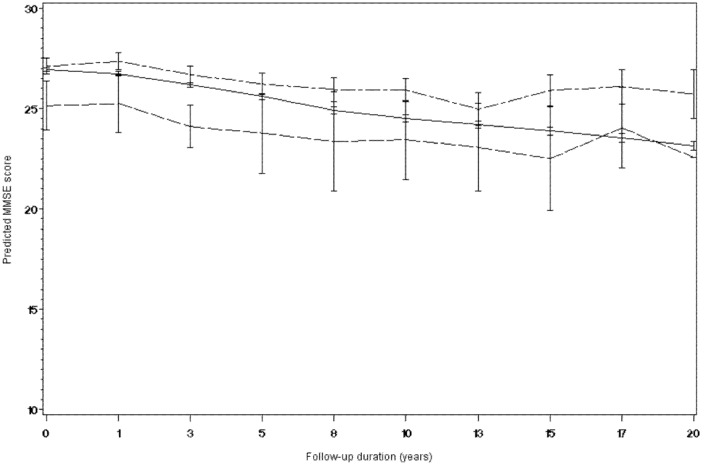
The data were gathered from the prospective community-based cohort study 'Paquid'. Within the study sample of 3612 non-demented participants aged 65 and over at baseline, three groups were compared: 589 subjects reporting use of EGb761® at at least one of the ten assessment visits, 149 subjects reporting use of piracetam at one of the assessment visits and 2874 subjects not reporting use of either EGb761® or piracetam. Decline on MMSE, verbal fluency and visual memory over the 20-year follow-up was analysed with a multivariate mixed linear effects model. A significant difference in MMSE decline over the 20-year follow-up was observed in the EGb761® and piracetam treatment groups compared to the 'neither treatment' group. These effects were in opposite directions: the EGb761® group declined less rapidly than the 'neither treatment' group, whereas the piracetam group declined more rapidly (β = -0.6). Regarding verbal fluency and visual memory, no difference was observed between the EGb761® group and the 'neither treatment' group (respectively, β = 0.21 and β = -0.03), whereas the piracetam group declined more rapidly (respectively, β = -1.40 and β = -0.44). When comparing the EGb761® and piracetam groups directly, a different decline was observed for the three tests (respectively β = -1.07, β = -1.61 and β = -0.41).
Cognitive decline in a non-demented elderly population was lower in subjects who reported using EGb761® than in those who did not. This effect may be a specific medication effect of EGb761®, since it was not observed for another nootropic medication, piracetam.
许多研究都着眼于银杏叶提取物(EGb761®;Tanakan®)和吡拉西坦(Nootropyl®)等各种益智药对与年龄相关的认知能力下降的潜在益处,但由于样本量小或随访时间不足,往往得出不一致的结果。本研究评估了在 20 年期间,老年人服用 EGb761®与认知功能之间的关联。
数据来自前瞻性社区为基础的队列研究“Paquid”。在基线时年龄在 65 岁及以上的 3612 名非痴呆参与者的研究样本中,比较了三组:589 名报告在至少十次评估访视中使用 EGb761®的受试者、149 名报告在一次评估访视中使用吡拉西坦的受试者和 2874 名未报告使用 EGb761®或吡拉西坦的受试者。使用多变量混合线性效应模型分析 20 年随访期间 MMSE、言语流畅性和视觉记忆的下降情况。与“未治疗”组相比,EGb761®和吡拉西坦治疗组在 20 年随访期间的 MMSE 下降有显著差异。这些影响方向相反:EGb761®组比“未治疗”组下降速度较慢,而吡拉西坦组下降速度较快(β= -0.6)。关于言语流畅性和视觉记忆,EGb761®组与“未治疗”组之间无差异(分别为β= 0.21 和β= -0.03),而吡拉西坦组下降速度较快(分别为β= -1.40 和β= -0.44)。当直接比较 EGb761®和吡拉西坦组时,三个测试的下降情况不同(分别为β= -1.07、β= -1.61 和β= -0.41)。
在非痴呆的老年人群中,报告使用 EGb761®的受试者认知能力下降速度低于未使用者。这种影响可能是 EGb761®的一种特定药物作用,因为在另一种益智药吡拉西坦中没有观察到这种作用。