Jakobsen Anna, Laurberg Peter, Vestergaard Peter, Andersen Stig
Arctic Health Research Centre, Aalborg University Hospital, Aalborg, Denmark.
Int J Circumpolar Health. 2013;72:19596. doi: 10.3402/ijch.v72i0.19596. Epub 2013 Jan 11.
Osteoporosis is a debilitating condition characterized by fractures, pain and premature death. Risk factors for osteoporosis predict the risk of fragility fractures.
To describe the occurrence of risk factors for osteoporosis among populations in Nuuk, the capital of Greenland.
A random sample of women born in 1934-42, 1945-47, 1956, and men born in 1956 were selected from the national civil registry. A questionnaire was sent out in Greenlandic and Danish on risk factors for osteoporosis: family history, smoking habits, alcohol intake, presence of disease, sun exposure, intake of dairy products, age at menopause (women) and number of falls. Additional questions included the frequency of back pain, previous fractures, intake of vitamin D and calcium supplements, use of anti-osteoporotic drugs, steroids and other drugs.
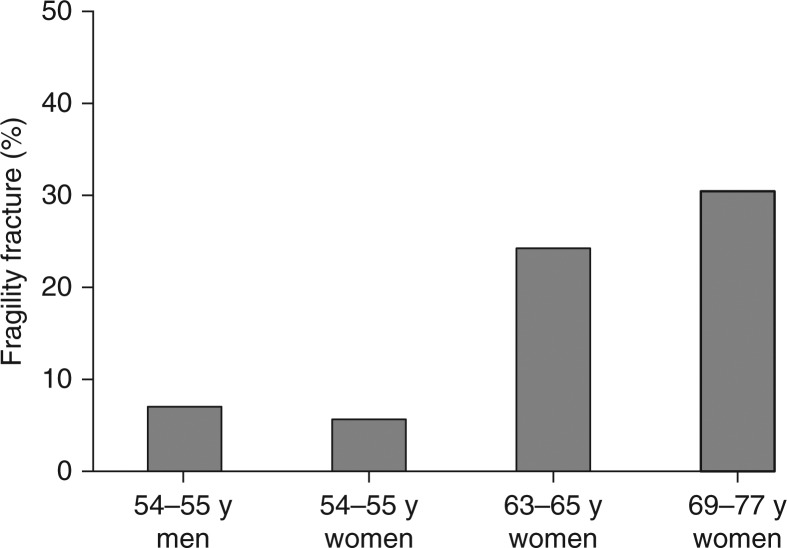
The questionnaire was sent to 317 subjects confirmed to be living at an address in Nuuk and 181 (57.1%) responded. More young women than older women were smokers (60.6% vs. 35.0%; p=0.022) while limited sun exposure was reported by more of the old women (37.2% vs. 5.6%; p=0.003). Family history of osteoporosis was reported by 15.0%, without difference between groups. Alcohol and milk intake did not differ between groups. Premature menopause was reported by 17.9% of the women. Falls within the last year were reported by 42.4% with fewer falls in the oldest age group (21.9% vs. 50.0%; p=0.005). Frequency of fragility fractures increased with age (5.7% vs. 24.3% vs. 30.4%; p=0.02) and the risk of a fragility fracture increased with age (p=0.004; OR, 95% CI: 4.5, 1.6-12.2, reference: below 70 years), when adjusted for smoking, gender and falls. The use of anti-osteoporotic drugs was low (3.4%) while 28.8% took calcium and vitamin D supplements.
Age is a dominating risk factor for fragility fractures in Greenland. The use of anti-osteoporotic drugs is low in Greenland, even if osteoporotic fractures are common in old age.
骨质疏松症是一种使人衰弱的病症,其特征为骨折、疼痛和过早死亡。骨质疏松症的风险因素可预测脆性骨折的风险。
描述格陵兰首府努克人群中骨质疏松症风险因素的发生情况。
从国家民事登记处随机抽取1934年至1942年、1945年至1947年出生的女性以及1956年出生的女性和1956年出生的男性。用格陵兰语和丹麦语发放了一份关于骨质疏松症风险因素的问卷:家族病史、吸烟习惯、酒精摄入量、疾病状况、日照情况、乳制品摄入量、绝经年龄(女性)和跌倒次数。其他问题包括背痛频率、既往骨折情况、维生素D和钙补充剂的摄入量、抗骨质疏松药物、类固醇和其他药物的使用情况。
问卷发送给了317名确认居住在努克某地址的受试者,181人(57.1%)回复。年轻女性吸烟者比老年女性多(60.6%对35.0%;p = 0.022),而老年女性报告日照有限的更多(37.2%对5.6%;p = 0.003)。报告有骨质疏松症家族病史的占15.0%,各群体间无差异。各群体间酒精和牛奶摄入量无差异。17.9%的女性报告有过早绝经情况。42.4%的人报告在过去一年中有跌倒,年龄最大的年龄组跌倒次数较少(21.9%对50.0%;p = 0.005)。脆性骨折的发生率随年龄增加而升高(5.7%对24.3%对30.4%;p = 0.02),在调整吸烟、性别和跌倒因素后,脆性骨折的风险随年龄增加而升高(p = 0.004;比值比,95%置信区间:4.5,1.6 - 12.2,参照:70岁以下)。抗骨质疏松药物的使用率较低(3.4%),而28.8%的人服用钙和维生素D补充剂。
年龄是格陵兰脆性骨折的主要风险因素。格陵兰抗骨质疏松药物的使用率较低,尽管骨质疏松性骨折在老年人中很常见。