Nutrition Research and Metabolism Core, North Carolina Translational Clinical Sciences Institute, 101 Manning Drive, CB#7600, University of North Carolina at Chapel Hill, Chapel Hill, NC 27599, USA.
Br J Nutr. 2013 Aug 28;110(3):559-68. doi: 10.1017/S0007114512005181. Epub 2013 Jan 18.
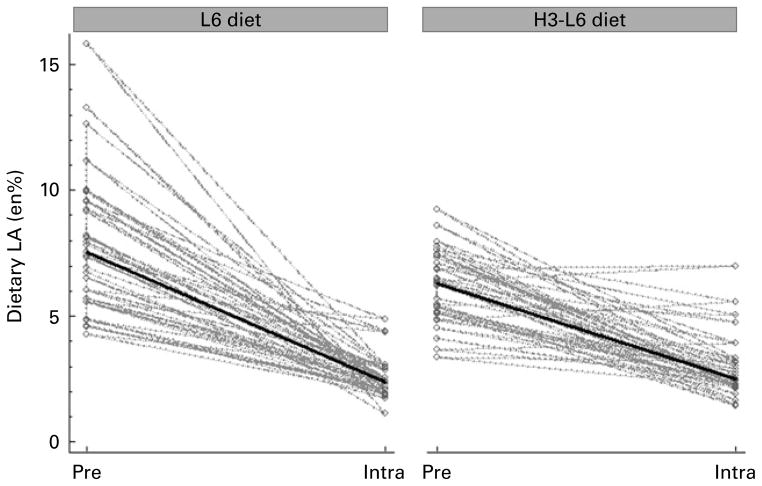
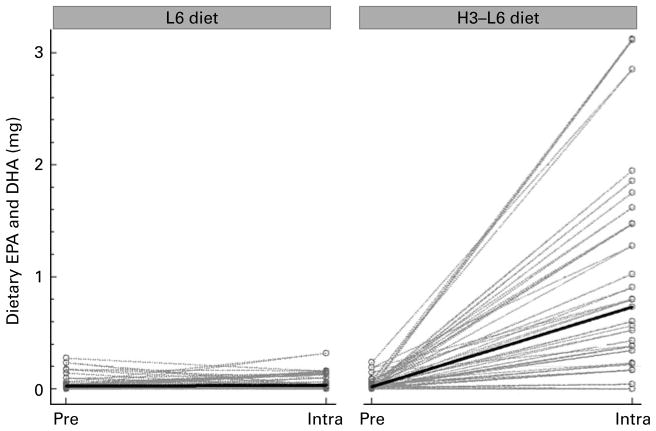
Few trials have evaluated the metabolic effects and health outcomes of lowering dietary n-6 PUFA. The objectives of the present paper were (1) to report the methods employed to lower dietary n-6 PUFA, while either increasing or maintaining n-3 PUFA intake and (2) to validate our methods with 24 h recalls and erythrocyte fatty acid analyses. A total of sixty-seven subjects were randomised to either (1) an average-n-3 PUFA, low-n-6 PUFA (L6) intervention designed to lower linoleic acid (LA; #2·5% of energy (en%)) and arachidonic acid (#60 mg/d), while maintaining an average US intake of n-3 PUFA or (2) a high-n-3 PUFA, low-n-6 PUFA (H3-L6) intervention designed to lower n-6 LA, while increasing the n-3 PUFA a-linolenic acid (ALA; $1·5 en%) and EPA þ DHA ($1000 mg/d). Pre- and intraintervention nutrient intakes were estimated with six 24 h dietary recalls per subject. Both groups achieved the targeted reductions in dietary LA to #2·5 en% (median LA 2·45 (2·1, 3·1); P,0·001). Intakes of n-3 PUFA did not change for the L6 group. Target increases in n-3 ALA (median 1·6 en%, (1·3, 2·0), P,0·001) and EPA þ DHA (1482 mg, (374, 2558), P,0·001) were achieved in the H3-L6 group. Dietary changes were validated by corresponding changes in erythrocyte n-6 and n-3 fatty acid composition. Dietary LA can be lowered to #2·5 en%, with or without concurrent increases in dietary n-3 PUFA, in an outpatient clinical trial setting using this integrated diet method.
很少有试验评估降低饮食 n-6 PUFA 的代谢影响和健康结果。本研究的目的是:(1) 报告降低饮食 n-6 PUFA 而同时增加或维持 n-3 PUFA 摄入的方法;(2) 通过 24 小时回顾和红细胞脂肪酸分析验证我们的方法。共有 67 名受试者随机分为以下两组:(1) 平均 n-3 PUFA、低 n-6 PUFA (L6) 干预组,旨在降低亚油酸 (LA;#2.5%能量 (en%)) 和花生四烯酸 (#60 mg/d),同时维持美国平均 n-3 PUFA 摄入量;(2) 高 n-3 PUFA、低 n-6 PUFA (H3-L6) 干预组,旨在降低 n-6 LA,同时增加 n-3 PUFA a-亚麻酸 (ALA;$1.5 en%) 和 EPA+DHA ($1000 mg/d)。每位受试者进行了 6 次 24 小时膳食回顾,以估计干预前后的营养素摄入量。两组均实现了饮食 LA 降低至 #2.5 en%的目标(中位数 LA 2.45 (2.1, 3.1);P,0.001)。L6 组 n-3 PUFA 摄入量没有变化。H3-L6 组 n-3 ALA 的目标增加量(中位数 1.6 en%,(1.3, 2.0),P,0.001)和 EPA+DHA(1482 mg,(374, 2558),P,0.001)实现了目标。红细胞 n-6 和 n-3 脂肪酸组成的相应变化验证了饮食的变化。在门诊临床试验环境中,使用这种综合饮食方法,饮食 LA 可降低至 #2.5 en%,同时或不伴饮食 n-3 PUFA 的增加。