Institute for Learning and Brain Sciences, University of Washington, 1715 Columbia Road N, Box 357988, Seattle, WA 98195, USA.
Neuroimage. 2014 Jan 1;84:681-7. doi: 10.1016/j.neuroimage.2013.09.061. Epub 2013 Oct 3.
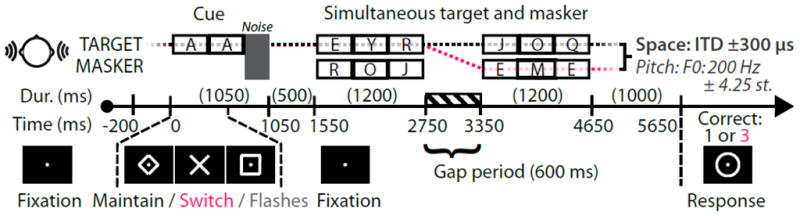
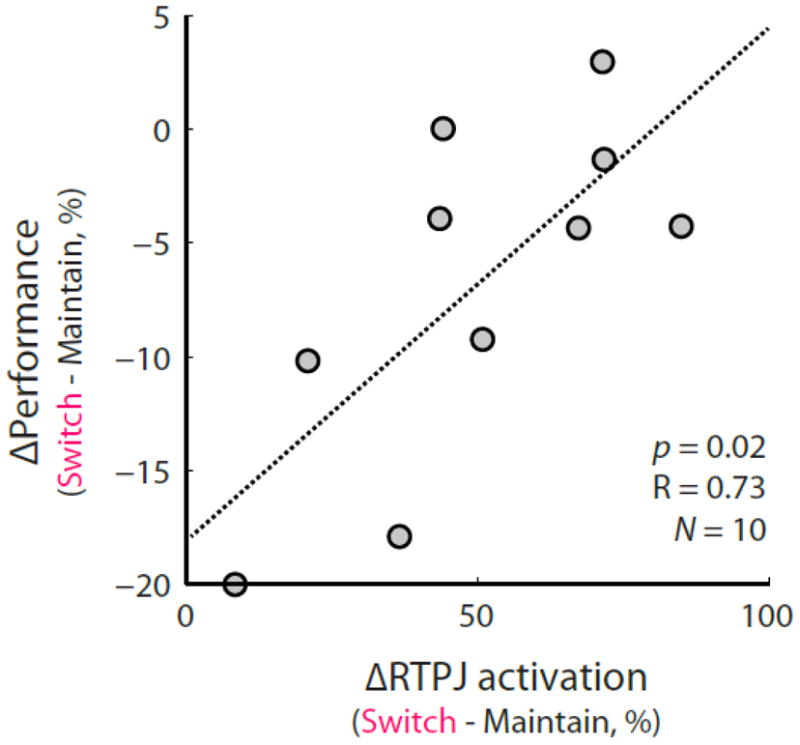
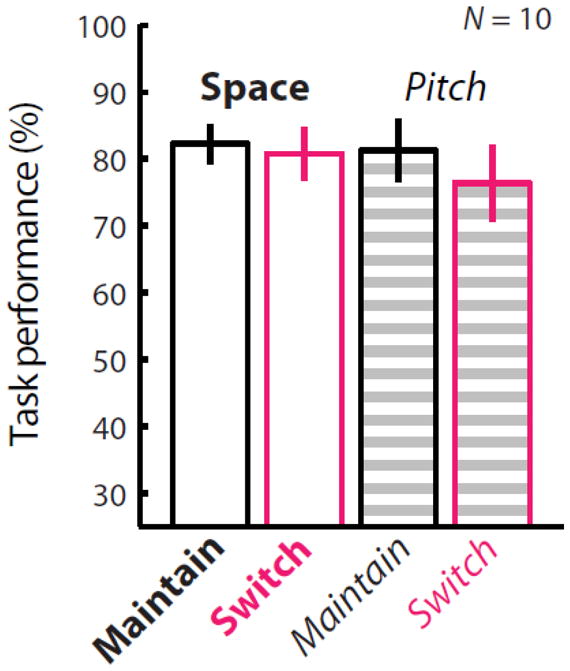
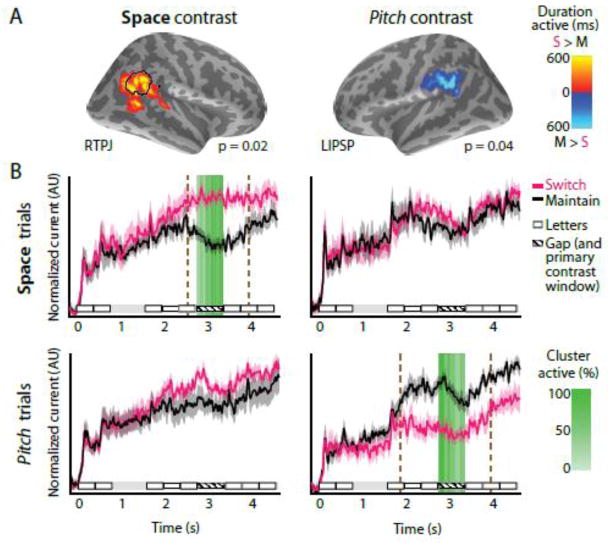
Switching attention between different stimuli of interest based on particular task demands is important in many everyday settings. In audition in particular, switching attention between different speakers of interest that are talking concurrently is often necessary for effective communication. Recently, it has been shown by multiple studies that auditory selective attention suppresses the representation of unwanted streams in auditory cortical areas in favor of the target stream of interest. However, the neural processing that guides this selective attention process is not well understood. Here we investigated the cortical mechanisms involved in switching attention based on two different types of auditory features. By combining magneto- and electro-encephalography (M-EEG) with an anatomical MRI constraint, we examined the cortical dynamics involved in switching auditory attention based on either spatial or pitch features. We designed a paradigm where listeners were cued in the beginning of each trial to switch or maintain attention halfway through the presentation of concurrent target and masker streams. By allowing listeners time to switch during a gap in the continuous target and masker stimuli, we were able to isolate the mechanisms involved in endogenous, top-down attention switching. Our results show a double dissociation between the involvement of right temporoparietal junction (RTPJ) and the left inferior parietal supramarginal part (LIPSP) in tasks requiring listeners to switch attention based on space and pitch features, respectively, suggesting that switching attention based on these features involves at least partially separate processes or behavioral strategies.
基于特定任务需求在不同感兴趣的刺激之间切换注意力在许多日常环境中都很重要。在听觉中,特别是在同时有多个感兴趣的说话者说话的情况下,为了进行有效的交流,经常需要在不同的说话者之间切换注意力。最近,多项研究表明,听觉选择性注意抑制了听觉皮质区域中不需要的流的表示,有利于感兴趣的目标流。然而,指导这种选择性注意过程的神经处理机制尚不清楚。在这里,我们研究了基于两种不同听觉特征切换注意力所涉及的皮质机制。通过将磁和脑电图(M-EEG)与解剖 MRI 约束相结合,我们检查了基于空间或音高特征切换听觉注意力所涉及的皮质动力学。我们设计了一个范式,在每个试验的开始,提示听众在同时呈现目标和掩蔽流的过程中切换或保持注意力。通过允许听众在连续目标和掩蔽刺激的间隙中切换,我们能够分离涉及内源性、自上而下注意力切换的机制。我们的结果表明,在需要听众基于空间和音高特征切换注意力的任务中,右侧颞顶联合区(RTPJ)和左侧下顶叶缘上区(LIPSP)的参与存在双重分离,这表明基于这些特征的注意力切换至少涉及部分分离的过程或行为策略。