Neuroscience Center, University of Helsinki Helsinki, Finland ; Institute of General Pathology and Pathophysiology, Russian Academy of Medical Sciences Moscow, Russia ; Scientific Center for Children's Health, Russian Academy of Medical Sciences Moscow, Russia.
Front Mol Neurosci. 2013 Jan 10;5:102. doi: 10.3389/fnmol.2012.00102. eCollection 2012.
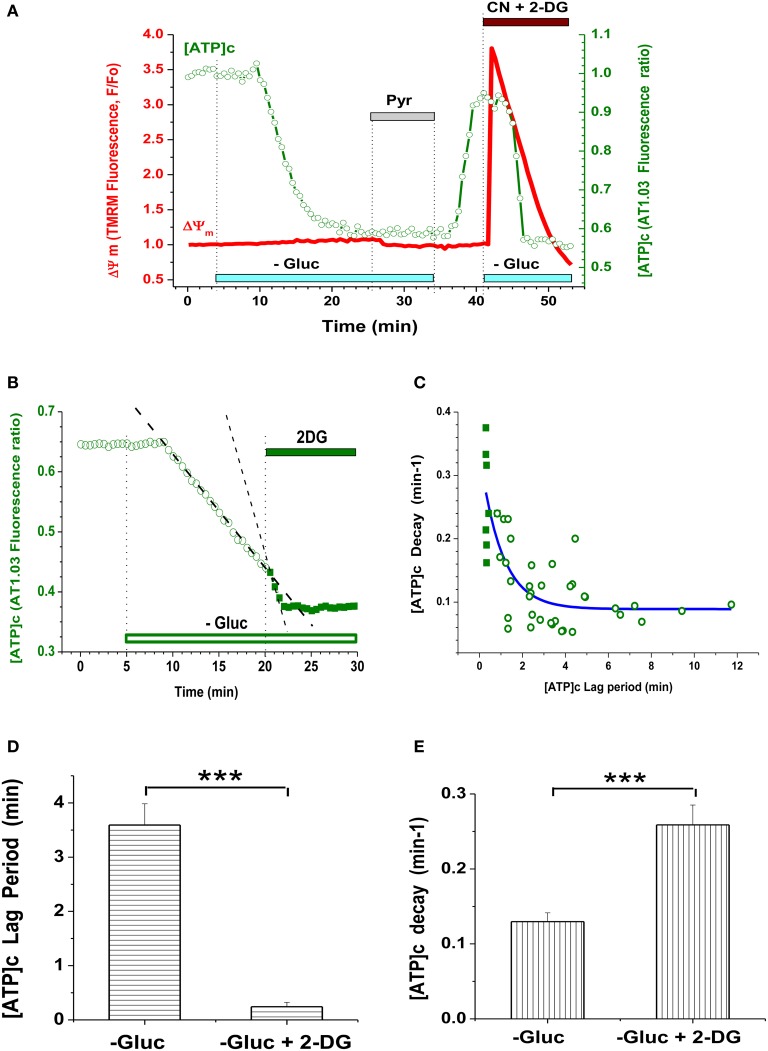
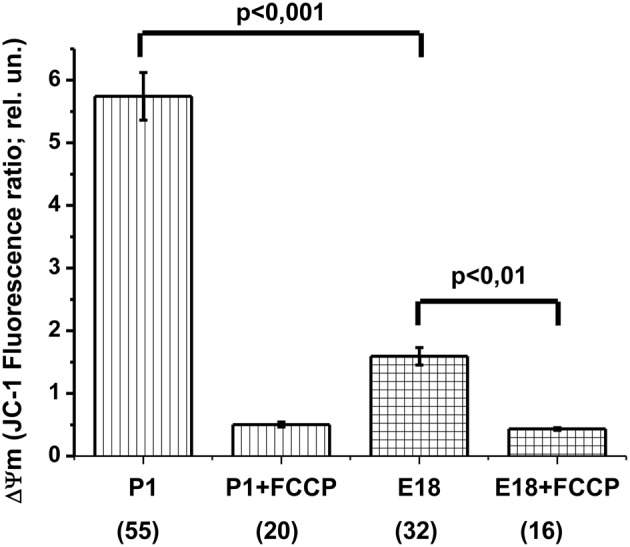
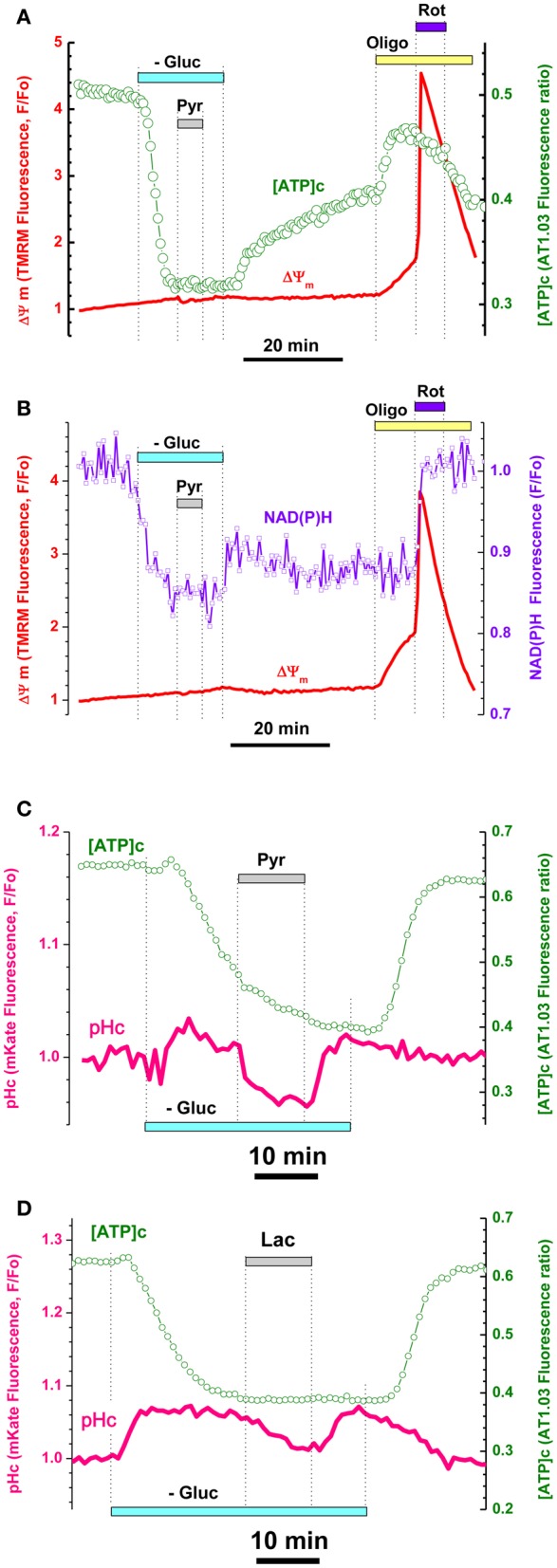
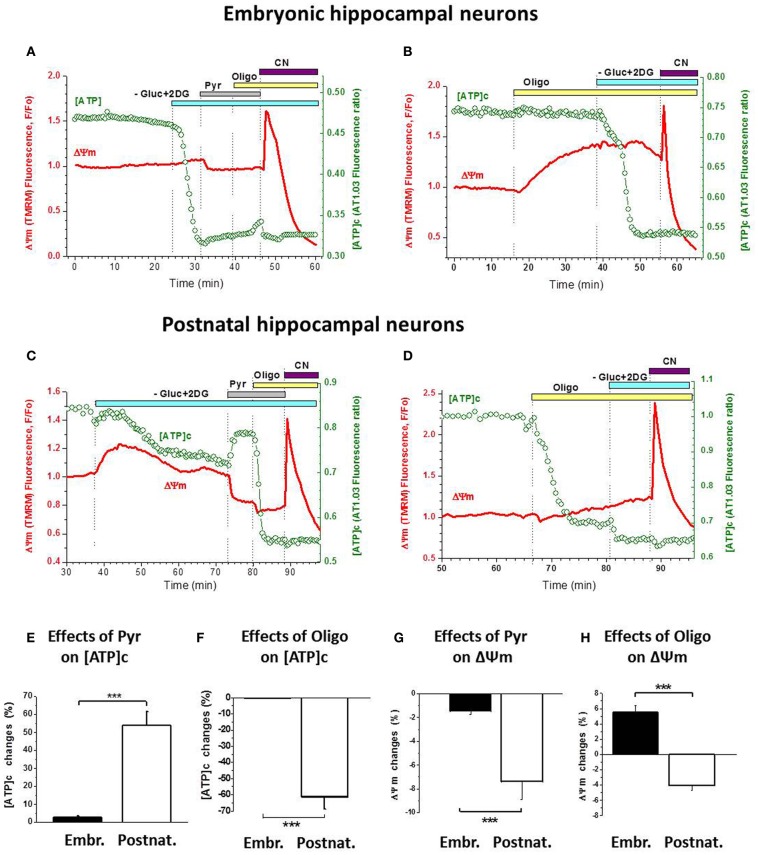
ATP in neurons is commonly believed to be synthesized mostly by mitochondria via oxidative phosphorylation. Neuronal mitochondria have been studied primarily in culture, i.e., in neurons isolated either from embryos or from neonatal pups. Although it is generally assumed that both embryonic and postnatal cultured neurons derive their ATP from mitochondrial oxidative phosphorylation, this has never been tested experimentally. We expressed the FRET-based ATP sensor AT1.03 in cultured hippocampal neurons isolated either from E17 to E18 rat embryos or from P1 to P2 rat pups and monitored [ATP]c simultaneously with mitochondrial membrane potential (ΔΨm; TMRM) and NAD(P)H autofluorescence. In embryonic neurons, transient glucose deprivation induced a near-complete decrease in [ATP]c, which was partially reversible and was accelerated by inhibition of glycolysis with 2-deoxyglucose. In the absence of glucose, pyruvate did not cause any significant increase in [ATP]c in 84% of embryonic neurons, and inhibition of mitochondrial ATP synthase with oligomycin failed to decrease [ATP]c. Moreover, ΔΨm was significantly reduced by oligomycin, indicating that mitochondria acted as consumers rather than producers of ATP in embryonic neurons. In sharp contrast, in postnatal neurons pyruvate added during glucose deprivation significantly increased [ATP]c (by 54 ± 8%), whereas oligomycin induced a sharp decline in [ATP]c and increased ΔΨm. These signs of oxidative phosphorylation were observed in all tested P1-P2 neurons. Measurement of ΔΨm with the potential-sensitive probe JC-1 revealed that neuronal mitochondrial membrane potential was significantly reduced in embryonic cultures compared to the postnatal ones, possibly due to increased proton permeability of inner mitochondrial membrane. We conclude that, in embryonic, but not postnatal neuronal cultures, ATP synthesis is predominantly glycolytic and the oxidative phosphorylation-mediated synthesis of ATP by mitochondrial F1Fo-ATPase is insignificant.
神经元中的 ATP 通常被认为主要通过线粒体的氧化磷酸化合成。神经元线粒体主要在培养物中进行研究,即在从胚胎或新生幼崽中分离的神经元中进行研究。尽管普遍认为胚胎和新生培养的神经元的 ATP 均来自线粒体氧化磷酸化,但这从未经过实验测试。我们在从 E17 至 E18 大鼠胚胎或从 P1 至 P2 大鼠幼崽中分离的培养海马神经元中表达了基于 FRET 的 ATP 传感器 AT1.03,并同时监测 [ATP]c、线粒体膜电位(ΔΨm;TMRM)和 NAD(P)H 自发荧光。在胚胎神经元中,短暂的葡萄糖剥夺会导致 [ATP]c 几乎完全下降,这种下降部分是可逆的,并可通过 2-脱氧葡萄糖抑制糖酵解而加速。在没有葡萄糖的情况下,丙酮酸在 84%的胚胎神经元中不会引起 [ATP]c 的任何显著增加,并且用寡霉素抑制线粒体 ATP 合酶也不能降低 [ATP]c。此外,寡霉素显著降低了 ΔΨm,表明线粒体在胚胎神经元中充当 ATP 的消费者而不是生产者。相比之下,在新生神经元中,在葡萄糖剥夺期间添加丙酮酸会显著增加 [ATP]c(增加 54±8%),而寡霉素则会导致 [ATP]c 急剧下降并增加 ΔΨm。在所有测试的 P1-P2 神经元中都观察到了这些氧化磷酸化的迹象。使用电位敏感探针 JC-1 测量 ΔΨm 表明,与新生神经元相比,胚胎培养物中的神经元线粒体膜电位显著降低,这可能是由于线粒体内膜质子通透性增加所致。我们得出结论,在胚胎神经元培养物中,但不在新生神经元培养物中,ATP 合成主要是糖酵解途径,而线粒体 F1Fo-ATP 酶介导的氧化磷酸化合成 ATP 的作用并不显著。