Health Economics and Decision Science, School of Health and Related Research, University of Sheffield, Sheffield, UK.
Value Health. 2013 Jan-Feb;16(1):104-13. doi: 10.1016/j.jval.2012.09.001.
Health state valuation exercises can be conducted online, but the quality of data generated is unclear.
To investigate whether responses to binary choice health state valuation questions differ by administration mode: online versus face to face.
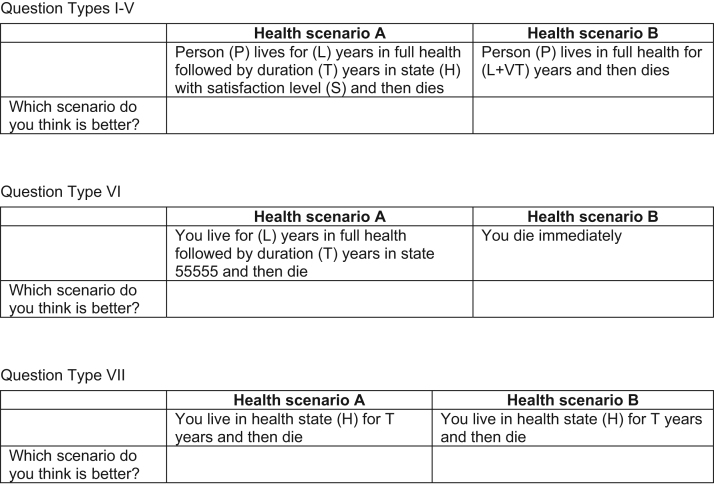
Identical surveys including demographic, self-reported health status, and seven types of binary choice valuation questions were administered in online and computer-assisted personal interview (CAPI) settings. Samples were recruited following procedures employed in typical online or CAPI studies. Analysis included descriptive comparisons of the distribution of responses across the binary options and probit regression to explain the propensity to choose one option across modes of administration, controlling for background characteristics.
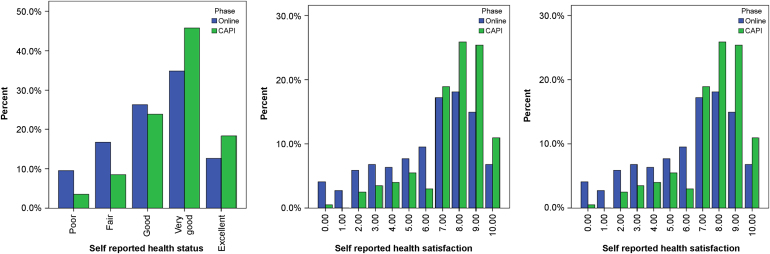
Overall, 422 (221 online; 201 CAPI) respondents completed a survey. There were no overall age or sex differences. Online respondents were educated to a higher level than were the CAPI sample and general population, and employment status differed. CAPI respondents reported significantly better general health and health/life satisfaction. CAPI took significantly longer to complete. There was no effect of the mode of administration on responses to the valuation questions, and this was replicated when demographic differences were controlled.
The findings suggest that both modes may be equally valid for health state valuation studies using binary choice methods (e.g., discrete choice experiments). There are some differences between the observable characteristics of the samples, and the groups may differ further in terms of unobservable characteristics. When designing health state valuation studies, the advantages and disadvantages of both approaches must be considered.
健康状态评估可以在线进行,但生成数据的质量尚不清楚。
调查健康状态二项选择评估问题的答案是否因管理模式(在线与面对面)而异。
采用相同的调查,包括人口统计学、自我报告的健康状况以及七种类型的二项选择评估问题,分别在在线和计算机辅助个人访谈(CAPI)环境中进行。按照典型的在线或 CAPI 研究中的程序招募样本。分析包括对二项选择选项分布的描述性比较,以及使用概率回归来解释跨管理模式选择一种选项的倾向,同时控制背景特征。
共有 422 名(221 名在线;201 名 CAPI)受访者完成了一项调查。在年龄和性别方面没有总体差异。在线受访者的教育程度高于 CAPI 样本和一般人群,且就业状况不同。CAPI 受访者报告的总体健康状况和健康/生活满意度明显更好。CAPI 完成时间明显更长。管理模式对评估问题的回答没有影响,当控制人口统计学差异时也是如此。
这些发现表明,在使用二项选择方法(例如离散选择实验)进行健康状态评估研究时,这两种模式都可能同样有效。样本的可观察特征存在差异,并且在不可观察特征方面,两个群体可能存在进一步的差异。在设计健康状态评估研究时,必须考虑两种方法的优缺点。