Department of Psychology, University of Groningen, Groningen, The Netherlands.
PLoS One. 2013;8(1):e54186. doi: 10.1371/journal.pone.0054186. Epub 2013 Jan 16.
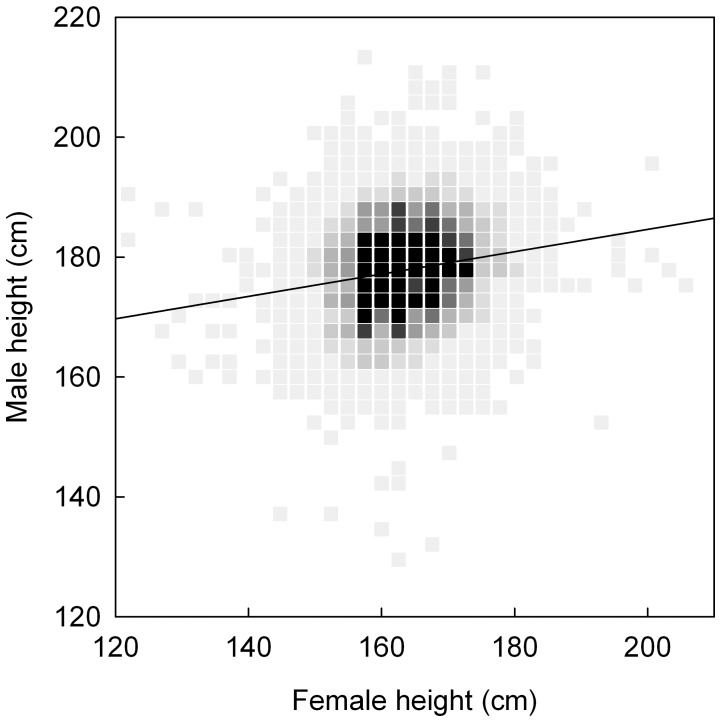
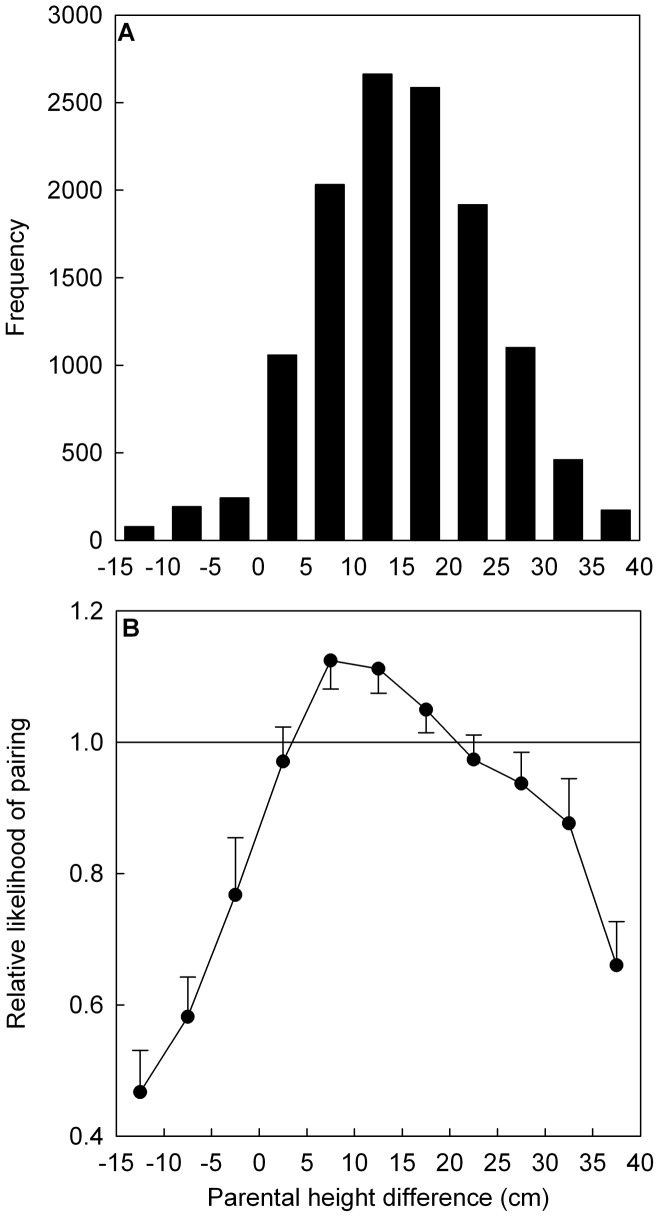
Pair formation, acquiring a mate to form a reproductive unit, is a complex process. Mating preferences are a step in this process. However, due to constraining factors such as availability of mates, rival competition, and mutual mate choice, preferred characteristics may not be realised in the actual partner. People value height in their partner and we investigated to what extent preferences for height are realised in actual couples. We used data from the Millennium Cohort Study (UK) and compared the distribution of height difference in actual couples to simulations of random mating to test how established mate preferences map on to actual mating patterns. In line with mate preferences, we found evidence for: (i) assortative mating (r = .18), (ii) the male-taller norm, and, for the first time, (iii) for the male-not-too-tall norm. Couples where the male partner was shorter, or over 25 cm taller than the female partner, occurred at lower frequency in actual couples than expected by chance, but the magnitude of these effects was modest. We also investigated another preference rule, namely that short women (and tall men) prefer large height differences with their partner, whereas tall women (and short men) prefer small height differences. These patterns were also observed in our population, although the strengths of these associations were weaker than previously reported strength of preferences. We conclude that while preferences for partner height generally translate into actual pairing, they do so only modestly.
配对形成,即形成繁殖单位的伴侣选择,是一个复杂的过程。交配偏好是这个过程的一个步骤。然而,由于伴侣的可获得性、竞争和相互伴侣选择等约束因素,理想特征可能不会在实际伴侣中体现。人们重视伴侣的身高,我们调查了在实际伴侣中身高偏好的实现程度。我们使用了来自千禧年队列研究(英国)的数据,并将实际伴侣中身高差异的分布与随机交配的模拟进行了比较,以检验既定的伴侣偏好如何映射到实际的交配模式上。与伴侣偏好一致,我们发现了以下证据:(i) 交配偏好(r=0.18),(ii) 男性更高的规范,以及,首次发现,(iii) 男性不过于高大的规范。在实际伴侣中,男性伴侣比女性伴侣矮或高 25 厘米以上的情况比随机情况下发生的频率要低,但这些效应的程度是适度的。我们还研究了另一个偏好规则,即矮个子女性(和高个子男性)更喜欢与伴侣有较大的身高差异,而高个子女性(和矮个子男性)则更喜欢身高差异较小。这些模式在我们的人群中也观察到了,尽管这些关联的强度比之前报道的偏好强度要弱。我们的结论是,虽然伴侣身高偏好通常会转化为实际配对,但这种转化程度是适度的。