Key Laboratory of Forest Disaster Warning and Control of Yunnan Province, Southwest Forestry University, Kunming, China.
PLoS One. 2013;8(1):e54411. doi: 10.1371/journal.pone.0054411. Epub 2013 Jan 14.
Host and parasitoid interaction is one of the most fascinating relationships of insects, which is currently receiving an increasing interest. Understanding the mechanisms evolved by the parasitoids to evade or suppress the host immune system is important for dissecting this interaction, while it was still poorly known. In order to gain insight into the immune response of Tenebrio molitor to parasitization by Scleroderma guani, the transcriptome of T. molitor pupae was sequenced with focus on immune-related gene, and the non-parasitized and parasitized T. molitor pupae were analyzed by digital gene expression (DGE) analysis with special emphasis on parasitoid-induced immune-related genes using Illumina sequencing.
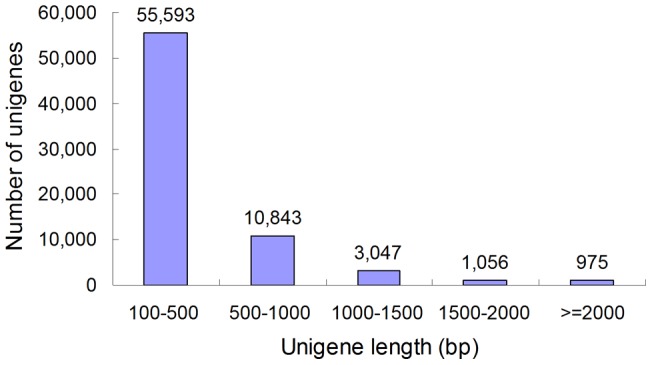
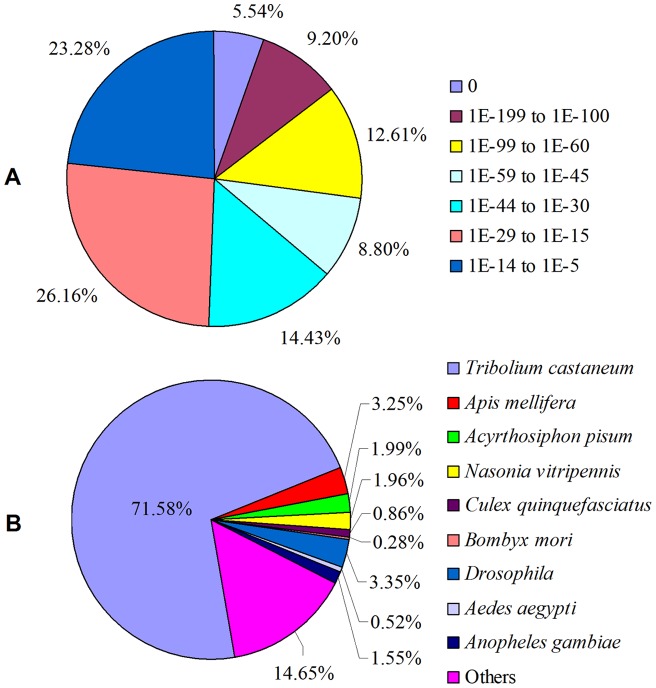
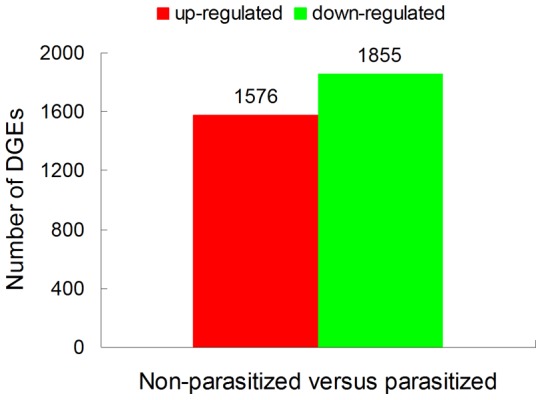
METHODOLOGY/PRINCIPAL FINDINGS: In a single run, 264,698 raw reads were obtained. De novo assembly generated 71,514 unigenes with mean length of 424 bp. Of those unigenes, 37,373 (52.26%) showed similarity to the known proteins in the NCBI nr database. Via analysis of the transcriptome data in depth, 430 unigenes related to immunity were identified. DGE analysis revealed that parasitization by S. guani had considerable impacts on the transcriptome profile of T. molitor pupae, as indicated by the significant up- or down-regulation of 3,431 parasitism-responsive transcripts. The expression of a total of 74 unigenes involved in immune response of T. molitor was significantly altered after parasitization.
CONCLUSIONS/SIGNIFICANCE: obtained T. molitor transcriptome, in addition to establishing a fundamental resource for further research on functional genomics, has allowed the discovery of a large group of immune genes that might provide a meaningful framework to better understand the immune response in this species and other beetles. The DGE profiling data provides comprehensive T. molitor immune gene expression information at the transcriptional level following parasitization, and sheds valuable light on the molecular understanding of the host-parasitoid interaction.
宿主与寄生蜂的相互作用是昆虫中最吸引人的关系之一,目前越来越受到关注。了解寄生蜂逃避或抑制宿主免疫系统的进化机制对于剖析这种相互作用非常重要,但目前对此了解甚少。为了深入了解黄粉虫幼虫被瓜实蝇蛹蜂寄生后的免疫反应,本研究对黄粉虫幼虫的转录组进行了测序,重点关注免疫相关基因,并利用 Illumina 测序对非寄生和寄生的黄粉虫幼虫进行了数字基因表达(DGE)分析,特别强调了寄生诱导的免疫相关基因。
方法/主要发现:在一次运行中,获得了 264698 条原始reads。从头组装生成了 71514 条平均长度为 424bp 的 unigenes。在这些 unigenes中,有 37373 条(52.26%)与 NCBI nr 数据库中的已知蛋白具有相似性。通过深入分析转录组数据,鉴定出 430 条与免疫相关的 unigenes。DGE 分析表明,瓜实蝇蛹蜂的寄生对黄粉虫幼虫的转录组图谱有很大的影响,有 3431 条转录物被显著上调或下调。寄生后,黄粉虫幼虫总共有 74 条参与免疫反应的 unigenes的表达发生了显著改变。
结论/意义:本研究获得的黄粉虫转录组不仅为进一步开展功能基因组学研究建立了一个基础资源,还发现了一大群免疫基因,为更好地理解该物种和其他甲虫的免疫反应提供了有意义的框架。DGE 分析为寄生后黄粉虫幼虫在转录水平上的免疫基因表达提供了全面的信息,为宿主-寄生蜂相互作用的分子理解提供了有价值的线索。