Neubauer Aljoscha S, Langer Julian, Liegl Raffael, Haritoglou Christos, Wolf Armin, Kozak Igor, Seidensticker Florian, Ulbig Michael, Freeman William R, Kampik Anselm, Kernt Marcus
Ludwig-Maximilians University, Department of Ophthalmology, Munich, Germany.
Clin Ophthalmol. 2013;7:121-8. doi: 10.2147/OPTH.S38559. Epub 2013 Jan 16.
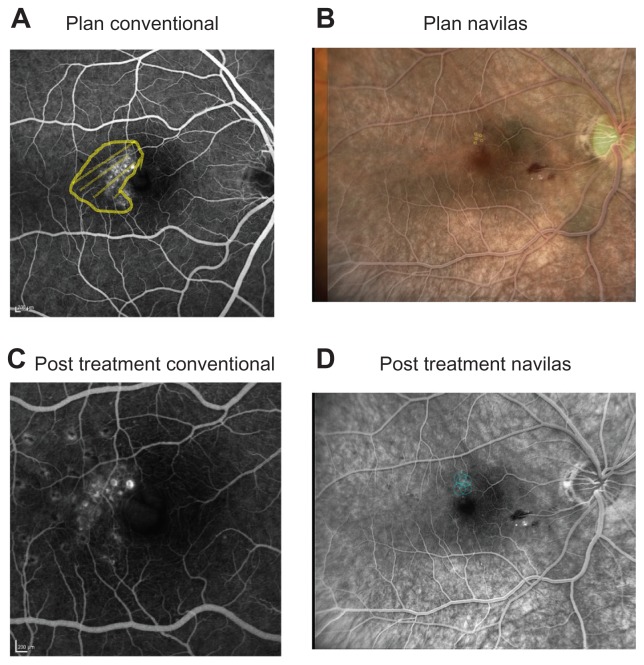
The purpose of this study was to evaluate and compare clinical outcomes and retreatment rates using navigated macular laser versus conventional laser for the treatment of diabetic macular edema (DME).
In this prospective, interventional pilot study, 46 eyes from 46 consecutive patients with DME were allocated to receive macular laser photocoagulation using navigated laser. Best corrected visual acuity and retreatment rate were evaluated for up to 12 months after treatment. The control group was drawn based on chart review of 119 patients treated by conventional laser at the same institutions during the same time period. Propensity score matching was performed with Stata, based on the nearest-neighbor method.
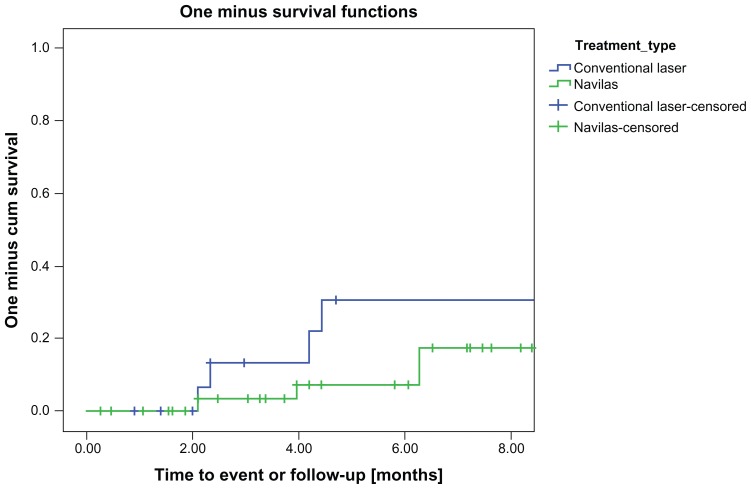
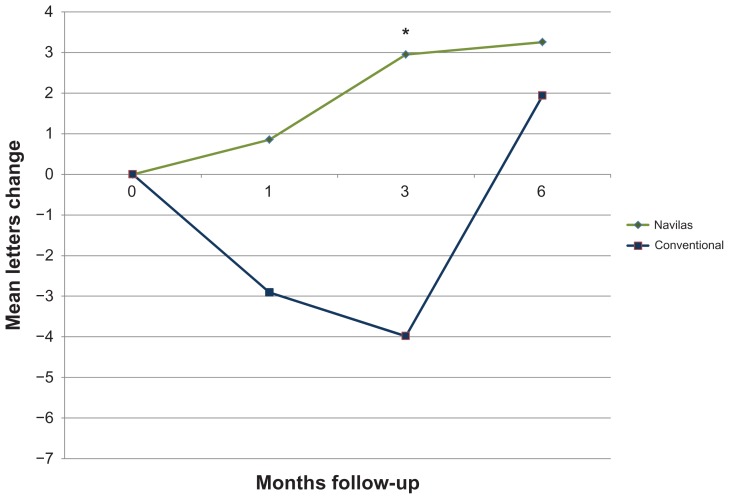
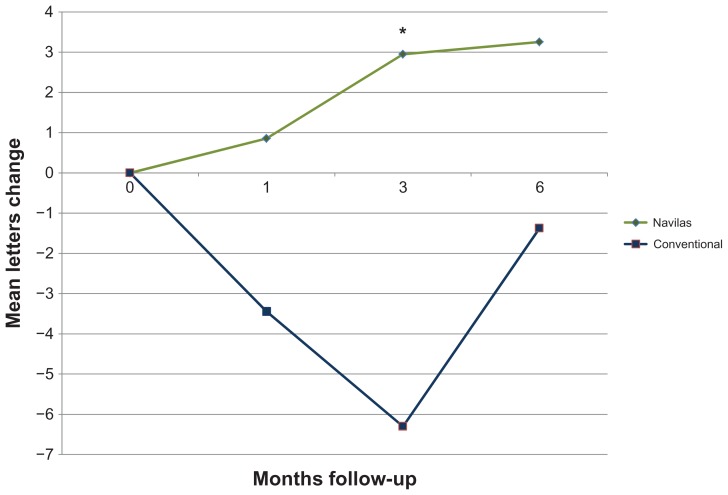
Propensity score matching for age, gender, baseline visual acuity, and number of laser spots yielded 28 matched patients for the control group. Visual acuity after navigated macular laser improved from a mean 0.48 ± 0.37 logMAR by a mean +2.9 letters after 3 months, while the control group showed a mean -4.0 letters (P = 0.03). After 6 months, navigated laser maintained a mean visual gain of +3.3 letters, and the conventional laser group showed a slower mean increase to +1.9 letters versus baseline. Using Kaplan-Meier analysis, the laser retreatment rate showed separation of the survival curves after 2 months, with fewer retreatments in the navigated group than in the conventional laser group during the first 8 months (18% versus 31%, respectively, P = 0.02).
The short-term results of this pilot study suggest that navigated macular photocoagulation is an effective technique and could be considered as a valid alternative to conventional slit-lamp laser for DME when focal laser photocoagulation is indicated. The observed lower retreatment rates with navigated retinal laser therapy in the first 8 months suggest a more durable treatment effect.
本研究旨在评估和比较使用导航黄斑激光与传统激光治疗糖尿病性黄斑水肿(DME)的临床疗效和再次治疗率。
在这项前瞻性干预性初步研究中,连续纳入46例DME患者的46只眼,接受导航激光黄斑光凝治疗。治疗后长达12个月评估最佳矫正视力和再次治疗率。对照组通过回顾同一机构同期接受传统激光治疗的119例患者的病历得出。使用Stata软件基于最近邻法进行倾向得分匹配。
对年龄、性别、基线视力和激光光斑数量进行倾向得分匹配后,对照组有28例匹配患者。导航黄斑激光治疗后3个月,视力从平均0.48±0.37 logMAR提高了平均+2.9个字母,而对照组平均下降了-4.0个字母(P = 0.03)。6个月后,导航激光保持平均视力提高+3.3个字母,传统激光组相对于基线的平均提高速度较慢,为+1.9个字母。使用Kaplan-Meier分析,激光再次治疗率在2个月后显示出生存曲线分离,在前8个月中,导航组的再次治疗次数少于传统激光组(分别为18%和31%,P = 0.02)。
这项初步研究的短期结果表明,导航黄斑光凝是一种有效的技术,当需要进行局部激光光凝时,可被视为传统裂隙灯激光治疗DME的有效替代方法。在前8个月观察到的导航视网膜激光治疗较低的再次治疗率表明其治疗效果更持久。