Kim Young-Sung, Kim Su-Hwan, Kim Kyoung-Hwa, Jhin Min-Ju, Kim Won-Kyung, Lee Young-Kyoo, Seol Yang-Jo, Lee Yong-Moo
Department of Periodontics, Asan Medical Center, Seoul, Korea. ; Department of Dentistry, University of Ulsan College of Medicine, Seoul, Korea.
J Periodontal Implant Sci. 2012 Dec;42(6):204-11. doi: 10.5051/jpis.2012.42.6.204. Epub 2012 Dec 31.
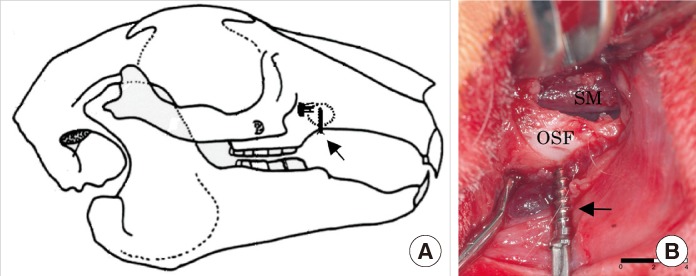
This study was performed to establish an experimental rabbit model for single-stage maxillary sinus augmentation with simultaneous implant placement.
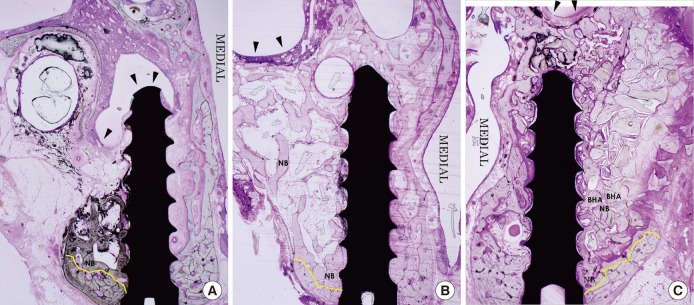
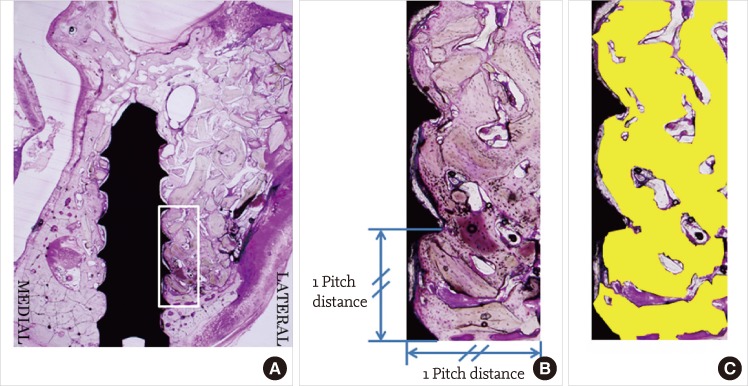
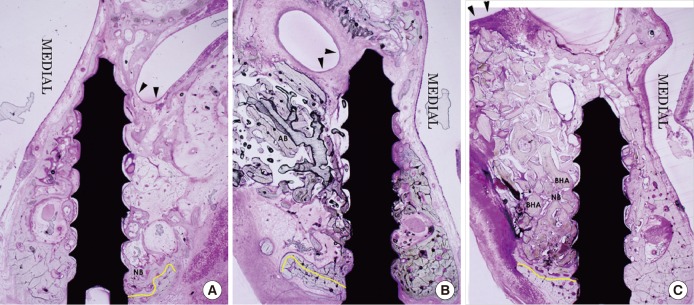
Twelve mature New Zealand white rabbits were used for the experiments. The rabbit maxillary sinuses were divided into 3 groups according to sinus augmentation materials: blood clot (BC), autogenous bone (AB), and bovine-derived hydroxyapatite (BHA). Small titanium implants were simultaneously placed in the animals during the sinus augmentation procedure. The rabbits were sacrificed 4 and 8 weeks after surgery and were observed histologically. Histomorphometric analyses using image analysis software were also performed to evaluate the parameters related to bone regeneration and implant-bone integration.
The BC group showed an evident collapse of the sinus membrane and limited new bone formation around the original sinus floor at 4 and 8 weeks. In the AB group, the sinus membrane was well retained above the implant apex, and new bone formation was significant at both examination periods. The BHA group also showed retention of the elevated sinus membrane above the screw apex and evident new bone formation at both points in time. The total area of the mineral component (TMA) in the area of interest and the bone-to-implant contact did not show any significant differences among all the groups. In the AB group, the TMA had significantly decreased from 4 to 8 weeks.
Within the limits of this study, the rabbit sinus model showed satisfactory results in the comparison of different grafting conditions in single-stage sinus floor elevation with simultaneous implant placement. We found that the rabbit model was useful for maxillary sinus augmentation with simultaneous implant placement.
本研究旨在建立一种同期植入种植体的单阶段上颌窦提升实验兔模型。
选用12只成年新西兰白兔进行实验。根据上颌窦提升材料将兔上颌窦分为3组:血凝块(BC)、自体骨(AB)和牛源羟基磷灰石(BHA)。在进行上颌窦提升手术的同时,将小型钛种植体植入动物体内。术后4周和8周处死兔子并进行组织学观察。还使用图像分析软件进行组织形态计量学分析,以评估与骨再生和种植体-骨整合相关的参数。
BC组在术后4周和8周时,窦膜明显塌陷,原窦底周围新骨形成有限。AB组中,窦膜在上颌种植体顶端上方保留良好,两个检查时期新骨形成均显著。BHA组在两个时间点也显示出提升的窦膜在螺钉顶端上方保留,新骨形成明显。所有组中,感兴趣区域的矿物质成分总面积(TMA)和骨与种植体的接触情况均无显著差异。AB组中,TMA在4周和8周之间显著下降。
在本研究范围内,兔上颌窦模型在同期植入种植体的单阶段窦底提升不同植骨条件比较中显示出满意结果。我们发现该兔模型对于同期植入种植体的上颌窦提升是有用的。