School of Psychology, University of Glasgow, Glasgow, United Kingdom.
PLoS One. 2013;8(1):e54798. doi: 10.1371/journal.pone.0054798. Epub 2013 Jan 21.
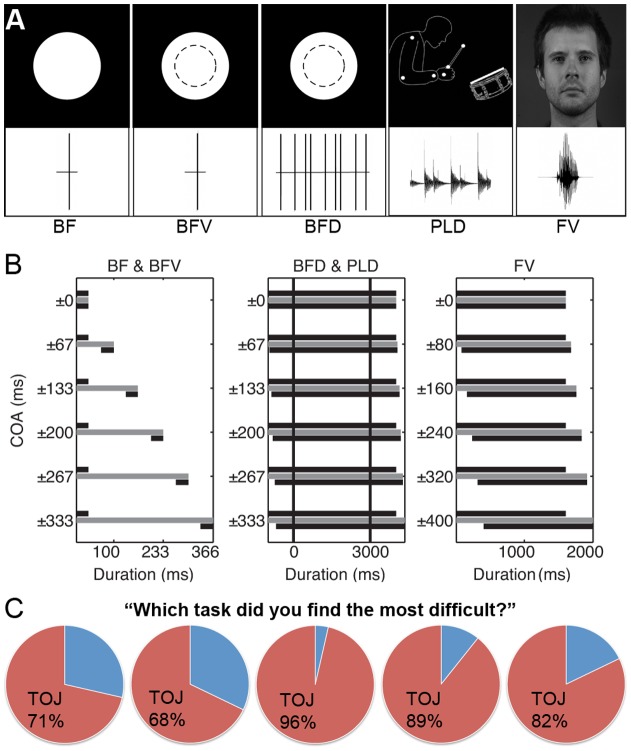
Synchrony judgments involve deciding whether cues to an event are in synch or out of synch, while temporal order judgments involve deciding which of the cues came first. When the cues come from different sensory modalities these judgments can be used to investigate multisensory integration in the temporal domain. However, evidence indicates that that these two tasks should not be used interchangeably as it is unlikely that they measure the same perceptual mechanism. The current experiment further explores this issue across a variety of different audiovisual stimulus types.
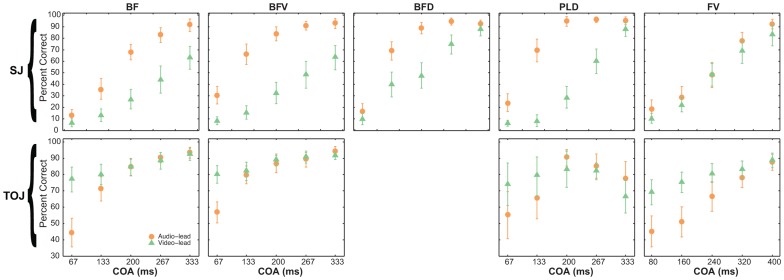
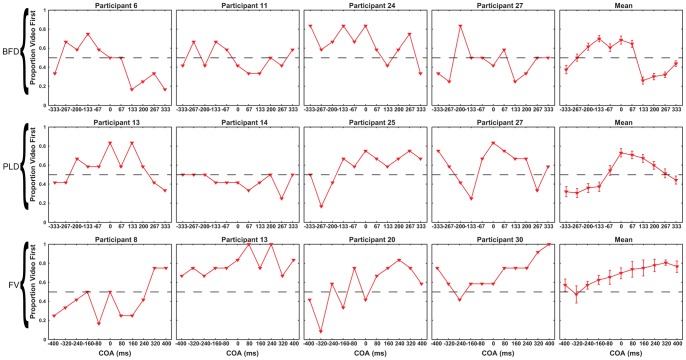
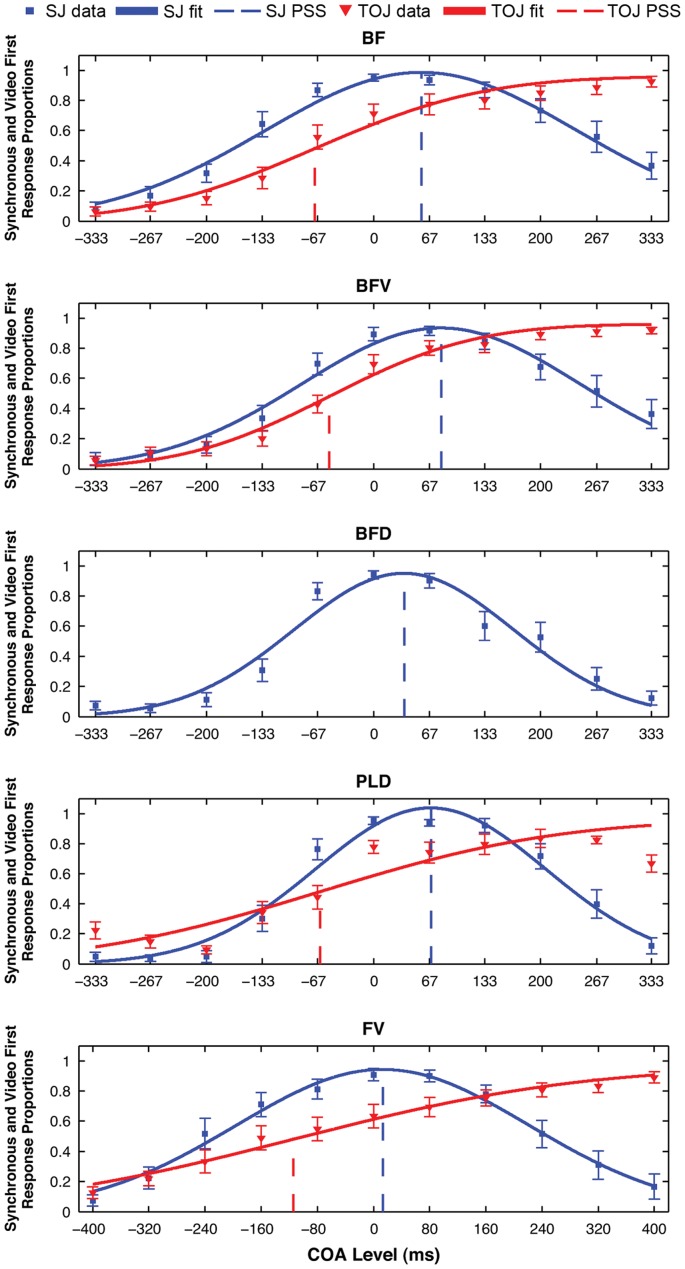
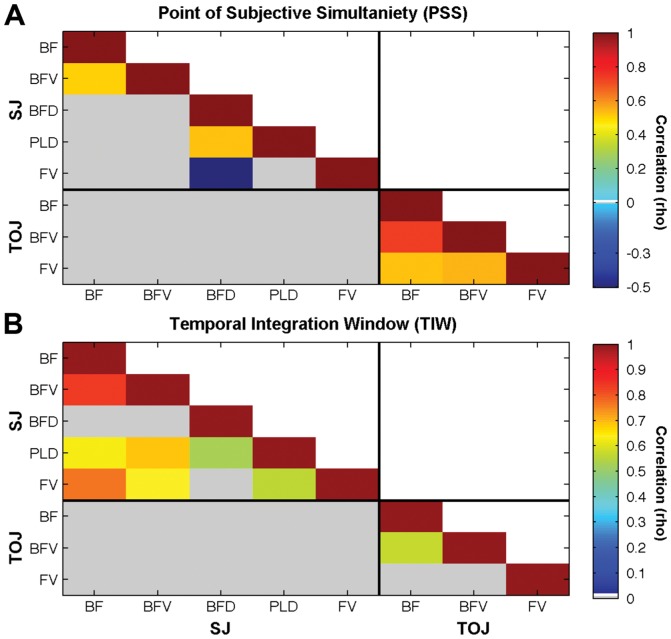
METHODOLOGY/PRINCIPAL FINDINGS: Participants were presented with 5 audiovisual stimulus types, each at 11 parametrically manipulated levels of cue asynchrony. During separate blocks, participants had to make synchrony judgments or temporal order judgments. For some stimulus types many participants were unable to successfully make temporal order judgments, but they were able to make synchrony judgments. The mean points of subjective simultaneity for synchrony judgments were all video-leading, while those for temporal order judgments were all audio-leading. In the within participants analyses no correlation was found across the two tasks for either the point of subjective simultaneity or the temporal integration window.
Stimulus type influenced how the two tasks differed; nevertheless, consistent differences were found between the two tasks regardless of stimulus type. Therefore, in line with previous work, we conclude that synchrony and temporal order judgments are supported by different perceptual mechanisms and should not be interpreted as being representative of the same perceptual process.
同步判断涉及决定事件提示是否同步或不同步,而时间顺序判断涉及决定哪个提示先出现。当提示来自不同的感觉模态时,这些判断可用于研究时间域中的多感觉整合。然而,有证据表明,这两个任务不应互换使用,因为它们不太可能测量相同的感知机制。本实验进一步在各种不同的视听刺激类型中探讨了这个问题。
方法/主要发现:参与者被呈现 5 种视听刺激类型,每种类型在 11 个参数化的提示异步水平上。在单独的块中,参与者必须进行同步判断或时间顺序判断。对于某些刺激类型,许多参与者无法成功地进行时间顺序判断,但他们能够进行同步判断。同步判断的主观同时性平均值都是视频领先,而时间顺序判断的平均值都是音频领先。在参与者内的分析中,两个任务之间无论是主观同时性还是时间整合窗口都没有相关性。
刺激类型影响了这两个任务的差异;然而,无论刺激类型如何,两个任务之间都存在一致的差异。因此,与之前的工作一致,我们得出结论,同步判断和时间顺序判断由不同的感知机制支持,不应被解释为代表相同的感知过程。