Department of Orthopedic Surgery, Chang Gung University College of Medicine Kaohsiung Chang Gung Memorial Hospital, Kaohsiung, Taiwan.
BMC Musculoskelet Disord. 2013 Jan 28;14:44. doi: 10.1186/1471-2474-14-44.
Extracorporeal shockwave therapy (ESWT) shows chondroprotective effect in osteoarthritis of the rat knees. However, the ideal number of ESWT is unknown. This study investigated the effects of different numbers of ESWT in osteoarthritis of the knee in rats.
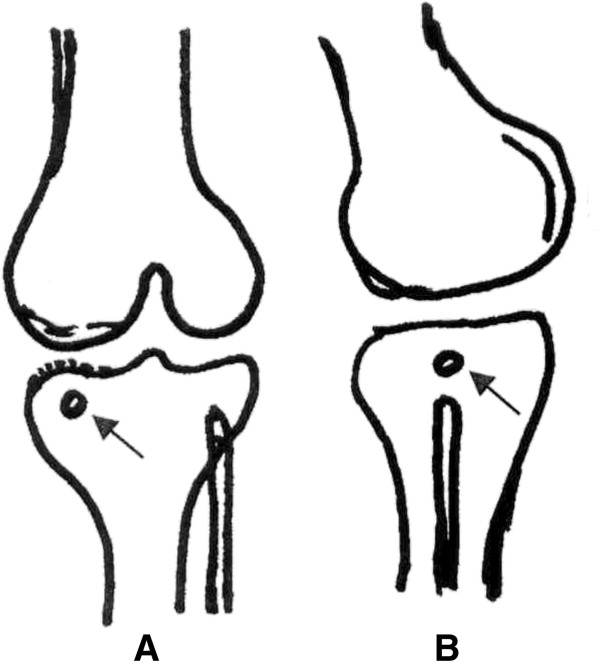
Forty-five male Sprague-Dawley rats were divided into five groups. Group I underwent sham arthrotomy without anterior cruciate ligament transection (ACLT) or medial meniscectomy (MM) and received no ESWT. Group II underwent ACLT + MM and received no ESWT. Group III underwent ACLT + MM, and received ESWT once a week for one treatment. Group IV underwent ACLT + MM and received ESWT twice a week for 2 treatments. Group V underwent ACLT + MM and received ESWT three times a week for 3 treatments. Each treatment consisted of 800 impulses of shockwave at 14 Kv to the medial tibia condyle. The evaluations included radiographs of the knee, histomorphological examination and immunohistochemical analysis at 12 weeks.
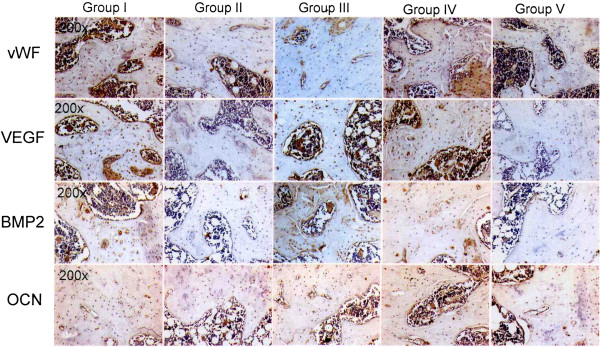
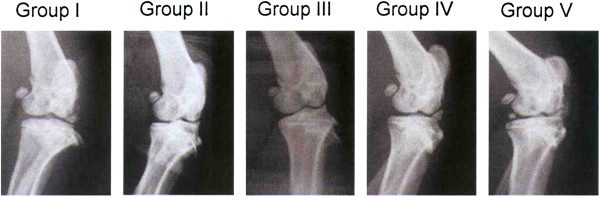
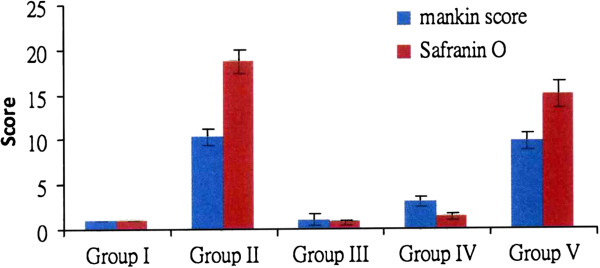
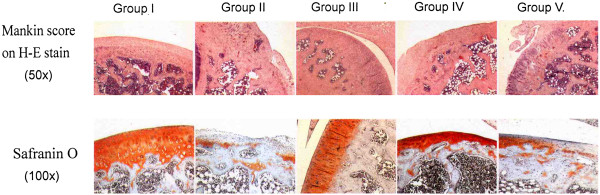
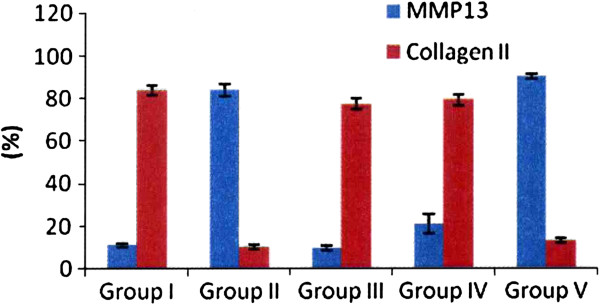
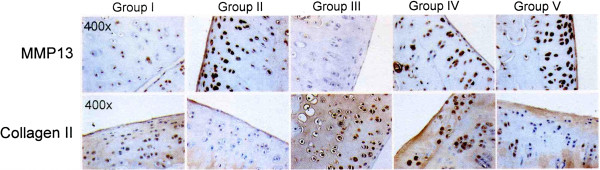
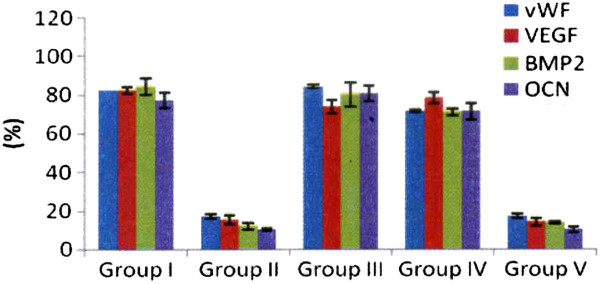
At 12 weeks, group II and V showed more radiographic arthritis than groups I, III and IV. On histomorphological examination, the Safranin O matrix staining in groups III and IV are significantly better than in groups II and V, and the Mankin scores in groups III and IV are less than groups II and V. Groups III and IV showed significant decreases of Mankin score and increase of Safranin O stain as compared to group I. Group V showed significant increases of Mankin score and a decrease of Safranin O stain as compared to group II. In articular cartilage, group II showed significant increase of MMP13 and decrease of collagen II as compared to group I. Groups III and IV showed significant decrease of MMP13 and increase of collagen II as compared to group I. Group V showed significant increase of MMP13 and decrease of collagen II as compared to group II. In subchondral bone, vWF, VEGF, BMP-2 and osteocalcin significantly decreased in groups II and V, but increased in groups III and IV relative to group I.
ESWT shows a number of treatment related chondroproctective effect in osteoarthritis of the knee in rats.
体外冲击波疗法(ESWT)在大鼠膝关节骨关节炎中显示出软骨保护作用。然而,理想的 ESWT 次数尚不清楚。本研究旨在探讨不同 ESWT 次数对大鼠膝关节骨关节炎的影响。
45 只雄性 Sprague-Dawley 大鼠随机分为 5 组。I 组仅行关节切开术,不进行前交叉韧带切断(ACLT)和内侧半月板切除术(MM),也不接受 ESWT。II 组行 ACLT+MM 手术,但不接受 ESWT。III 组行 ACLT+MM 手术,每周接受 ESWT 治疗 1 次,共 1 个疗程。IV 组行 ACLT+MM 手术,每周接受 ESWT 治疗 2 次,共 2 个疗程。V 组行 ACLT+MM 手术,每周接受 ESWT 治疗 3 次,共 3 个疗程。每次治疗时,对内侧胫骨髁进行 800 次冲击波,能量为 14kV。12 周后,对各组大鼠进行膝关节 X 线片、组织形态学检查和免疫组织化学分析。
12 周时,与 I、III、IV 组相比,II 组和 V 组的 X 线片关节炎评分更高。组织形态学检查显示,III 组和 IV 组的番红 O 基质染色明显优于 II 组和 V 组,Mankin 评分明显低于 II 组和 V 组。与 I 组相比,III 组和 IV 组的 Mankin 评分显著降低,番红 O 染色增加。与 II 组相比,V 组的 Mankin 评分显著升高,番红 O 染色减少。与 I 组相比,II 组的软骨中 MMP13 表达增加,Ⅱ型胶原表达减少。与 I 组相比,III 组和 IV 组的 MMP13 表达减少,Ⅱ型胶原表达增加。与 II 组相比,V 组的 MMP13 表达增加,Ⅱ型胶原表达减少。在软骨下骨中,与 I 组相比,II 组和 V 组的 vWF、VEGF、BMP-2 和骨钙素表达显著减少,而 III 组和 IV 组的 vWF、VEGF、BMP-2 和骨钙素表达显著增加。
ESWT 对大鼠膝关节骨关节炎有一定的治疗相关软骨保护作用。