Department of Internal Medicine, University of Michigan Medical School, Ann Arbor, MI, USA.
Diabetes Metab Syndr Obes. 2013;6:17-29. doi: 10.2147/DMSO.S36024. Epub 2013 Jan 17.
Diabetic foot ulcers are a major source of morbidity, limb loss, and mortality. A prolonged inflammatory response, extracellular matrix degradation irregularities, and increased bacteria presence have all been hypothesized as major contributing factors in the delayed healing of diabetic wounds. Collagen components such as fibroblast and keratinocytes are fundamental to the process of wound healing and skin formation. Wound dressings that contain collagen products create a biological scaffold matrix that supports the regulation of extracellular components and promotes wound healing.
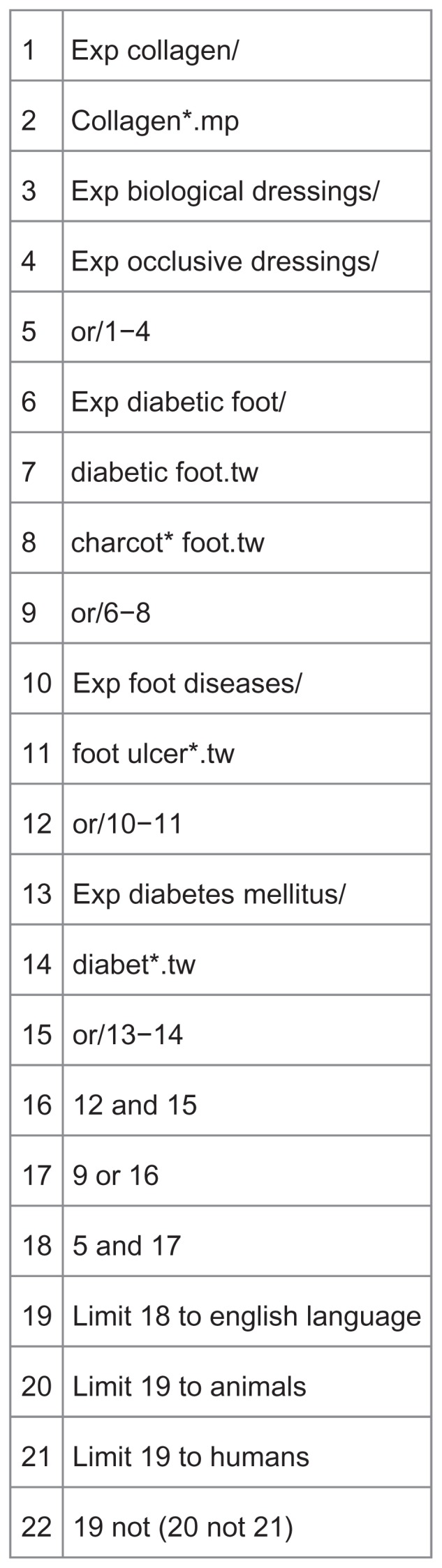
A systematic review of studies reporting collagen wound dressings used in the treatment of Diabetic foot ulcers was conducted. Comprehensive searches were run in Ovid MEDLINE, PubMed, EMBASE, and ISI Web of Science to capture citations pertaining to the use of collagen wound dressings in the treatment of diabetic foot ulcers. The searches were limited to human studies reported in English.
Using our search strategy, 26 papers were discussed, and included 13 randomized designs, twelve prospective cohorts, and one retrospective cohort, representing 2386 patients with diabetic foot ulcers. Our design was not a formal meta-analysis. In those studies where complete epithelialization, 58% of collagen-treated wounds completely healed (weighted mean 67%). Only 23% of studies reported control group healing with 29% healing (weighted mean 11%) described for controls.
Collagen-based wound dressings can be an effective tool in the healing of diabetic foot wounds. The current studies show an overall increase in healing rates despite limitations in study designs. This study suggests that future works focus on biofilms and extracellular regulation, and include high risk patients.
糖尿病足溃疡是发病率、肢体丧失和死亡率的主要原因。延长的炎症反应、细胞外基质降解异常和增加的细菌存在都被认为是糖尿病伤口愈合延迟的主要因素。成纤维细胞和角质形成细胞等胶原成分是伤口愈合和皮肤形成过程的基础。含有胶原蛋白产品的伤口敷料可形成生物支架基质,支持细胞外成分的调节并促进伤口愈合。
对报告胶原伤口敷料用于治疗糖尿病足溃疡的研究进行了系统评价。在 Ovid MEDLINE、PubMed、EMBASE 和 ISI Web of Science 中进行了全面检索,以捕获有关胶原伤口敷料在治疗糖尿病足溃疡中的应用的引文。检索仅限于用英文报告的人体研究。
使用我们的搜索策略,讨论了 26 篇论文,其中包括 13 项随机设计、12 项前瞻性队列研究和 1 项回顾性队列研究,代表了 2386 例糖尿病足溃疡患者。我们的设计不是正式的荟萃分析。在那些完全上皮化的研究中,67%的胶原蛋白治疗伤口完全愈合(加权平均值为 67%)。只有 23%的研究报告了对照组的愈合情况,其中 11%的对照组描述了愈合情况(加权平均值为 11%)。
基于胶原蛋白的伤口敷料可以成为治疗糖尿病足伤口的有效工具。尽管研究设计存在局限性,但目前的研究表明愈合率总体上有所提高。本研究表明,未来的研究工作应侧重于生物膜和细胞外调节,并纳入高危患者。