Zhang Shijia, Danchuk Svitlana D, Imhof Kathleen Mp, Semon Julie A, Scruggs Brittni A, Bonvillain Ryan W, Strong Amy L, Gimble Jeffrey M, Betancourt Aline M, Sullivan Deborah E, Bunnell Bruce A
Stem Cell Res Ther. 2013 Jan 29;4(1):13. doi: 10.1186/scrt161.
Adipose-derived stem cells (ASCs) have emerged as important regulators of inflammatory/immune responses in vitro and in vivo and represent attractive candidates for cell-based therapies for diseases that involve excessive inflammation. Acute lung injury (ALI) is an inflammatory condition for which treatment is mainly supportive due to lack of effective therapies. In this study, the therapeutic effects of ASC-based therapy were assessed in vivo by comparison of the anti-inflammatory properties of both human and murine ASCs in a mouse model of lipopolysaccharide (LPS)-induced ALI.
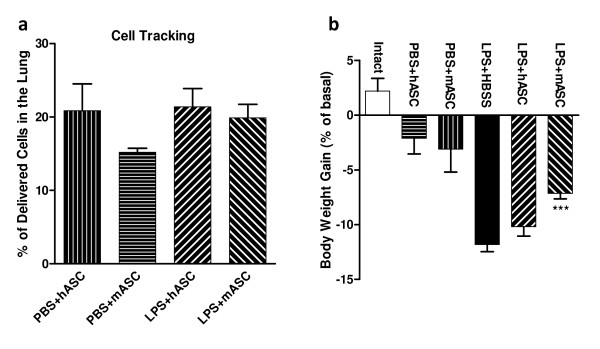
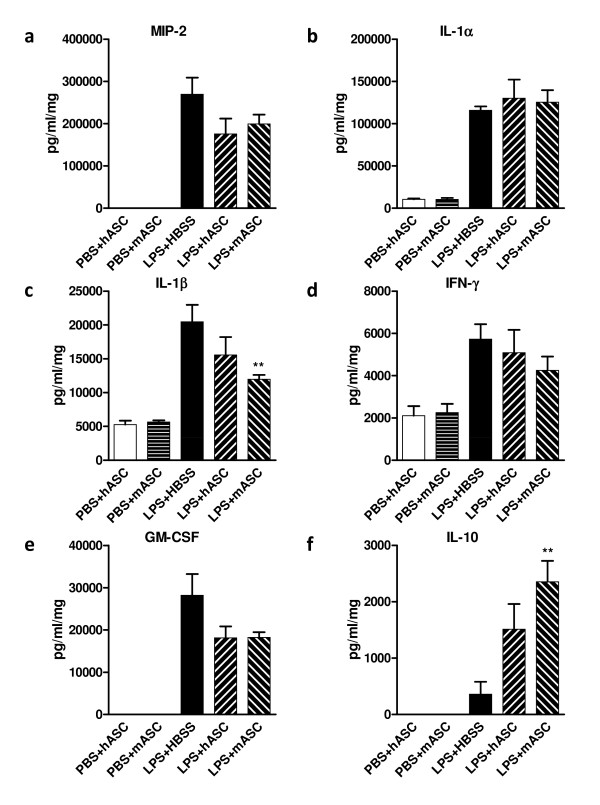
Human ASCs (hASCs) or mouse ASCs (mASCs) were delivered to C57Bl/6 mice (7.5 × 10⁵ total cells/mouse) by oropharyngeal aspiration (OA) four hours after the animals were challenged with lipopolysaccharide (15 mg/kg). Mice were sacrificed 24 and 72 hours after LPS exposure, and lung histology examined for evaluation of inflammation and injury. Bronchoalveolar lavage fluid (BALF) was analyzed to determine total and differential cell counts, total protein and albumin concentrations, and myeloperoxidase (MPO) activity. Cytokine expression in the injured lungs was measured at the steady-state mRNA levels and protein levels for assessment of the degree of lung inflammation.
Both human and mouse ASC treatments provided protective anti-inflammatory responses. There were decreased levels of leukocyte (for example neutrophil) migration into the alveoli, total protein and albumin concentrations in BALF, and MPO activity after the induction of ALI following both therapies. Additionally, cell therapy with both cell types effectively suppressed the expression of proinflammatory cytokines and increased the anti-inflammatory cytokine interleukin 10 (IL-10). Overall, the syngeneic mASC therapy had a more potent therapeutic effect than the xenogeneic hASC therapy in this model.
Treatment with hASCs or mASCs significantly attenuated LPS-induced acute lung injury in mice. These results suggest a potential benefit for using an ASC-based therapy to treat clinical ALI and may possibly prevent the development of acute respiratory distress syndrome (ARDS).
脂肪来源干细胞(ASC)已成为体内外炎症/免疫反应的重要调节因子,对于涉及过度炎症的疾病,是极具吸引力的细胞疗法候选对象。急性肺损伤(ALI)是一种炎症性疾病,由于缺乏有效治疗方法,其治疗主要是支持性的。在本研究中,通过比较人源和鼠源ASC在脂多糖(LPS)诱导的ALI小鼠模型中的抗炎特性,在体内评估了基于ASC的治疗效果。
在用脂多糖(15mg/kg)攻击动物4小时后,通过口咽抽吸(OA)将人ASC(hASC)或鼠ASC(mASC)递送至C57Bl/6小鼠(每只小鼠共7.5×105个细胞)。在LPS暴露后24小时和72小时处死小鼠,并检查肺组织学以评估炎症和损伤。分析支气管肺泡灌洗液(BALF)以确定总细胞数和分类细胞数、总蛋白和白蛋白浓度以及髓过氧化物酶(MPO)活性。在稳态mRNA水平和蛋白质水平测量受损肺中的细胞因子表达,以评估肺部炎症程度。
人源和鼠源ASC治疗均提供了保护性抗炎反应。在两种治疗诱导ALI后,白细胞(例如中性粒细胞)向肺泡的迁移水平、BALF中的总蛋白和白蛋白浓度以及MPO活性均降低。此外,两种细胞类型的细胞疗法均有效抑制促炎细胞因子的表达并增加抗炎细胞因子白细胞介素10(IL-10)。总体而言,在该模型中,同基因mASC疗法比异基因hASC疗法具有更强的治疗效果。
hASC或mASC治疗可显著减轻小鼠LPS诱导的急性肺损伤。这些结果表明基于ASC的疗法治疗临床ALI具有潜在益处,并且可能预防急性呼吸窘迫综合征(ARDS)的发生。